admin
admin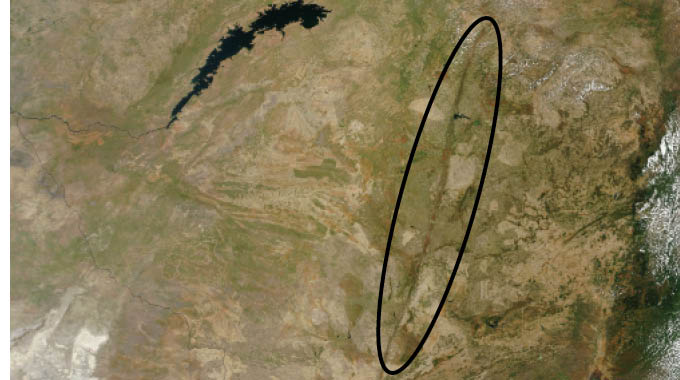
Freedom Mupanedemo, Midlands Bureau
TRENDING for about 550km, the Great Dyke, Zimbabwe’s mineral rich belt has its tail in the Midlands Province.
From Mberengwa, the belt rips through the heart of the province, frothing and vomiting all kinds of minerals along the way, it laps into Mashonaland West, forming a parched neckline of hills and hillocks stretching further to the far north up to Guruve in Mashonaland Central.
Ordinarily referred to as the spinal cord of Zimbabwe, the Great Dyke has more than 10 minerals that include gold, platinum, chrome, nickel, mica and asbestos among other mineral deposits.
It is the Great Dyke that inspired the establishment of many cities, towns and settlements in Zimbabwe.
Zvishavane town, Shurugwi, Kwekwe City, Kadoma, Banket, Mhangura have sprawling suburbs, a hive of activities and fully fledged municipalities — all living testimony of how the Great Dyke can easily pass as the Zimbabwe’s backbone.
Giant mining companies in the country like Unki Mines, Mimosa, Zimplats, Zimasco-all sip and suckle from the nipples of the Great Dyke, forever dripping with the riches that is gold, platinum and chrome.
Mineral riches along the Great Dyke have contributed a lot to the national economy peoples’ livelihoods.
Other than agriculture, mining is the major driver of the Zimbabwean economy.
Addressing an inaugural Artisanal and Small-Scale Miners Annual Conference that was held in Gweru some weeks ago, President Emmerson Mnangagwa said Zimbabwe was under siege from her erstwhile former colonisers because of the mineral resource base that they seek to plunder.
He said the country had borne the brunt of a decade-long economic sanctions imposed by the West because they wanted to exploit the country’s minerals.
“This country which is between Zambezi and Limpopo rivers is so blessed. We are rich in minerals, we have a number of minerals including rare earth minerals,” said the President.
President Mnangagwa said it was because of the country’s riches in minerals that the West imposed economic sanctions on the country.
He said the recent discovery of rare earth minerals was the reason the country was in trouble with the super powers which were trying to find ways to plunder.
“But being rich in minerals is the reason why we are in serious trouble with our detractors. We will, however, remain firm and will not allow foreigners to dictate policies to us on how we should mine our minerals,” said the President.
Government recently launched a road map to achieve a 12 billion mining economy by the year 2023.
Mines and Mining Development Minister, Cde Winston Chitando said the milestone could be achieved basing on the riches that were found in the country’s treasured Great Dyke.
He said the ministry was ready to support all small-scale miners most of whom were taping from the Great Dyke.
He said his ministry was seized with issues to do with policy that will help small-scale miners improve production.
“As Government we stand ready to support the small-scale mining sector so that we reach the $12 billion target with ease,” said Minister Chitando.
He said his ministry has set up a desk to cater for the small-scale miners.
“The small-scale miners are contributing a lot and the President has ordered that we set up a desk in my ministry specifically for the small-scale miners. This is because they contribute a lot to the mineral output,” he said.
Midlands Provincial Affairs Minister, Senator Larry Mavhima said the Great Dyke was richer in the Midlands Province.
“Midlands by virtue of lying along the Great Dyke is the country’s mining hub. Talk of the country’s largest mining concerns, Mimosa, Unki Mines, Total Mine, Murowa, Shabanie Mine, they are all in the Midlands. The economy of the province is hinged on mining,” he said.
Minister Mavima said of the over 200 000 small-scale miners in the country, a majority of them were in the Midlands.
He said small-scale miners play a critical role in upping the country’s minerals production and as such should be given the respect they deserve.
“Small-scale miners account for about 60 percent of gold deliveries. This makes them a major player in the economic development,” he said.
Minister Mavima urged artisanal miners to shun violence in the mining sector.
“Due to the abundance of the gold deposits along the Great dyke, there has been intermittent clashes from among the artisanal miners, we condemn such acts, we want peace in the mining sector, let’s exploit our God-given resources peacefully,” said Minister Mavima.
Zimbabwe Miners Federation (ZMF) spokesperson, Mr Dosman Mangisi said there are about four million people in Zimbabwe who were benefiting either directly or indirectly from artisanal and small-scale miners.
According to statistics by the Mines and Mining Development Ministry, artisanal miners and small-scale miners contribute 60 percent of the country’s gold output.
With the world becoming more technologically advanced each day, there is growing demand in rare earth minerals which only China is to date the giant miner of rare earth minerals.
Director, Zimbabwe Geological Survey, Mr Forbes Mugumbate said Zimbabwe has an untapped resource base in the form of rare earth minerals.
He said these can be found in areas like Binga, Mberengwa, Mutoko among other areas.
“The Katete carbonatite north of Gwayi River, some 50km north east of Hwange in the Binga area, contains high concentrations of Rare Earth Minerals (REE) combined with phosphate. The deposit is being explored by a private company.
“The Gungwa carbonatite in north of Rushinga has concentrations of several thousand parts per million of REE. A private company has secured the deposit for the purposes of conducting detailed exploration and evaluation.
“Several pegmatites including the Bikita Pegmatite Field, the Smokey Pegmatite in Mberengwa, the Donza Pegmatites in Mutoko, and the Bepe Pegmatites in Buhera are reported to be enriched in rare earth minerals that could be recovered as by-products of other pegmatite minerals,” said Mr Mugumbate.
According to Mr Mugumbate, rare earth elements (REE) are a group of 17 metals with unique properties that make them critical in the manufacturing of high technology gadgets that people use every day. The metals that are currently in high demand are used in a range of different technologies, and demand is higher for some than it is for others.
They can be divided into “heavy” and “light” categories based on their atomic weight. The concentration of different rare earths varies within each given deposit, but usually a deposit is dominated by either heavy or light rare earths.
REE are critical in the manufacture of high technology gadgets such as computer memory, DVDs, rechargeable batteries, cellphones, catalytic converters, permanent magnets, fluorescent lighting and much more.


 Online Reporter