

 Chronicle Editor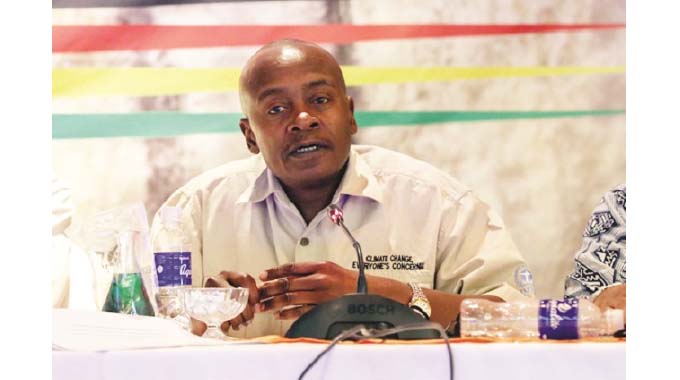
Michael Magoronga, Midlands Correspondent
The country is reeling from the effects of climate change with the majority of the population staring hunger in the face after rains unexpectedly disappeared during the 2021/22 summer cropping season.
World leaders have been coming up with ideas to combat the negative effects of climate change that have resulted in more flooding, extreme weather conditions and uncontrollable veld fires among others.
The use of fossil fuels came to the fore as they were discovered to be the major drivers of global warming owing to their emissions.
Western countries led by the United States of America and Britain called for the banning of use of fossil fuels especially coal and promised a US$100 billion per year until 2025 for a smooth transition from coal to other cleaner energy sources by African countries.
The West, however, failed to stick to their word and African countries have been complaining that it takes between three and five years for them to get funding approved and released.
African countries that rely on coal like South Africa, Botswana and Zimbabwe, have been calling for the West to honour its pledge by releasing the promised funding.
Despite the empty promises from the West and the collective efforts by regional blocs like United Nations (UN), Southern African Development Community (Sadc) and Common Market for Eastern and Southern Africa (Comesa) to try and make the West honour its pledge, each country has been making individual efforts to access funding projects in a bid to fight climate change.
Of note is South Africa, which, following a meeting between President Cyril Ramaphosa and his American counterpart Joe Biden, the United States pledged a US$8,5 billion partnership to help South Africa finance a quicker transition from coal that will provide a model for other countries.
For Zimbabwe, it is, however, a unique situation as the country is fighting the war from many fronts given the illegal sanctions imposed on it by the West.
Climate change is a global phenomenon with actions having to be implemented locally and in the process of implementation, there is a lot of financing required for both mitigation and adaptation.
Financing opportunities like the Green Climate Fund was created for that reason with the resources being pooled from developed countries which also have an influence on its accessibility.
Sanctions have influenced the levels of funding and countries like Zimbabwe will continue to suffer from failure to access funding.
The West wants Zimbabwe, which generates about 70 percent of its energy from coal, to stop using the natural resource yet they are not willing to fund the projects.
President Mnangagwa has not been silent about it and vowed “never to stop” using coal and reminded the developed countries that they reached their current status using the same resource.
Zimbabwe targets to cut carbon emissions by 40 percent by 2030, and President Mnangagwa wants developed countries to support vulnerable nations that contribute the least to climate change.
The President is always on record saying the removal of sanctions on Zimbabwe will help the country achieve its commitments to fight climate change and the country was open for investment in green industries.
While Zimbabwe suffers from global warming driven by emission of greenhouse gases, the country is a “net sink” that is absorbing more carbon than it releases.
President Mnangagwa said climate change challenges have led to an increasing frequency of severe droughts and cyclone-induced floods.
“This, coupled with the economic sanctions imposed on us and the Covid-19 pandemic, have had negative impacts on the people of my country. Notwithstanding that as a country we are ‘a net sink’; I am pleased to highlight that Zimbabwe has revised its Nationally Determined Contributions and committed to a conditional 40 percent per capita greenhouse gas emissions reduction target, by 2030.
Comprehensive strategies are also being implemented towards mainstreaming climate change adaptation and resilience across all sectors of our economy,” he told the Africa Green Revolution Forum 2022 Presidential Summit Panel discussion recently.
Environment, Climate, Tourism and Hospitality Industry Minister Nqobizitha Mangaliso Ndlovu applauded African heads of states who have been demanding the unconditional removal of the sanctions.
He applauded regional bodies like Sadc, Comesa and the AU for standing with Zimbabwe in the removal of illegal sanctions.
“As a country, we are grateful to the African continent and Comesa for firmly calling for the removal of the sanctions.
As a country we have an extra burden of sanctions which makes it difficult for us to receive funding for the fight against climate change. The lack of funding will thus make it difficult to achieve our NDCs and other economic ambitions,” he said.
Comesa also raised their concern recently saying the illegal sanctions are also impacting negatively in the fight against effects of climate change for the regional bloc.
In an interview on the sidelines of a Comesa regional preparatory meeting for COP-27 in Harare recently, Comesa Climate Change Project Officer Mr Lwembe Mwale said the sanctions were affecting the collective mitigation and adaptation efforts which are crucial in fighting climate change in the region.
“If the country is under sanctions, it means there are no financial flows into the country for any reason, including climate change. That is why regional bodies like Sadc and Comesa come in so that they do joint resource mobilisation for programmes to fight climate change where Zimbabwe is part of those programmes,” he said.
Mr Mwale said it was important that Zimbabwe be included in these programmes to counter the sanctions and help the country attain its NDCs, Vision 2030 and its climate change pledges in line with the Paris Agreement.
There is a need for Comesa member states to put in place greater efforts in mobilising finance for the fight against climate change and put across policies that address climate change as the region is reeling from climate change, he reckons.
“According to the latest IPCC report by climate scientists, we are not on track as a region to achieve the temperature goal of 1,5 degrees.
But also, if you look at the negative impact of climate change in the region, it’s increasing; we have more floods, more droughts. That shows that the climate crisis is increasing in terms of its impact,” he said.
Director Climate Change Department, Mr Washington Zhakata said the sanctions were impeding on the potential hydro power projects that are supposed to be taking place on the Zambezi River.
“Zimbabwe has a potential for climate mitigation through hydro-power generation projects which can easily replace the thermal power stations.
But the country has not been receiving adequate funding since 2000 due to sanctions and this has stifled climate action in Zimbabwe,” he said.
If the climate change fight is genuine, then sanctions should be unconditionally lifted.
As we head towards COP-27, African nations are expected to continue with their call for the unconditional removal of sanctions as they are impacting negatively not only on Zimbabwe but the continent as a whole. -@michaelmagoron1


 Blessing Chizhande
 Online Reporter