Boiketlo Lufu and Andile Bhebhe, [email protected] and [email protected]
CLOSE your eyes. Picture your childhood home. Walk through the front door. What do you see? The colour of the walls? The furniture? A family photograph on the shelf?
Most people can do this easily. Yet nobody showed you that image. Your mind created it on its own. Scientists have spent decades trying to understand how this happens, and why some people cannot do it at all.
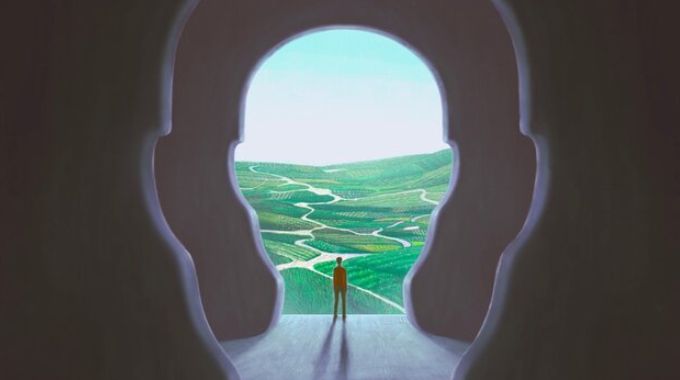
This is the world of mental imagery. It is the experience of seeing something in your mind when nothing is actually in front of you. It is how you remember a friend’s face, plan a route to the clinic, or rehearse a speech before you deliver it. It shapes how we learn, remember, navigate, and manage our emotions. But mental imagery is not just a weak version of real seeing. It is stranger and more revealing than that.
For years, psychologists have asked a simple question: what form do mental images take in the brain? Two major theories have tried to answer it.
The first is Dual Coding Theory. In 1971, Allan Paivio proposed that the mind runs two systems at the same time. One system handles language and the other handles images. When we learn something, we can store it in one or both systems.
This helps explain why we remember concrete words like “apple” better than abstract words like “justice”. Concrete words are stored in both systems, which gives us two ways to retrieve them. Recent research supports this.
Studies in 2025 showed that images help people learn new words better than text alone. Other studies on people with aphantasia, a condition where a person cannot form mental images, found that a lack of imagery makes it harder to remember object colours.
Classic experiments also support it. In 1971, Shepard and Metzler showed people pairs of 3D shapes and asked if they were the same object.
The more a shape had to be rotated to match, the longer people took to answer, as if they were physically turning it in their minds.
The second theory offers the opposite view. In 1973, Zenon Pylyshyn argued that we do not store pictures in our brains at all. His propositional theory says the brain stores abstract, language-like statements.
When you visualise your childhood home, your brain is not opening a photo album. It is reading statements like “the door is brown” and “the couch is to the left” and then building a temporary experience from them. His key point is that we use general knowledge to fill in gaps.
Our mental images are often idealised, not accurate. Recent work also supports this. A 2025 study found that people with aphantasia could still reduce fear through imagery exercises, suggesting that abstract knowledge alone can drive emotional change.
Both theories capture something true, but neither explains everything. Dual Coding is intuitive but too simple.
It does not fully explain how the two systems interact. Propositional theory explains why our images are often inaccurate, but it struggles to explain why images feel so spatial and picture-like.
Both also rely heavily on what people say they see, which we cannot directly verify. This is where aphantasia research helps, because it provides a natural experiment. Today, many researchers favour a hybrid model.
The mind may use a picture-like visual buffer, but that buffer is built and controlled by abstract knowledge. New evidence from brain imaging is pushing us beyond the old “pictures versus words” stalemate.
Perhaps the best evidence that imagery is constructed comes from its limits. If mental images were perfect photographs, they would be accurate and complete. They are not. Try to draw a coin from memory.
Most people fail even after handling coins for years. We remember the general shape but not the details, which suggests our images are general frameworks, not photographs. Look at the famous duck-rabbit illusion. Once your brain decides it is a duck, it becomes hard to see it as a rabbit from memory alone.
What we know shapes what we see in our mind. Try to picture a huge piano next to a tiny mouse. It is hard to keep both equally clear, because the mind’s eye has limited space. And you cannot rotate an image instantly. The larger the angle, the longer it takes.
Our minds also build maps of our environment. Psychologist Edward Tolman called them cognitive maps in 1948. In maze experiments with rats, he found that rats that explored freely later navigated efficiently when a reward was introduced. They had formed a mental layout.
Humans use such maps every day, but they are not accurate. We tend to straighten curved roads, turn odd angles into right angles, overestimate distances between familiar places, and group locations by neighbourhood. We often trust this internal GPS too much, which is why giving directions from memory alone can lead to errors.
This brings us to metacognition, or thinking about your own thinking. When it comes to imagery, it means being aware of your own ability to form images and knowing when to use them.
People differ a lot. People with aphantasia often assume phrases like “picture this” are just metaphors, until they discover that others actually see images. People with hyperphantasia, who have extremely vivid imagery, may assume everyone sees as clearly as they do.
Research in 2024 shows these differences affect emotion regulation and attention. Learning to monitor your imagery is therefore a practical skill.
Understanding this has everyday value. For learning, dual coding works. Study with both words and diagrams to create two retrieval routes. Teachers should mix methods, including drawings, demonstrations, storytelling and discussion. For navigation, do not trust your inner map blindly. Use landmarks and street names. For memory, weak mental pictures do not mean a weak memory. People with aphantasia remember well, but they use different strategies such as verbal codes and external aids. For self-awareness, notice your own imagery style and when it helps or misleads you.
The debate is not over. Future research needs to ask whether training can improve imagery vividness, what happens in the brain when we use different forms of representation, and how imagery works in digital environments like virtual reality.
In the end, mental imagery is one of the most fascinating aspects of human cognition. It feels effortless, yet it is deeply complex. It feels like seeing, yet it is not perception.
Research on aphantasia now shows that imagery is neither purely depictive nor purely propositional, but a hybrid shaped by individual differences.
The mind’s eye is not a camera that simply records reality. Nor is it a calculator that only processes symbols. It is something in between, a dynamic and personal simulation of the world.
Not everyone sees the world the same way. Some see vivid pictures. Some see nothing at all. Most are somewhere in between. Recognising this diversity is not just good science. It is also a form of empathy.
*Boiketlo Lufu and Andile Bhebhe are part of the Psychology Degree Study Programme at Great Zimbabwe University. they can be contacted on +263 77 113 7214 for feedback*