Online Reporter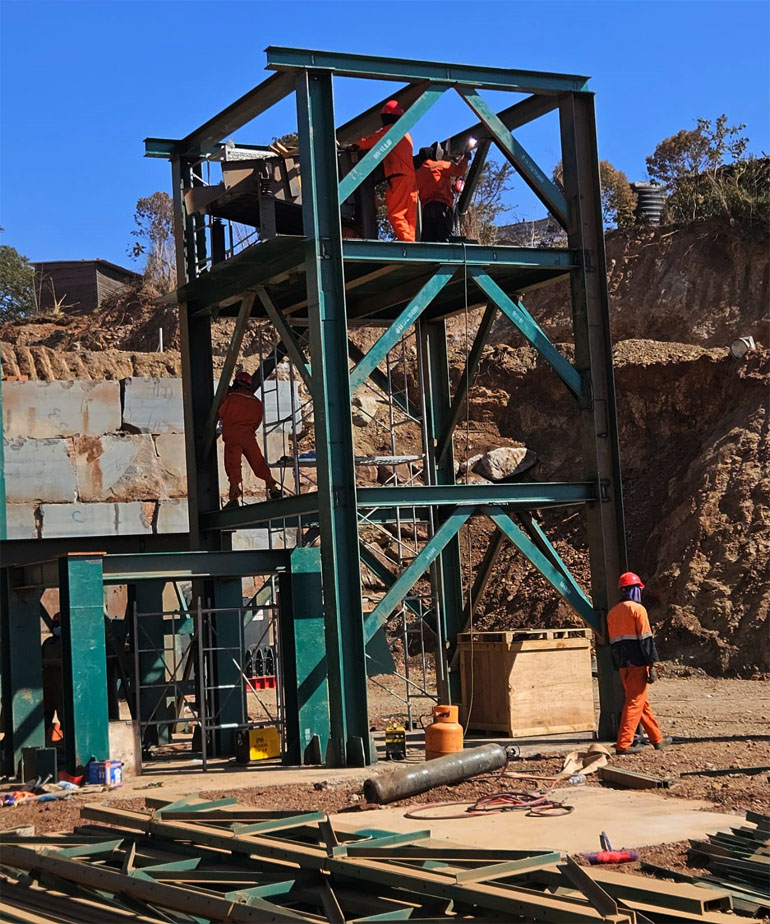
Samuel Kadungure
News Editor
AT dawn, Mount Sinia no longer echoes with the sounds of illegal mining.
Instead, it reverberates with the steady hum of construction machinery and the promise of transformation.
Articulated dump trucks navigate freshly carved access roads, hauling tonnes of earth down the mountainside, while excavators methodically cut into the rugged terrain. The work is deliberate and precise.
Engineers are excavating up to 25 metres into the mountain to create the foundation for the US$15 million Rosa Villa Student Accommodation Complex, a development poised to redefine both Mutare’s skyline and its student housing landscape.
For years, Mount Sinia bore the scars of illegal artisanal mining. Deep pits and abandoned shafts dotted the slope, turning sections of the mountain into hazardous terrain and leaving surrounding communities exposed to environmental and safety risks.
Today, those scars are gradually disappearing.
Project manager, Mr Farai Chimonyo, said extensive benching works are underway to stabilise the mountain and prepare the site for construction.
“We are currently carrying out pre-commencement benching works. If those who used to conduct illegal mining here returned today, they will struggle to recognise the area. The mountain has been reshaped in a controlled and scientifically engineered manner. Very soon, the bench level will reach the former mining shafts and create a stable platform for development. Previously, this area was littered with dangerous pits,” he said.
What makes the project unique is that almost nothing is going to waste.
Instead of discarding the excavated soil, developers have incorporated it into an innovative construction process. The earth removed from the mountain is being transported to a nearby site where a brick manufacturing plant is being established.
At the heart of the operation is a soil pulverising system designed to transform excavated material into construction-grade bricks. The mechanised process breaks down compacted soil, removes unwanted material and produces a fine, uniform mixture suitable for brick production.
“It is a fully integrated system. The excavated soil is processed and converted into bricks that will be used in construction. This addresses earlier concerns that stockpiles of excavated material could create environmental risks. Instead, the soil becomes a valuable resource,” said Mr Chimonyo.
The approach, not only minimises waste, but also creates a self-sustaining construction ecosystem.
“It is essentially a closed-loop development model. The mountain provides the material, and that material is transformed into the structures that will accommodate future generations of students,” he said.
However, Rosa Villa is about far more than bricks and mortar.
Developers envision the project as the catalyst for the emergence of a vibrant student district in Toronto, one of Mutare’s fastest-growing suburbs.
Mr Chimonyo sees the development as laying the foundation for a university town similar to Mount Pleasant in Harare, home to the University of Zimbabwe.
“The student accommodation project should be viewed as the cornerstone of a much bigger vision. We want Toronto to become to Mutare what Mount Pleasant is to the University of Zimbabwe. The area is strategically positioned to serve students from Africa University, Manicaland State University of Applied Sciences, Mutare Polytechnic and other tertiary institutions,” he said.
The economic rationale behind the development is compelling.
A feasibility study conducted by Dr Maxwell Mutema revealed that Mutare faces a shortage of approximately 6 125 student beds. Once completed, Rosa Villa will provide accommodation for about 1 000 students, making a significant contribution towards easing the city’s accommodation deficit.
“There is a huge gap between available accommodation and demand. While this project will provide around 1 000 beds, thousands more are still required. That presents opportunities for additional investors to come in and develop complementary projects,” said Mr Chimonyo.
The anticipated influx of students is already beginning to influence local investment patterns.
Property owners are increasingly viewing land and housing through a different lens. Rather than purely residential developments, many are considering student accommodation, retail outlets, restaurants, study centres, transport services and other businesses designed to serve a growing student population.
“When large numbers of students live in one area, amenities naturally follow. The objective is to create an environment where students enjoy access to the same services and conveniences they would expect on a university campus,” he said.
Manicaland Director for Economic Affairs and Investment Promotion, Mr Munyaradzi Rubaya, described the project as a timely intervention that addresses a critical housing challenge.
“The city urgently requires investments of this nature. The demand for student accommodation continues to rise alongside enrolment growth at tertiary institutions,” he said.
The journey to reach this stage has not been without challenges.
Initially conceptualised in 2018, the project stalled for several years due to funding constraints.
It was only last year that momentum was restored after landowner, Mr Max Chad, entered into a partnership with Chinese construction firm, Golden Cube Corporation, a company with experience in large-scale urban and smart-city developments.
The partnership breathed new life into a project that many believed would remain on the drawing board.
Beyond addressing accommodation shortages, the development is expected to create jobs during construction and operation while stimulating investment in the surrounding area.
Despite concerns raised by some residents regarding vegetation clearance and environmental impacts, project managers insist that the works are being undertaken within approved engineering and environmental guidelines.
They argue that the rehabilitation of land previously damaged by illegal mining is, in fact, reducing long-term risks while creating a safer and more stable environment.
Standing on the mountainside today, it is difficult to imagine the abandoned shafts and hazardous pits that once occupied the site. In their place is a vast construction zone driven by a bold vision: converting a scarred mountain into a thriving student city.
If that vision is realised, Rosa Villa will not merely solve an accommodation shortage. It will help create a new educational and economic hub, transforming Toronto into one of Mutare’s most dynamic communities and providing a lasting legacy for generations of students to come.