admin
admin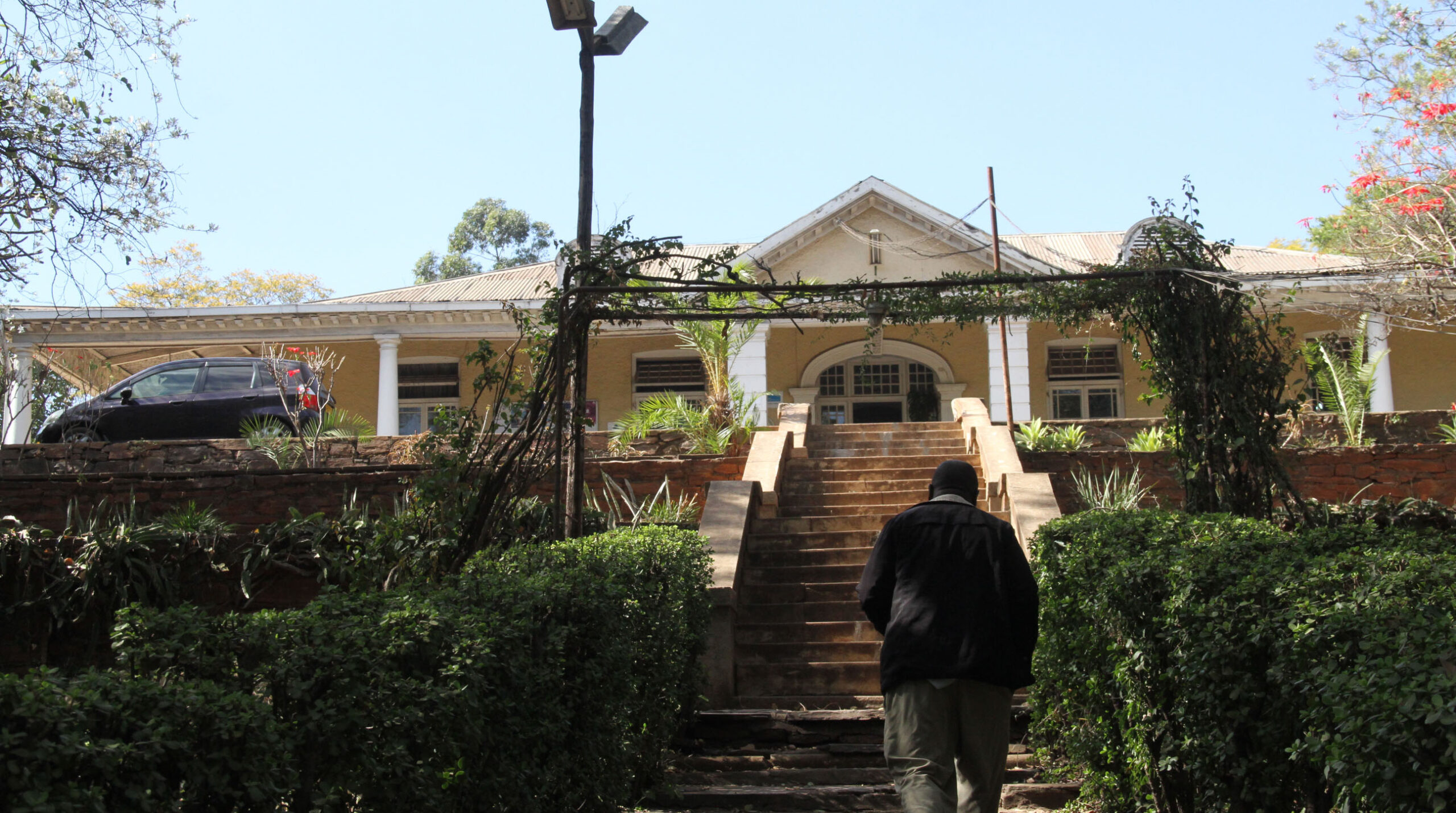
Tendai Chara
Perched on the summit of a small hill on the western side of the Harare Kopje area is an imposing white house built in typical English colonial architecture.
Partially hidden, large and very old exotic and indigenous trees block what would have been extremely beautiful views of this palatial house. The preserved trees and the immaculately terraced garden speaks of great efforts that were made to make the environs attractive.
Welcome to the Ranche House, one of the country’s most iconic and historical colonial buildings.
As one climbs the steep flight of stairs from the car park, the splendour of the house suddenly bursts into view. With a big courtyard and long veranda, the occupants of the house obviously had the rare pleasure of watching stunning views of the sun settling into the horizon.
Historical accounts state that the land on which the Ranche House was build was originally bought by a company, Johnson, Heany and Borrow. The company named the place “The Ranche”.
Further, another company, the United Goldfields Company acquired a part of the stand in 1895, marking the beginning of the Ranche House.
Built at a total cost of £10 000, a princely fortune then, Ranche House was completed in 1899, with Sir Raleigh Grey, the company’s managing director, being the first resident.
In his book, Historic Buildings of Harare, author Peter Jackson described in detail, some of the features that made Ranche House one of the finest houses in colonial Rhodesia for many years.
Jackson wrote: “The house was originally U-shaped around a rear courtyard, which has since been roofed over. The kitchen and pantry are in the southern leg of the U. A central passage follows the shape of the house with rooms leading off both sides.”
According to Jackson, among some of the then rare features on the house were small pane venetian doors that were set into a key-stoned basket arch leading into the entrance hall. The house also boasts of interior timber floors and panelled doors with brassware, with the ceilings being plastered linen framed into panels. A wide verandah roofed with heavy timber beams and dentiled eaves was one of the most distinctive features of the house.
Jackson further states that the house, which went on to house Rhodesian government officials, was the first house in Salisbury (now Harare) to be lit with carbide-acetylene gas lamps, when paraffin lamps were in almost universal use.
Apart from the former splendour, the building went on to house Ranche House College, an important institution which immensely contributed to the development of the country’s education sector.
At a time when black people were treated as inferior, the institution accepted and treated black students on an equal basis with their white counterparts.
That equality was maintained even after the white government of Ian Smith decreed racial segregation in education and banned mixed-race children’s sporting events. Some accounts state that at one point, the sons of Ian Smith and Abel Muzorewa would find themselves writing exams at the same time at Ranche House College.
In 1961, Ranche House was occupied by Ken Mew, who, in 1963, was recruited as the principal of the Ranche House College, which had been established a year earlier.
Ever since, the college has produced hundreds of thousands of students that went on to excel in their chosen careers.
Hurungwe East National Assembly member, Honourable Ngoni Takudzwa Masenda, who studied “O” and “A” Level at the college before proceeding to the University of Zimbabwe, said Ranche House College is an important institution which played a pivotal role in the development of the country.
“Some of us who were coming from the liberation war had the opportunity to study part-time at this institution. Many people who went on to excel in their careers passed through this institution,” Hon Masenda said.
After resigning from Ranche House College in 1982, Mew started the Glen Forest Training Centre, where uneducated blacks could learn basic skills like animal husbandry, blacksmithing and baking.
Historians state that Ranche House College was chosen as neutral ground and hosted part of the secret talks that led to the “one-man, one-vote” election in 1980.
But just like the moon that has both the bright and dark sides, Ranche House is also widely believed to be haunted by the ghost of its most prominent resident, Sir Raleigh Grey.
Apart from Jackson who made reference to the presence of a ghost at the house, former students said they sometimes felt uneasy at the college.
“I remember during the early 1980s when I was a student there. I attended lessons during the night and reports of mysterious sightings at the house circled.
“The ghost of an elderly white man was said to be seen patrolling the area,” said the former student who requested anonymity.
Although Sir Raleigh Grey returned to Britain in the late 1920s and then died at a London nursing home in 1936, his ghost is widely believed to be seen puffing a cigarette whilst sitting cross-legged on the verandah.


 Online Reporter