dyton mupawaenda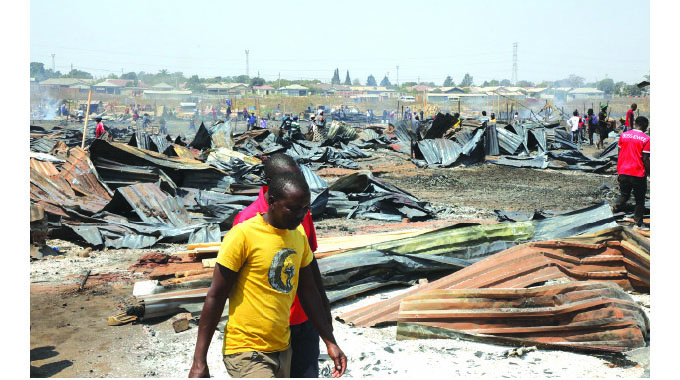
Rumbidzayi Zinyuke-Senior Reporter
Just like a phoenix, Glen View Home Industry complex continually has to rise from its ashes.
Of course, the fire that razed part of the biggest home industry in the country last week did its damage, but with burned rubble still littering the ground, men and women who toil in complex have already started bringing it back to life.
Makeshift stalls made from wooden poles and iron sheets salvaged from the ground have been put up.
Charred sewing machines have been revived and are gently whirring as the carpenters stitch together material to cover the sofas being assembled on one side.
Those who have not restored their stalls work in the open area that once housed the fruits of their hard work.
While the morale is still low, life has to go on.
“I cannot afford to sit at home and mourn what I lost but I have to come back to work so that I can put food on the table for my family. Everyone here has to work so that we can replace what we lost,” said Billiard Makatare, as he threaded his blackened machine.
“I managed to clean this one machine and fix it to a new wooden table so that I can start working. Of course, it is not working as it should, but this will do until I have an alternative.”
A fire breaking out at Glen View complex once or twice a year is no longer surprising.
Those who work there say it has almost become normal.
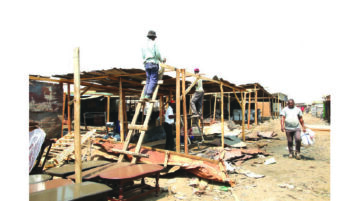
A man sets up a new working stall after fire destroyed Glen View complex in Harare yesterday. — Picture: Joseph Manditswara.
Apparently, the fires break out around September and October and no one can ever pinpoint the cause. It is almost as if there is a force behind the fires.
Some say the fires could be accidental as someone clearing their land right next to the complex can start one that spreads fast towards the furniture. Because the carpenters work with flammable material, the fire is likely to spread fast and destroy everything.
Then there is the idea that rivalry between the people working in the area can cause someone to start a fire to hurt their competitor. Or thieves can start a fire to cover up a burglary.
Others believe that there is some ‘juju’ at play. Those working within the complex are said to be seeking portions to help them grow their business and get all customers coming to them.
There are even wild theories that claim that the complex is haunted by a marine spirit that is not happy with what is happening so it causes the fire to punish those who are misbehaving.
“We have all heard these theories but they remain just that. We have never been able to explain how these fires start. In most cases, it starts in the middle of the night and we wake up to ashes so pinpointing the cause of the fire is difficult. What I can tell you is that when the fire starts, no one can do anything. It spreads so quickly that I would be tempted to believe some of those theories. The speed at which it spreads is not normal,” said Mr Samuel Gwenzi.
He said he had been affected several times by these fires that he had resorted to setting aside money that would help him recover whenever a fire eats up the complex.
“Every year we lose stuff here but we need to continue working. As a way of surviving, I have learnt to put money aside so that I have capital in the event that something like this happens. Because I cannot keep money, I sometimes buy cattle or other assets which I can easily sell when the time comes,” he said.
Others have not been so lucky.
For Mr Caleb Muchingami, the shed that he has restored remains empty because he has no capital to start working. He was just waiting for a miracle.
“I only heard about the fire the morning after the fire and I arrived here to see only ashes. Everything I had, including furniture that had already been paid for by customers was destroyed so besides replacing my stuff, I need to reimburse the customer. I have only managed to fix the shed but there is nothing inside because I don’t not have the capital to buy the raw material to start,” he said.
Middlemen that work around the complex have also not made it easy for the workmen and women.
For women it becomes worse as they fear what the middlemen will do should they complain about the interference in their work.
“We have been working here for years, even back when we used to pay levies to the city council, but over the years, we have seen new people who are coming in and causing problems for us. We have no power to say no when they come with a customer and state a price for our goods, even when they inflate it. After a sale, they will give you what they want and take the rest. They have nothing to lose so they can cause trouble,” a woman who preferred to remain anonymous.
She said the middlemen can afford to do what they are doing because there is no order in the complex anymore.
For years, the Harare City Council has been promising to look into the issues affecting the Glen View Home Industry, but little action has been taken. Most of the promises have been made after each fire but are soon forgotten, until the next fire.
According to the workers, urgent action is needed to restore order in the complex, which has become overcrowded over the years.
Mr Knowledge Gwenzi, who has been affected more than four times said the place needed proper structures and access roads if there was hope of controlling any future fires.
“We use mostly wood to build our sheds so when a fire starts, we are bound to lose out. What we need are steel structures that can withstand fire. We also need proper roads in the complex so that when fire gets to that road it can be contained on one side. We also need Council to help us dispose of the garbage which accumulates while we work because that debris can fuel a fire,” he said.
Small and Medium Enterprises for Economic Development national chairman Mr Lloyd Bhaera concurred that a lot needed to be done to ensure the informal traders working in the home industry continued to contribute to the country’s development.
“We have several issues at Glen View complex that need to be addressed. The fact that fire breaks out in the complex on a yearly basis, sometimes more frequently, means these people’s incomes are affected as much. After they have purchased equipment, raw material and other things needed for their work, they lose everything. This is a difficult situation,” he said.
He said the effects were not only financial but psychological, hence action was needed.
“What should happen is that these SMEs should be re-organised. Glen View complex is too overcrowded so they should be spaced so that when fire catches in one stall, it will not quickly spread to the other stalls. If we can decentralise the complex and have the same concept in Kuwadzana, Mabvuku, Dzivarasekwa and other areas, people will not need to congest Glen View. This will also help in ensuring that they can pay council rates transparently for them to receive services,” he said.
Mr Bahera said there was also need to register them so that they can insure their products once they formalise.
He said those who stock flammable material should also have their own shed outside the complex to prevent fire hazards in line with NSSA regulations.
“We are doing to our best to try to re-organise, re-plan and engage the necessary authorities to make sure the complex works in an organised manner. If we can get an investor to put in sheds in the complex we might see a change. People will be spaced so that they work formally without being crowded. This will do away with all these criminal elements who are abusing those people. We need to restore that area,” he said.
What the workers within Glen View complex want is a chance to earn a decent living for their families.
Said Mr Lordshare Gwenzi: “Some of us are still young and we want to work to that we can have a better future. I am hopeful that if we can work without all these problems, we will improve our lives. We always come back here because there is nowhere for us to go, so we strive to make better lives for our children.”



 Online Reporter