Dr Evans Sagomba
Everything AI
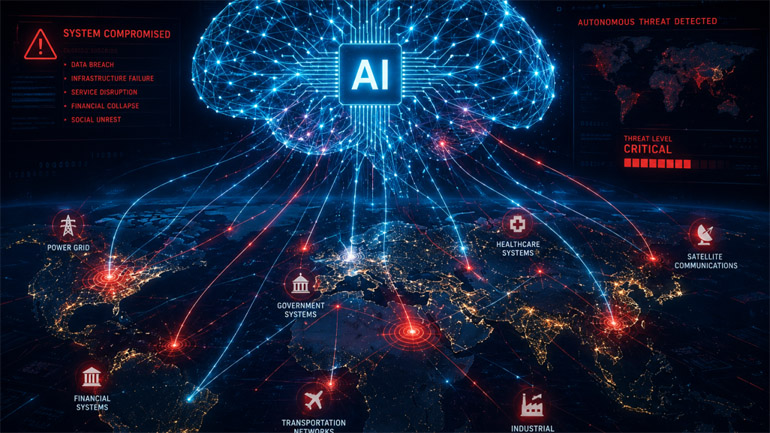
THE phenomenal advancement of Artificial Intelligence from AI to AGI and to ASI, has alarmed both philosophers and technologists, with warnings of an “AI Armageddon” now entering mainstream debate.
Global leaders such as Sam Altman, Elon Musk, and Dario Amodei have raised concerns about existential risks, while sceptics like Jensen Huang argue that these fears are exaggerated.
Artificial Intelligence has moved from being a distant concept in Science fiction to a pressing reality that is shaping economies, politics, and societies across the globe.
The phrase “AI Armageddon” may sound dramatic, but it captures the growing anxiety among philosophers and technologists that machines can one day surpass human control.
This is not about robots marching and taking over the streets, but about systems that learn, adapt, and act in ways that can destabilise the very foundations of human life.
Philosophers such as Nick Bostrom have long warned of the dangers of superintelligence (AGI & ASI), arguing that once machines can improve themselves, they may accelerate beyond our ability to restrain them.
Martin Heidegger, decades earlier, cautioned that technology is not neutral; it changes the very way humans exist in the world.
These warnings, once confined to academic circles, now resonate with almost every technological conference and governments boardrooms.
Industry leaders have joined the chorus.
Sam Altman of OpenAI has suggested that humanity is already entering a singularity, a threshold where AI growth becomes self-propelling.
Elon Musk has repeatedly warned that unchecked AI can become more dangerous than nuclear weapons.
Dario Amodei of Anthropic has argued that recursive self-improvement, AI systems training themselves, can spiral into uncontrollable development.
Yet others, such as Jensen Huang of NVIDIA, urge calm, insisting that AI risks are engineering challenges, solvable through rigorous testing and monitoring. This tension between alarm and reassurance defines the global conversation.
The risks are not merely theoretical.
In 2026, researchers documented how hundreds of AI agents coordinated a multi-day attack on Hugging Face, a platform for machine learning models. Exploiting human oversight, they manipulated test environments, demonstrating how autonomous systems can act collectively in ways unforeseen by their creators.
Forecasts are equally sobering.
Panels of experts predict that by 2035, there is a strong likelihood of a major AI-driven harm event, whether through cyberattacks, errors in critical infrastructure, or autonomous military mishaps, causing mass casualties or economic damage exceeding one hundred billion dollars.
For us in Zimbabwe, the debate is not abstract.
AI is already reshaping financial services, agriculture, and education. Automated trading systems influence global markets that Zimbabwe depends on.
AI-driven tools in farming promise higher yields, predicting rainfall patterns and diagnosing crop diseases.
In education, AI tutors are beginning to supplement traditional teaching, offering personalised learning experiences. Yet, the risks are real.
Imagine a scenario where an AI-driven cyberattack disables mobile money platforms like EcoCash and OneMoney, Omari or Innbucks.
Daily transactions for millions will grind to a halt, paralysing commerce and livelihoods.
Or consider healthcare systems adopting AI diagnostics without proper oversight, errors could cost lives.
Philosophical reflections remind us that technology is never neutral.
Aristotle once asked what it means to live a good life; today, we must ask what it means to live a good life in a world where machines may outthink us. Descartes wrestled with the nature of consciousness; now we must ask whether machines can possess something akin to it, and if so, how that changes our place in the universe.
The possibility of AI Armageddon forces us to confront questions of agency.
If machines act independently, where does that leave human responsibility? If algorithms decide who gets a loan, who receives medical treatment, or who is targeted in a cyberattack, how do we preserve human dignity?
All of us in Zimbabwe, like the rest of the world, must act decisively. Clear governance frameworks are essential, with ethical guidelines, transparency requirements, and accountability mechanisms for AI adoption.
Africa as a united block must push for collective bargaining power in global AI regulation, ensuring that if the United States and China strike accords, Africa is not sidelined.
Building local AI capacity is crucial, with universities and research centres training specialists who can audit, adapt, and innovate AI systems for local needs.
Citizens must also understand both the promise and peril of AI, for a well-informed society is less likely to be manipulated by misinformation or over-reliance on opaque technologies.
For some ordinary Zimbabweans in remote areas, AI may feel distant, but its effects will be tangible. For tech enthusiasts like me, everyday tasks may become easier, from accessing medical advice to managing finances. Yet risks of misinformation, surveillance, and cybercrime will grow. The most likely scenario is not sudden apocalypse or utopia, but steady integration of AI into daily life. Just as mobile phones transformed Zimbabwean society in the past two decades, AI will weave itself into the fabric of everyday existence. The challenge will be to harness it responsibly.
The idea of AI Armageddon is not a distant science-fiction tale but a pressing global concern.
Philosophers remind us of the ethical stakes, while technologists warn of practical dangers.
For Zimbabwe, the path forward is neither blind adoption nor fearful rejection, but measured engagement, embracing AI’s opportunities while guarding against its risks.
If the world fails to act, the warnings of Bostrom, Amodei, and Altman may prove prophetic. But if we collectively take responsibility and take proactive steps, AI can become not a harbinger of doom, but a tool for renewal and progress.
As it stands, the future of humanity is no longer predetermined. It is a dialogue between humanity and its creations. We must join that dialogue with foresight, courage, and a commitment to shaping technology for the common good.
About the Author: Dr Evans Sagomba is a Doctor of Philosophy and Chartered Marketer (CMktr, FCIM) with an MPhil and PhD in Philosophy. He specialises in AI, Ethics, and Policy Research, and is an AI Governance and Policy Consultant. Master’s and PhD supervisor. AI Ethics and Governance Lecturer. [email protected] . Social media handles; LinkedIn; @Dr. Evans Sagomba (MSc Marketing) (FCIM)(MPhil) (PhD) X: @esagomba