Vusumuzi Dube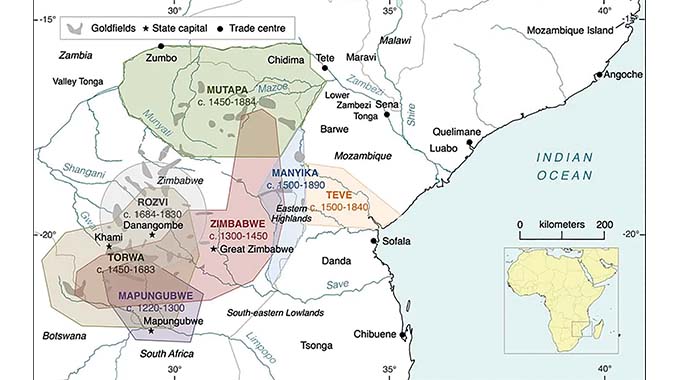
MUTAPA State is regarded as a conquest state. There was a conquering army under Mutota in the Dande Valley. It is argued that the state was an offshoot of Great Zimbabwe state but however, authors point out that the relationship between Mutapa and Great Zimbabwe state was obscure or not clear. Little is known on how Mutapa state came into being. Portuguese record sources could be used to reconstruct its history but there is a problem of reliability of these sources, that is 1420-1470, the dating is very inaccurate and unreliable so one has to rely on oral traditions collected during the 18th and 19th century.
Independent Theory
Some questioned whether Mutota existed especially Beach Abraham does not link Mutota with Great Zimbabwe but with Guruuswa, that is an environmental term rather than a specific place because the dynasties are claimed to have been originated in Guruuswa. This is referred as an Independent Theory which rejects an element of migration of people to the North from Great Zimbabwe. Though this theory sounds convincing considering the availability of resources, it lacks archaeological evidence hence its validity is questionable.
Migration Theory
The second version with regards to the rise and origin of the Mutapa state is linked to Great Zimbabwe e.g. evidence of similar stone works at Chitakochangonya i.e. Mutota’s capital. Archaeological evidence indicates its link with Great Zimbabwe in terms of similar stone works. According to archaeology, Great Zimbabwe’s culture had spread far beyond its vicinity and started to fall in the middle of the 14th century for reasons which are not clear. Historian Mudenge says that it spread even as far as Mozambique coast and the lower Zambezi. Despite archaeological evidence, oral traditions also suggested that factors like civil wars, over population, decline in gold production, shortage of salt, fall in trade ,vastness of Great Zimbabwe state could have led to the downfall of Great Zimbabwe hence marking the rise of a new state quite similar to Great Zimbabwe in the north. It is suggested that some groups under Mutota started moving northwards from Great Zimbabwe towards an area already in touch with Great Zimbabwe.

Oral traditions sources have given the version of the conquering army from Great Zimbabwe under the leadership of Mutota thus overpowering Tavara, Tonga in the north searching for salt. Its foundation was a gradual process through assimilation of the conquered groups in the Dande area. Thus, environmental factors like availability of good pastures, ivory, good fertile soils ,good rainfall and weak societies could have attracted this intruding group from Great Zimbabwe to settle there.
However, push factors such as deterioration in natural resources i.e. salt, gold, ivory, copper, and succession disputes, civil wars at Great Zimbabwe could have forced some of Gumanye culture people to move away in search of green pastures. The salt theory has been overused to explain the critical shortages of most basic necessities in their way of life. Thus, both push and pull factors could be used to explain the rise and origin of Mutapa state.
In the final analysis, the well accepted version today is of the migratory group from Great Zimbabwe with a strong army which was used to conquer the inhabitants in the north e.g. Tavara and Tonga. The rationale behind the acceptance of this version is the similarities of stone works between Great Zimbabwe ruins with those at Chitakochangonya. Thus, the change of environmental conditions at Great Zimbabwe could have led people to look for new areas i.e. shortage of pastures, mineral resources, salt and firewood etc.
Factors for its expansion
When the group started to get settled, the expansion process started to take shape under the leadership of Mutota and his successors like Matope. Installation of his relatives in charge of vast empire like Nyamhita, one of his daughters controlled the Handa district. Personal advantages had some divine position from his ancestors. He was feared by his people who saw him as a barometer of the condition of the state e.g. a health king, means a healthy state.
This instilled an element of unity based on fear (forced unity). Alliance system was also used to expand the state, making vassal chiefs paying tribute in form of gold and ivory. A strong conquering army enabled him to establish himself among the local people e.g Tavara, Tonga hence consolidating his state. Marriage alliances created more relatives and this approach is credited for more relations with local people. Availability of mineral resources and salt promoted external trade and trade relations with foreigners.
Dr Manners Msongelwa is the president of History Teachers of Zimbabwe and a teacher at Camelot College in Kwekwe.



 Online Reporter