Online Reporter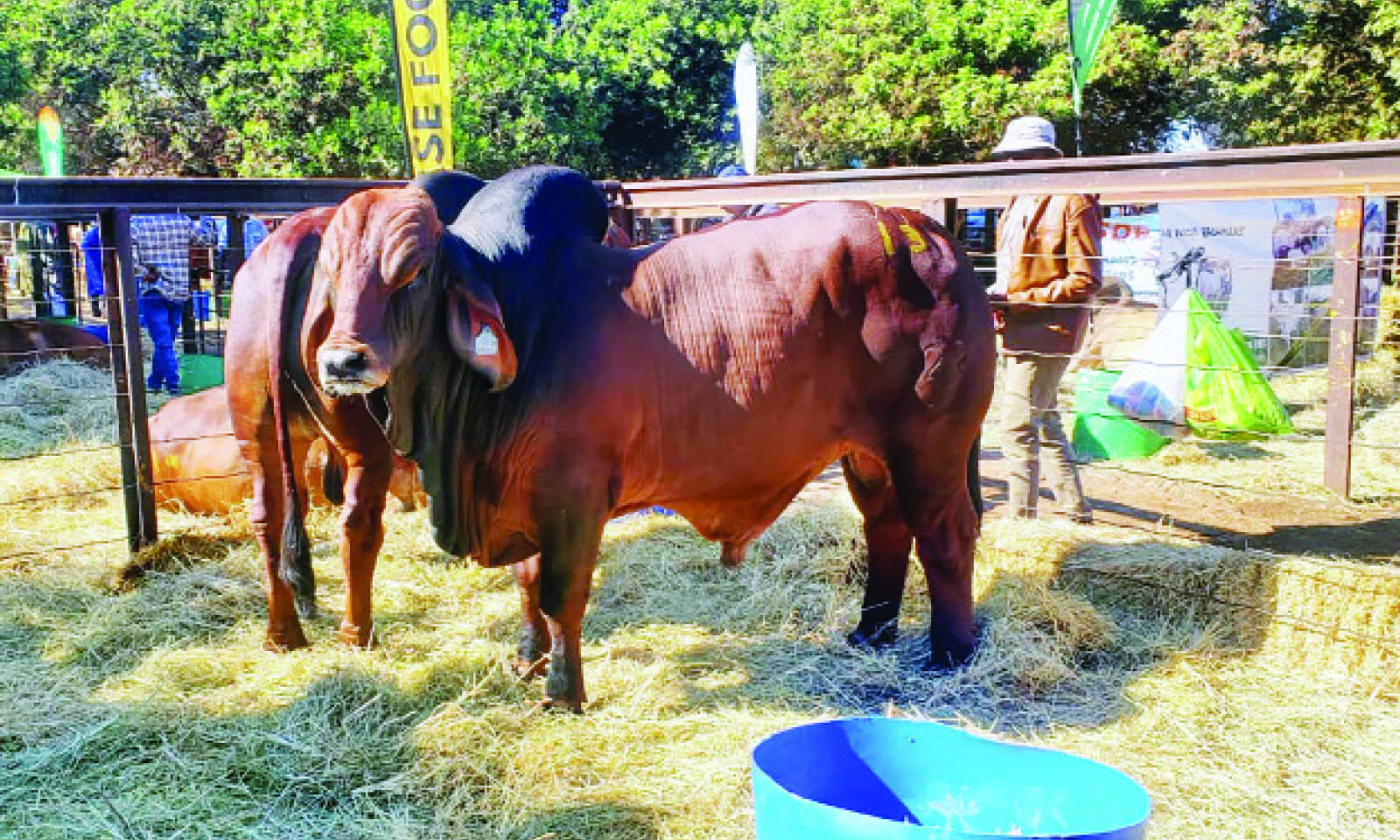
Theseus Shambare
Features Writer
THE sun has barely lifted over the thornveld of Esigodini, but already the rhythmic thud of hooves carries across the dew damp ground.
Behind the herd, Edmore Nyathi walks at a steady pace, his boots scuffing the sandy track.
Ahead of him, a column of heavy framed Simmental bulls follows in single file, their breath steaming in the cool air.
Five kilometres there; five kilometres back. Every day!
“This is their gym,” Nyathi said with a grin, glancing over his shoulder at the animals.
“We walk them to build muscle, burn fat and harden them for both the veld and the sale ring. A bull that moves well and stands solid will always fetch its price.”
It is this kind of precision that separates ordinary cattle from elite stock—and the proof is found at the 57th National Breed Sale in Mt Hampden, where Nyathi’s bulls are among the 140 top tier animals under the hammer.
Branded the “Battle of the Breeds,” the event, which was held recently in Harare has drawn the crème of Zimbabwe’s livestock industry: Borans, Brahmans, Simmentals, Tulis, Beefmasters, Nkone and Dorpers.
The air hums with expectation as auctioneers work the crowd, prices climbing with each bid.
When a Brahman bull smashes the day’s record at US$40 000 and a Dorper ram makes history at US$4 300, the arena erupts in applause.
But Dr Mario Beffa, general manager of the Zimbabwe Herd Book (ZHB), said the spectacle is only the visible end of a much longer story.
“Every animal here has been years in the making,” he said. “They are DNA verified, performance recorded and bred with a purpose. These sales are not just about money. They are about the science and discipline behind Zimbabwe’s commercial beef and sheep industries.”
Nyathi’s farm is a case in point.
In addition to the daily walks, he grows his own feed—maize, sunflower, lucerne—and rotates his herds through carefully managed paddocks.
Calving is synchronised with the flush of pasture after the rains, ensuring calves get the best nutrition from the start.
Disease control is rigorous and staff are trained in both husbandry and artificial insemination.
Nyathi himself can inseminate two cows from a single straw of semen, a skill that halves costs while doubling the reach of imported genetics.
“Good genetics without good management is wasted,” he said. “It is about pairing the right bloodline with the right care.”
The philosophy is shared by Chipo Mudzengi of Chiredzi, who favours the hardy, tick resistant Tuli breed for her Lowveld operation.
Her cattle thrive on sparse grazing and still calve reliably, making them ideal for a low input, high return system.
For her, the Breed Sale is part market, part classroom.
“I learn what bloodlines are working, I meet other breeders and I get ideas to improve my own herd,” she said.
For Government, these farmers are the vanguard of the Livestock Growth and Recovery Plan, which aims to boost the national herd to seven million by 2030 and strengthen its genetic base.
Deputy Minister of Lands, Agriculture, Fisheries, Water and Rural Development, Davis Marapira, said the shift is about more than just headcount.
“We are moving from keeping cattle for prestige to keeping cattle for productivity,” Marapira said, moments after collecting two Dorper sheep for his own flock.
“Smallholder farmers produce over 90 percent of our marketed cattle. If we get genetics right and management right, the impact is national. This is how we build a resilient herd that competes across the region.”
Back at the arena, one of Nyathi’s Simmental bulls steps into the ring.
The bidding is brisk.
Seven thousand. Seven thousand five hundred. Eight thousand. When the hammer falls, the buyer shakes Nyathi’s hand and the bull is led out to a waiting truck.
“It is not just about the cheque,” Nyathi said afterwards, standing in the shade as dust swirls in the afternoon heat.
“It is about knowing that bull will improve someone else’s herd. That is how we grow, one farm at a time.”
As the last animals are loaded and the crowd filters out, the talk is of record prices and promising bloodlines.
But the real story began far from the arena, in the quiet hours before dawn, with the sound of hooves on a sandy track.
Out there, in the daily discipline of walks, feed crops, and careful breeding, Zimbabwe’s new gold is being forged—one step, one calf, and one sale at a time.