admin
admin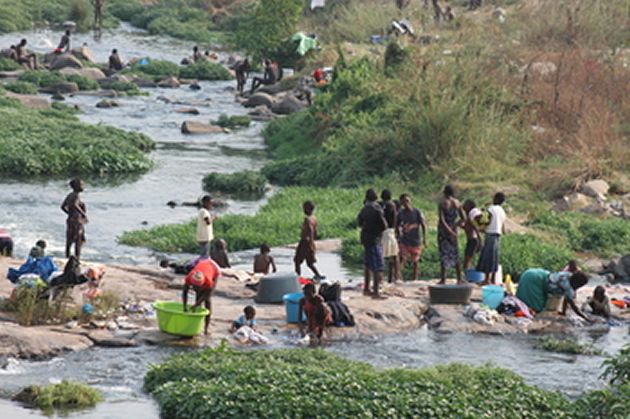
Farai Kuvirimirwa & Tichaona Zindoga Features Writers
THE mere mention of Harare’s Mukuvisi River triggers mixed reactions. The river, which originates somewhere in the wetlands near Msasa on the north-eastern limits of Harare and snakes through Eastlea, Sunningdale, Mbare and Waterfalls to the southern high-density suburb of Glen Norah, is the embodiment of filth.
The river is one of the major sources of water for Lake Chivero, Harare’s main water source.
Mukuvisi flows throughout the year, largely serenely, yet its water carries a malevolent greyish-green colour and a perpetual choking, acidic smell.
This is because of all manner of pollution that the river suffers from industrial and sewage effluent, and/or waste.
The banks of Mukuvisi present a perennial verdant cover to the homeless and this homeless community has the unenviable distinction of masterminding all sorts of crime from pickpocketing to burglaries in nearby suburbs of Sunningdale, Mbare, Waterfalls, Highfield and Glen Norah.
Lately, Mukuvisi’s banks have played host to the increasing species of bush sex workers, prophets and n’angas.
Mukuvisi River is life, though.
World travellers and readers may aptly think of parallels between Mukuvisi and the Ganges River in India, a river notorious for its phenomenal pollution caused by, according to one account, raw sewage, plastic bags and bottles, industrial effluents, human waste, chemicals from tanneries, discarded idols, cow dung, partially cremated corpses, garlands of flowers, human remains, animal carcasses, butcher’s offals, chemical dyes from sari factories and construction waste.
Only the Ganges River, located in the ancient city of Varanasi, is holy.
Mukuvisi is not.
However, unholy Mukuvisi is saving the lives of hundreds of families in Hopley, a sprawling, informal settlement south of Harare and Glen Norah whose residents flock to the river to wash and bath.
There are no water amenities in Hopley while supplies are scarce and erratic in Glen Norah, which has also grown is size.
Mukuvisi is widest and shallowest near the Beatrice Road roundabout.
Standing on the bridge over the river, men, women and children bathing (naked) and washing, presents a rare spectacle.
This week The Herald ventured farther and caught up with the people of Mukuvisi River.
And as one descends into the river, the picture becomes more real, with men and women and children conforming to the usual social order in which women do their chores, children play and, more aloof, men sit down, talking and smoking – and bathing.
There is an attempt to have a respectable distance between the two groups, for the sake of common decency.
Not that the anatomy of the other seems to matter much, in this wonted situation.
“I have been coming to this river to wash clothes and several household clothing over the past three months. I have a well which my husband dug before he passed on but water has been scarce over the past few months,” explained a woman from Hopley who identified herself as Elma.
“Many people have wells in Hopley but the water table is now low, since it is now the dry season. I come here with my son so that he can bath before we go home and also he would assist me with carrying water for both drinking and cooking,” said Elma.
Drinking water is extracted from shallow wells dug on the banks of the river.
Elma said she also bathes in the river not far from where men come to wash.
“I used to be shy but there is no other option. I can do all I do and those men who bath nearby do not mind,” she said.
Elma said she washes at the same spot all the time.
Asked if she was not afraid of contracting disease from the water, she said: “There is no other place close to where I stay where I can fetch water. If it was dangerous to my health, I could have died a long time ago.”
A Glen Norah resident, Mrs Gloria Remeso, said there was no water at her home and Mukuvisi was the only option.
She understands the risks, though.
“There is no running water in our taps for household use. We can take this water after bathing here to cook at home and sometimes use it in our toilet which is a health risk.
“I have a feeling the water poses a serious health risk to us because sometimes foam can pile which I suspect is a result of chemicals being dumped upstream,” she said.
The residents’ line of defence is standard: they do not have access to clean water.
For Glen Norah residents, the situation is compounded by the fact that it is a rocky area.
“I tried to sink a borehole but there is a hard rock underneath which makes it difficult to reach the water table,” said a woman who refused to be named.
A Glen Norah man, identified only as Mutema, corroborated these accounts.
He also said that there was an understanding of some kind of territorialism among the men and women bathing in the river, hence there were no troubles of peeping Toms, or even indecent assaults or rape.
“We do this every day, so there is nothing new,” he said.
Meanwhile, someone has found a business opportunity.
Mr Anesu Magorimbo of Glen Norah A said he resorted to farming vegetables for sale in his neighbourhood.
“I used to be a security guard but the company has since closed. I saw it fit to establish a garden to continue with what I used to do at my place of residence.
“There has not been tap water for three months and my garden wilted six months ago since there was no water for them. I am making a living out of these vegetables and I have a ready market for them everyday,” he said.
Magorimbo said he camps at the garden so that no one steals from it.
“Some come to buy them in bulk here but I have had several cases where people steal from my garden. I take turns with my son to sleep here so that no one comes to steal.
“I can water my garden, wash, cook and sleep here without any problems,” he said.
Environmental authorities, however, are worried by the use by residents of Mukuvisi’s dirty water.
Environmental Management Agency national spokesperson Mr Steady Kangata said the water in the stream was not suitable for human consumption.
“The water in Mukuvisi is polluted by effluent discharged by local authorities and is not fit for human consumption or use. It is also raw water and it contains raw sewage and partially treated sewage in its different areas.
“The water people must drink has to be potable and treated by various chemicals which minimises the risk of contracting diseases. Activities in the catchment of Mukuvisi make the risks worse and sewage disposed of has phosphates and nitrates hence there is an increased growth of weeds such as hyacinth,” Mr Kangata said.
He said various industries and local authorities have been dumping treated and untreated effluent which is not expected of them.
“We do not expect them to do so and most people who use the water risk suffering from rash, eye infections and various diseases caused by bacteria.
There are chemicals such as mercury which are persistent in the ecosystem thereby affecting various trophic levels.
“It is not advisable for people to use water from rivers and streams that pass through urban areas,” said Mr Kangata.
Results of water samples taken by The Herald and sent to the Government Specialist Laboratories for testing were still unavailable at the time of writing.
However, previous studies have established a high concentration of heavy metal pollutants, nitrates and phosphates which can be dangerous to human and aquatic life.


 Online Reporter