admin
admin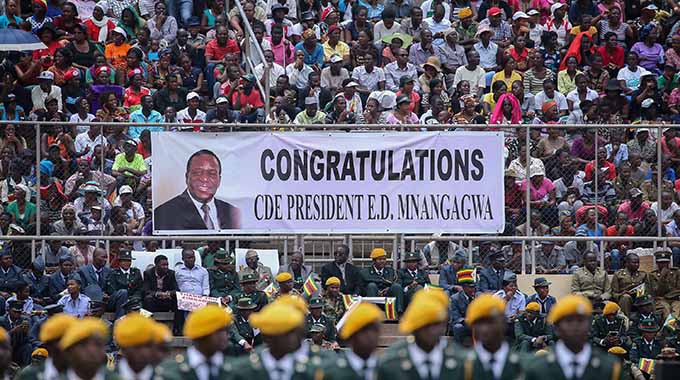
Tafadzwa Mugwadi Political Correspondent
When fundamental national processes unfold such as the one our world witnessed in 2017 in the historic month of November, there are various expectations and gamesmanship involving different agents of social change.
Different pockets in our society had various expectations and diverse feelings about what would obtain thereafter economically, socially and politically.
There are some who discerned and acknowledged that the last two decades of our country had seen enough decimation of the foundations of our economy, contamination of our politics characterised by social dis-cohesion, political polarisation, disenchantment, economic upheavals which had all but destroyed the foundations of our industry owing to the debilitating illegal sanctions regime.
This section of people therefore, appreciated that the new dispensation was not going to be an administration of miracles over the economy, creation of social cohesion, and national healing.
Rather, they were cognisant of the fact that the initial process of deconstruction of the old economy, old thinking and old approaches was imminently going to be motioned with the characteristic pain and sweat needed towards transition to a new economy.
This spoke to the contemporary and was founded on pragmatism. Pragmatism is what the Chinese say, “what works for China.” To the contrary, there was a highly and overzealously expectant group whose actions today show they were not alive to the reality of the past 20 years.
Rather, theirs could have been a case of a group that was expecting manna from heaven, or one that expected President Mnangagwa and his administration to miraculously change two fish and five loaves of bread to feed 5 000 people, to borrow from biblical tales.
Because of these mischievous groups, several forms of misinformed and unfair judgments have been made since the birth of the new dispensation ushered through the legendary Operation Restore Legacy. The nefarious actions of the latter have necessitated this piece.
The past was characterised by successive outcries over acts of mal-governance and asphyxiation of the political space in Zimbabwe and these reasons were used to justify the existence of and in the case of the US, the annualised renewal of illegal and unjustified sanctions on this country.
This led to the adulteration of the image of the country, its people, its leadership and particularly the ruling party ZANU-PF on the global stage.
Although some of those accusations such as elite corruption called upon the leadership to introspect and take corrective positive steps, some of them were by and large exaggerated accusations to say the least.
The advent of the new dispensation, which in itself was a product of twin processes involving the military and the people on one hand and the parliamentary impeachment process on the other, birthed a popular legitimate expectation for Government to renew its social contract with the people on a fresh page of trust, confidence, accountability, transparency and responsibility.
Indeed, the immediate task at hand for the Government and Zimbabweans was to consolidate the unity and oneness of our people which they demonstrated across political and racial persuasions in the historic month of the people’s reclamation of their revolution — the month of November in the year of our Lord, 2017.
The benefit of doubt given to Zimbabwe by global partners and to some extent, the goodwill shown by even some hostile partners during those eventful weeks meant that we had a big opportunity as a people and as leadership to do more and sustain the new-found trust.
The Government of President Mnangagwa must be proud to have embarked on a bumpy journey to walk the talk on the promises made by the man himself on his first inauguration in 2017 where he unequivocally and decisively clarified that his administration would seek to reform governance issues.
The first thing that he did was to bury the conflation between party and State functions which had become a feature of the previous administration.
Party functions have therefore been separated from Government and State functions to ensure the restoration of the principle that State and Government functions take a non-partisan outlook.
True to his vow, the President has overcome the temptation to sloganeer or address ZANU-PF issues on state functions. This is because these occasions must unite people from their diverse faculties of life and reignite the euphoria of oneness bequeathed to us by our forbearers.
It was indeed historic to see respected leaders of the opposition in their variety led by the late former MDC leader Morgan Tsvangirai, Joice Mujuru of NPP and many others coming to congratulate President Mnangagwa on his 2017 inauguration.
To demonstrate his consistency, President Mnangagwa since then has treated all national occasions such as the Independence celebrations, Heroes Day commemorations among many others with non-partisan gestures to show and school the upcoming generation of leaders that Zimbabwe comes first.
It is, however, shocking to hear small minds whispering in opposition corridors and civil society alleging that ZANU-PF failed to fill the National Sports Stadium on the day of SADC solidarity against sanctions. It is clear that only those who are not alive to the ongoing reform process continue to misconstrue State functions as ZANU-PF events.
I do not know if this is what our famed literacy rate in Africa prides of. The decision to stand with Zimbabwe which culminated in the SADC Day Against Sanctions was taken by Heads of State and Government and not heads of political parties.
Secondly, it was a decision taken by SADC in solidarity with Zimbabwe and its suffering people and not in solidarity with ZANU-PF per se although it would have appeared so, naturally because it is the only revolutionary outfit in the country.
That the other parties and their sympathisers boycotted it doesn’t make it a ZANU-PF occasion, but a State event, which is what the President has managed to draw since his inauguration.
To entrench his reform agenda, President Mnangagwa has initiated a speedy realignment of laws to the new Constitution to ensure that laws and other regulations that are archaic, rigid and oppressive in nature be repealed and or amended were necessary so that the people of Zimbabwe across the political divide enjoy the fruits of our flourishing freedom and enduring democracy.
In doing so, he has made it unequivocal, that these reforms are not meant to please any outsiders per se but the people of Zimbabwe, in partial fulfilment of the ethos of the liberation struggle where freedom was the cardinal promise.
This is the principal reason why Government motioned the repealing of POSA and AIPPA which had been thorny in our people’s desire to enjoy their fundamental freedoms. President Mnangagwa has managed to build an incomparable stature as a listening republican, a listening reformer who is committed to taking drastic corrective measures to ensure political rights are not only provided for, but that their enjoyment should be guaranteed albeit within the strict confines enshrined in our supreme law, the Constitution of the Republic of Zimbabwe.
This commitment was demonstrated practically by the historic free and fair peaceful elections in 2018, where all our political outfits, small or big participated freely. This won us international accolades even from some of our hostile counterparts. Some even went on to proudly code-name our 2018 elections, the best and democratic ever since Smith’s time, a posture that makes us proud today.
However, it will be dishonest to omit the fact that as President Mnangagwa and his team embarks on this onerous journey of political reforms, it is equally incumbent for our people across political divide to exercise and demonstrate responsibility, maturity and diligence in the enjoyment of our new found liberties.
The regrettable events of 01 August 2018 and the ugly unprecedented violence, looting and destruction of property that visited our towns and cities in mid-January must never be tolerated or accepted at all in the process of exercising our rights.
There is no justification to violent expression of oneself the world over. It is a betrayal against the President’s goodwill for civil society organisations and their allies in the MDC-Alliance to attempt to weaponize these reforms through acts of sabotage, planning chaos and other treasonous plots disguised as demonstrations.
Those known diplomats who are funding such nefarious plots will never want to see what they do here in Zimbabwe happening in their home countries. That is why in as much as these shenanigans will never be used to excuse or derail the reform agenda, it may be necessary to remind each other, that President Mnangagwa and his team will never ever watch Zimbabwe degenerating into an anarchic, violent and lawless society.
Rather, it is his constitutional mandate to protect the citizens of Zimbabwe and uphold the constitution of the Republic which he has sworn to protect and guarantee the security of everything Zimbabwean.
Such mandate to protect Zimbabweans wherever they are, also means protection of peace loving Zimbabweans from un-peaceful elements that rejoice in burning buildings and arsoning investment infrastructure, in the process destroying job creating prospects.
It is, therefore, necessary that Zimbabweans appreciate that in as much as section 59 of the Constitution provides for the right to demonstrate, it is scandalous and self-defeating to weaponise that right through acts of lawlessness. Peaceful demonstrations have always taken place and ended without incidents since the new dispensation.
Tafadzwa Mugwadi is a Zimpapers Senior Researcher. He is also a Political Scientist and a conflict mediation Scholar by profession. [email protected]



 Online Reporter