Online Reporter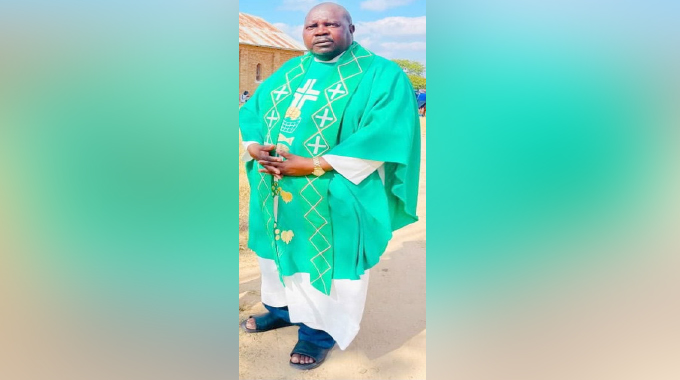
Bruce Ndlovu Sunday Life Reporter
THE pews of St Patrick’s Parish in Makokoba were packed on that winter day in July 2001.
The congregation was a remarkable blend of faith and influence.
Senior clergy stood shoulder to shoulder with political leaders, while ordinary parishioners filled every available space, united by the single purpose of watching the ordination of five young men who had answered the call to priesthood.
Among the faithfuls were Archbishop Emeritus Henry Karlen CMM and Archbishop Pius Ncube, whose presence underscored the significance of the ceremony.
Also seated among the congregation were Matabeleland South’s then Governor Stephen Jeqe Nkomo, Joanna Fuyana, the wife of nationalist icon Father Zimbabwe among other members of the revered Nkomo family.
Yet, amid those distinguished faces, one of the five young man being ordained that day remembers seeing something else. For Father Makawule Ndlovu, that occasion was more than just about the high-profile figures who packed the pews on that special occasion.
For him, that mass, that ordination, was the moment a dream finally came true.
A quarter of a century later, Fr Ndlovu, now the beloved parish priest at St Joseph’s Mission in Kezi, is preparing to celebrate the silver jubilee of his ordination on July 29.
On this occasion, Vice President Dr Constantino Chiwenga is set to be the guest of honour.
For Fr Makawule, this is a milestone that has prompted reflection not only on the road he has travelled but also on the thousands of lives he has quietly touched along the way.
“What I recall most about my ordination Mass on July 28, 2001 at St Patrick Parish was the immensity of inner joy that I felt at the fact that my dream to become a priest had come true. I had always wanted to become a priest and I recall the faces of the priests surrounding me, praying with me, praying for me,” Fr Makawule said.
“I remember the two archbishops there, Archbishop Emeritus Henry Karlen and Archbishop Pius Ncube. I remember again the congregation which also comprised prominent people such as the then Governor of Matabeleland South, Stephen Jeqe Nkomo.
“I remember Joanna Fuyana, the wife of Father Zimbabwe. I also recall the Nkomo family who were among the congregation. They were all part of the congregants that graced my ordination.”
Twenty-five years after kneeling before the altar in Makokoba, Father Makawule’s ministry continues to echo the promise he made on that memorable day.
His silver jubilee is not merely a celebration of years served. It is a celebration of lives restored, children educated, the sick comforted, the forgotten embraced and communities strengthened through quiet acts of compassion.
Looking back, Father Makawule said he believed that what made the occasion particularly special was the collective hope of the Catholic faithful, who saw the ordination of five priests as an answer to prayers for more labourers in God’s vineyard.
“The people from Bulawayo prayed in unison for priests. We were five of us that were ordained priests on that day. Unfortunately, some have left the ministry. Three have left the ministry because of various reasons. Only two of us remained among those who were ordained the same day.
“So, I’m very happy to make that reminiscence of 25 years, 25 years ago on the day of my ordination at St Patrick’s in Makokoba.”
For many in Kezi today, Father Makawule is more than a parish priest. His warm smile, infectious laugh and approachable nature have made him one of the district’s most cherished public figures.
Whether officiating at weddings, comforting grieving families, visiting schools or simply chatting with villagers after Mass, he has cultivated a ministry rooted in closeness to the people. Those who know him say his popularity stems not from grand gestures but from a genuine interest in the everyday struggles of those around him.
That compassion was shaped long before he arrived at St Joseph’s.
Among the defining chapters of his priesthood was his work among the destitute living at the Ngozi Mine squatter settlement on the outskirts of Bulawayo, where poverty, illness and hopelessness often went hand in hand.
Rather than seeing statistics or social problems, Father Makawule saw human beings worthy of dignity.
“Working with the destitute at Ngozi Mine squatter camp also gave me inner satisfaction. I experienced some form of satisfaction in working with the destitute.
“I realised their poverty. I realised their challenges, particularly the type of people who were there. Some of them were ex-prisoners who were not well integrated into society.
“Some of them grew as orphans and struggled. They did not go to school. Some of them had other kinds of challenges in life, be it mental health challenges or physical challenges.”
His ministry quickly expanded beyond the walls of the church. He became an organiser, fundraiser, counsellor and advocate, bringing together community leaders and institutions to improve the lives of people who had largely been forgotten.
“So, working with them, I derived a lot of inner satisfaction. I worked with many stakeholders. The local councillor of the area, Stars Mathe, now in Nkayi. I also worked with the local clinic. I took the sick squatters to the local clinic and I sought funds from people who assisted in their medication. I also worked with Falake Funeral Parlour to assist in the burial of those who died at Ngozi
Mine,” he said.
Death was a frequent visitor in the settlement, a painful reminder of the harsh realities many residents endured. Rather than turning away from those difficult moments, Father Makawule said he ensured that even the poorest received the dignity they deserved in death.
“In such conditions, obviously, some death would occur due to ill health, due to hunger, probably. So, I was very happy that Falake Funeral Parlour cooperated well with me to remove the deceased from the scene of death and also assist in the burial.”
While many institutions struggled to respond to the humanitarian crisis, Holy Trinity Parish in Cowdray Park, where Father Makawule was serving, became a sanctuary.
“I also housed all the squatters at our church in Cowdray Park, Holy Trinity, during the operation to clear out illegal dwellings around the country.
“And we, as a church, we provided accommodation for three months or so. Some gave birth there in the church.”
The church also became a temporary clinic and classroom.
“I had to work with the doctors from around Bulawayo to come and assist because a lot of people really needed medical assistance. They came.
“As for learners, I paid school fees for a good number of them in schools around Cowdray Park like Tategulu Primary School and Mahlathini Primary School. We paid school fees for many destitute children and that is something that also gave me a lot of satisfaction because I could see the problems around our community. These are some of the deeds that have given me course for reflection on the occasion of the silver jubilee”
Yet Father Makawule understood that people needed more than food, medicine and school fees. They also needed hope. To nurture that hope, he established a small Christian community inspired by St Francis of Assisi, the patron saint renowned for his love of the poor.
“Obviously, I created a cell for spiritual growth and we named it St Francis of Assisi, who was so keen on helping the destitute.
“And that cell, a spiritual cell, was a small Christian community that attended Sunday Mass in Cowdray Park. That was a great moment of joy and satisfaction for me.”