The third Russia-Africa Summit and Economic and Humanitarian Forum, held in Moscow on October 28-29 2026, marked an important stage in the development of relations between the Russian Federation and African states.
The Summit brought together delegations from 48 African countries, including more than twenty heads of state and government, under the theme of strengthening cooperation in the interests of peace, security, and sustainable development.
The event sought to build upon the foundations established during the inaugural Summit in Sochi in 2019 and the second Summit in St. Petersburg in 2023.
One of the most significant achievements of the Summit was the adoption of the Russia-Africa Partnership Action Plan for 2027-2029, which established a framework for future cooperation across political, economic, technological, educational, and humanitarian spheres.
The Summit participants also approved a final declaration reaffirming their commitment to a more equitable and multipolar international order and expanded cooperation in trade, food security, energy, healthcare, and digital technologies.
Another notable outcome was the endorsement of a declaration on the peaceful and responsible use of artificial intelligence, reflecting growing interest among African countries in technological modernisation and digital transformation.
The Summit also produced numerous intergovernmental and commercial agreements covering sectors such as agriculture, mining, energy, transport, education, healthcare, and security cooperation.
Russian President Vladimir Putin highlighted the growth of Russia-Africa trade and stressed Moscow’s intention to expand economic cooperation in agriculture, energy, industrial development, and infrastructure.
Discussions emphasised increasing local value addition in Africa rather than limiting cooperation to the export of raw materials.
Food security emerged as one of the central themes of the Summit. African leaders expressed interest in expanding cooperation with Russia in grain supplies, fertiliser production, agricultural mechanisation, irrigation, and technology transfer.
Russia reaffirmed its readiness to support African efforts to increase domestic agricultural production and strengthen food resilience.
Participants discussed opportunities for cooperation in conventional energy, renewable energy, and civilian nuclear power. Energy security was presented as a key pillar of Africa’s industrialisation agenda, with Russian companies expressing readiness to contribute expertise and investment.
The Summit also provided a platform for discussions on reforming international institutions.
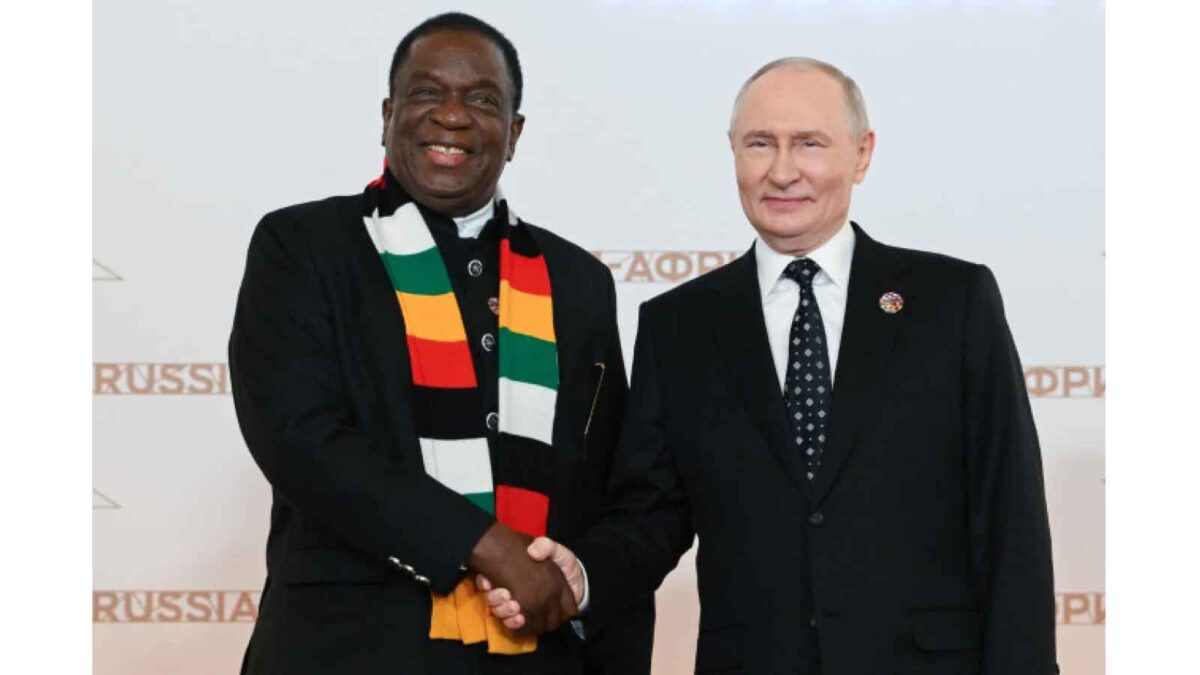
President Mnangagwa reiterated the need for stronger African representation in global decision-making structures, particularly within the United Nations system.
The events in Moscow served as an important venue for advancing country-specific agreements and strengthening direct government-to-government contacts. For Zimbabwe, the Moscow Summit represented an important opportunity to deepen an already friendly and long-standing partnership with Russia.
Zimbabwe and Russia have maintained close political relations based on mutual support in international forums and a shared commitment to sovereignty, non-interference, and the democratisation of international relations.
The Summit reinforced these common positions and provided a platform for further diplomatic engagement. Zimbabwe’s participation demonstrated its continued commitment to strengthening relations with Russia within the broader framework of Russia-Africa cooperation.
Many Russian companies have long been successfully implementing major investment projects in Africa, covering a wide range of sectors, including energy production, the peaceful use of nuclear energy, mining and mineral extraction, industrial cooperation, logistics, tourism and other areas.
Educational cooperation continues to be an important area of engagement.
The Summit highlighted scholarship programmes, academic exchanges and technical training initiatives offered to Zimbabwean students and professionals.
Zimbabwe’s objective of accelerating industrialisation aligns closely with the Summit’s focus on energy cooperation.
Russian expertise in energy infrastructure, including conventional and nuclear technologies, may provide future opportunities for collaboration aimed at supporting Zimbabwe’s long-term economic growth and energy security.
The third Russia-Africa Summit in Moscow demonstrated the continuing commitment of Russia and African countries to strengthening their political dialogue and expanding practical cooperation.
Through the adoption of the 2027-2029 Action Plan, the final declaration, and numerous sectoral bilateral agreements, the Summit established a framework for advancing trade, investment, food security, energy development, technological innovation, and educational exchanges.
For Zimbabwe, the Summit offered additional momentum for deepening relations with Russia across key sectors of national development.
Enhanced cooperation in mining, agriculture, education, technology, and energy has the potential to contribute significantly to Zimbabwe’s economic transformation while reinforcing the strong political ties that have characterised Russia-Zimbabwe relations for many years.
By Embassy of the Russian Federation in the Republic of Zimbabwe