dyton mupawaenda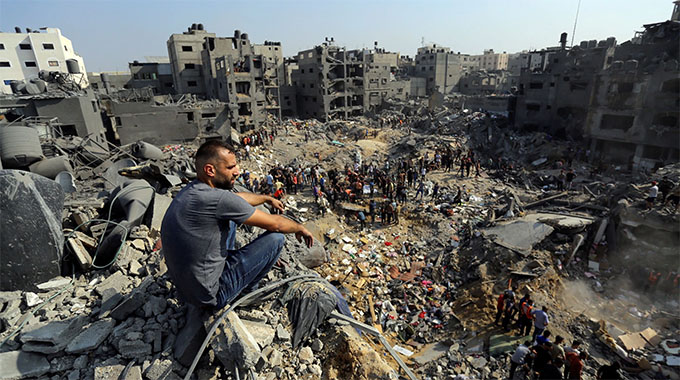
Francis Mufambi-Correspondent
The conflict between Israel and Palestine has been ongoing for decades and continues to shape global geopolitics.
The roots of the conflict can be traced back to the late 1800s when Jewish immigrants began settling in Palestine, which was then part of the Ottoman Empire.
In 1948, Israel declared independence, leading to war with its Arab neighbours and displacement of hundreds of thousands of Palestinians.
The conflict has remained unresolved, with Israel controlling much of the West Bank and claiming Jerusalem as its capital, while Palestinians seek their own state with East Jerusalem as the capital.
The conflict has had far-reaching geopolitical ramifications, from strain on relationships between the US and Arab states, to instability in the Middle East and North Africa.
Recent developments, including the growing influence of non-state actors like Hamas and Hezbollah coupled with the Israeli expansion of settlements, have added to the complexity of the conflict and its impact on global politics.
The Israeli-Palestinian conflict embodies an intricate and multifaceted geopolitical issue with multiple contributing factors.
While it is incorrect to solely attribute the escalation of the conflict to any single entity or group, it is worth examining the role of the West in its dynamics.
The involvement of Western powers has indeed had a significant impact on the Israel-Palestine conflict in particular and the Middle East in general.
Such influence has been significant to an extent where the West should shoulder majority of the blame especially when this conflict is escalating leading to unnecessary grievous and senseless losses of innocent lives. To start with, Western involvement in the conflict was the creation of the State of Israel in 1948.
Following World War II and the Holocaust, there was a clear international consensus to establish a Jewish homeland.
The United Nations, with widespread Western support, played a key role in the partitioning of Palestine, leading to the establishment of Israel.
This decision, while aimed at addressing an alleged biblical and historical injustice, disregarded the aspirations and concerns of the indigenous Palestinian population, ultimately sowing the seeds for the ongoing conflict and by extension castrating their rights including that of self-determination.
Furthermore, Western powers, especially the United States, have historically maintained a close alliance with Israel.
The US has provided substantial military and economic aid to Israel since its inception, which has undoubtedly impacted the power dynamics in the Middle East region.
This support has been carped for potentially enabling Israel’s occupation of Palestinian territories and its military actions, emboldening its stance against Palestinian aspirations for self-determination further worsening a precarious situation that was ensuing.
Furthermore, the diplomatic role played by Western countries in peace processes and negotiations deepened the Crises in the region.
Over the years, several Western-led initiatives have been launched with the aim of resolving the Israeli-Palestinian conflict, such as the Oslo Accords and the 2000 Camp David Summit.
However, the failure of these endeavours to achieve a lasting solution has led to further frustration and distrust among the Palestinian population, exacerbating the conflict.
Moreover, Western countries’ role in the arms trade has also contributed to the escalation of the conflict.
Significant arms sales to both Israel and various Arab states have led to an arms race in the region, increasing tensions and the potential for further violence.
It is important to note that while the West has played a role in the escalation of the conflict, other factors and actors, including regional dynamics, ideological and religious differences, and internal Palestinian politics, also contribute to the ongoing hostilities.
Effectively addressing the Israel-Palestine conflict requires a comprehensive understanding of its complex origins and involvement from various actors, including the West, along with a commitment to promoting dialogue, peace, and justice for all parties involved.
The Middle East has been marred by conflicts for decades, and while the Israel-Palestine conflict has garnered significant attention, the involvement of Western countries in perpetuating conflicts in the region is often overlooked.
It is imperative to shed light on specific instances where Western nations have played a contributing role in fuelling conflicts in the Middle East, leading to the continued instability and regression in relation of the attainment of the United Nations Sustainable Development Goals (SDGs).
One of the key conflicts the West cultivated in the Middle East was the Iran-Iraq War (1980-1988).
During this war, many Western countries, including the United States, Britain, and Germany, provided military support, intelligence, and financial aid to both Iran and Iraq, effectively prolonging the conflict.
The Reagan administration provided military intelligence and crucial intelligence data to Iraq, including satellite imagery of Iranian troop movements while British and German provided support to Iran with military equipment and spare parts.
During the 1990-1991 Gulf War, in response to Iraq’s invasion of Kuwait, Western countries moulded a coalition to conduct military operations, pushing Iraq out of Kuwait.
During the same war, Western forces targeted Iraq’s infrastructure, including water treatment facilities and power plants, leading to long-term impacts on the country’s civilian population.
After the conflict, Western countries imposed economic sanctions on Iraq, affecting the lives of ordinary Iraqis and exacerbating socio-economic grievances that had a potential to explode into civil unrest.
Another well documented example is the Syrian Civil War which started in 2011, and whose effects have caused immense suffering, has been influenced by external powers, principally Western nations.
The United States and its allies, provided military aid and support to various rebel groups in Syria, prolonging the conflict.
The US, together with some European nations, additionally conducted airstrikes against the Syrian government, exacerbating the conflict and leading to a more complex geopolitical situation.
The ongoing conflict in Yemen has seen Western countries providing military support and arms to various parties involved, further escalating the conflict.
Several Western nations, including the United States, the United Kingdom, and France, have continued to sell weapons to Saudi Arabia, a leading participant in the Yemeni conflict. Western countries have been assisting the Saudi-led coalition with intelligence sharing, mid-air refuelling, and targeting assistance, thereby indirectly contributing to the protraction of the conflict.
While the Israel-Palestine conflict remains a significant concern in the Middle East, other conflicts have been fuelled by the involvement of Western countries.
The examples provided demonstrate how actions such as military support, arms sales, and intervention have contributed to the protraction and exacerbation of conflicts in the region.
Recognising and acknowledging this involvement is crucial in the pursuit of lasting peace and stability in the Middle East. While progressive forces stand in solidarity with Palestine, in their pursuit of a fundamental right to exist as a legitimate state, to self-determination, economic development and access to their resources –a call for the end of Israeli occupation needs to be accentuated.
International instruments such as the United Nations General Assembly Resolution 181 (1947), UN Partition Plan for Palestine, the Fourth Geneva Convention and other UN Security Council Resolutions must be implemented with sincerity of purpose to attain a peaceful Middle East.
Francis Venom Mufambi is an International Trade and Diplomacy analyst writing in his own capacity. Feedback: [email protected]



 Online Reporter