

 admin
admin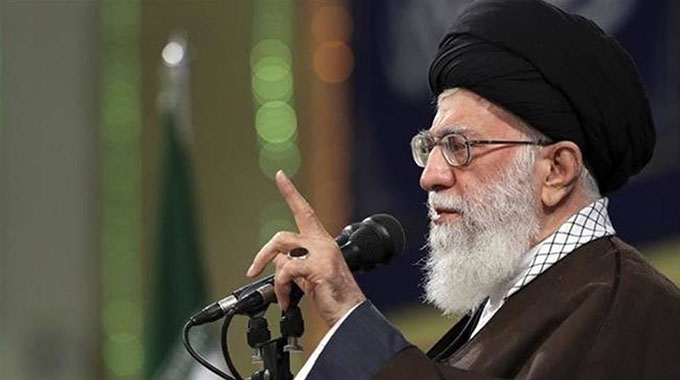
Correspondent
The Islamic Republic of Iran on June 5 held massive commemorations to mark the 30th anniversary of the demise of Grand Ayatollah Khomeini (PBUH). The main ceremony held at the shrine of the magnanimous Imam was led by His Eminence Ayatollah Khamenei—the Leader of the Islamic Revolution— who delivered a speech broadcast live on his official website as well as on the Islamic Republic of Iran Broadcasting.
His Eminence stressed, in his statements, that efforts to make the memory of Imam Khomeini (PBUH) perish have failed, asserting that during the 30 years since the demise of Imam Khomeini (PBUH), many efforts have been made to understate the name and reminiscences of our magnanimous Imam; yet, he received a longer lasting appeal.
Ayatollah Khamenei noted that “exactly 30 years have passed since that bitter historical day; 30 years since our separation from our popular honoured Imam; 30 years since that historic farewell and extraordinary and auspicious funeral that the people held for their dear and unique Imam.”
The Supreme Leader referred to the massive gathering as a sign of the lasting charismatic memory of Imam Khomeini. He added that during the 30 years many efforts have been made to understate the name and reminiscences of Imam. He noted that efforts have been made to trivialize the extraordinary popularity the Honoured Imam; nevertheless, the reality is that Imam Khomeini’s popularity not only did not diminish but also lasted longer.
Leader of the Islamic Revolution Ayatollah Seyed Ali Khamenei said the doctrine of resistance introduced by the late founder of the Islamic Republic, Imam Khomeini, is now a well-known concept.
Ayatollah Khamenei praised the lofty characteristics of Imam Khomeini, highlighting his resistance and persistence as outstanding virtues. The feature identified Imam as a School of Thought and a new path of resistance.
His Eminence applauded Imam Khomeini (PBUH)’s unyielding resistance in the face of tyranny and injustice and maintained that in the face of hardships, obstacles, and tyrannical systems, Imam Khomeini (PBUH) manifested his power of resistance to the entire world. During the fights, many abandoned the mission due to exhaustion and hopelessness, but Imam Khomeini resisted strongly without the slightest retreat.
Ayatollah Khamenei noted that after the victory of the revolution, pressure of another type and of greater scale and scope emerged, but the Imam did not miss on the principle of resistance. Threats, temptations and seductions had no effect on Imam Khomeini. The enemy failed to disrupt the calculating capabilities of the magnanimous Imam, which were based on the statements of the true religion of Islam.
The Supreme Leader defined resistance for his audience and maintained that resistance means choosing the right path, the correct path, and starting to travel along that path with the obstacles unable to stop the travel. That is how Imam Khomeini was. He had chosen a path and was travelling along that path.
The Leader of the Revolution viewed Imam Khomeini’s discourse as the rule of God’s religion and the divine ideology over the Muslim society and over the lives of the general public. After succeeding in defeating the obstacles and establishing the Islamic Republic, he announced that Iran would not oppress nor would it be oppressed.
Ayatollah Khamenei regarded Imam Khomeini’s discourse as derived from the Quran and stated that this discourse was extracted from the religious context and the Quran. Obviously, it had high profile enemies in imperialist regimes in the world, and as a result, animosities started from the first day.
The Supreme Leader reminded his audience that whenever the Iranian nation adopted resistance in face of animosities, they gained victory and fortified other nations to take the same path. His Eminence articulated that every time the Iranian people held on to resistance, they became victorious and advanced. The notion of resistance is strong today.
Ayatollah Khamenei observed that Imam Khomeini’s ideology of resistance was based on logic and wisdom and noted that Imam [Khomeini] had chosen the path of resistance. One part of it is that resistance is the natural reaction of every free and dignified nation in the face of intimidation and bullying. Every nation valuing its dignity, identity, and humanity would resist, make a stance and not accept something that is being forced upon it. This in itself is an independent and satisfying reason.
The Leader of the Revolution regarded resistance as more beneficial than compromise. So resisting is actually more beneficial. Experiences in the Islamic Republic confirms this.
The Leader of the Islamic Revolution described the Front of Resistance as being at a climax of integrity during the past 40 years.
Ayatollah Khamenei assured his audience that there is no dead-end to Iran’s economic problems, but that the country is advancing.
His Eminence dubbed the Iranian nation as the source of strength for the country.



 Online Reporter