admin
admin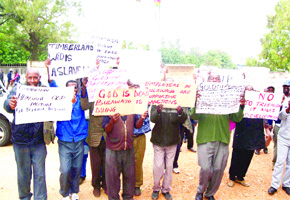
But has anyone from officialdom not only ever talked about empowerment but taken bold steps to give unemployed locals a brave new future by placing them in jobs.
The mind boggles.
The Midlands in particular and Matabeleland are provinces that are “filthy rich in minerals” to use the figure of speech only for the sake of emphasis and could come handy in putting back a morsel into the mouths of thousands of starving families whose breadwinners have lost jobs to illegal Western sanctions and are now roaming the streets of the City of Kings or eke out a meagre existence vending this or that oddment with the future growing ever so forlorn.
Other job-losers have probably crossed the border to search for better destiny abroad in spite of conditions there which are not favourable to migrant workers.
Mining companies might not be willing to offer these people jobs, probably for fear of stretching their budgets especially after acceding to government’s requirement for the companies to pay out part of their equity for community share schemes intended to develop communities in which the mines are located.
Moreover, the mines might have wanted to continue to scheme the cream of Zimbabwe’s mineral wealth, while indigenous people, who stake a claim for common ownership of the mines, settle for the whey as it were.
In any case, the royalties that mining companies pay to the Government are a paltry acknowledgement of the massive incomes from the sales of minerals many of them no doubt blow out of Zimbabwe to their external bank accounts, and would have been happier to continue to render to the state without any qualms at all had the Government not rolled out its indigenisation and economic empowerment programme to the mining industry.
In the circumstances, this pen contends that it would not only be prudent, but also a case of rescuing those who were affected by sanctions for no cause of themselves, if a lifeline were thrown to the victims by laying on equipment and cede money for them to join small scale miners around the country who nevertheless scratch the surface in the periphery of richer reserves of minerals pulsating in the ground beneath more sophisticated mining plants.
Such a development would surely end the one-man-for-himself and God-for-us-all situation in which the hapless former factory workers in Bulawayo find themselves today and who knows with crime obviously beckoning to some of them to try to feed their families.
Since mining is a lucrative enterprise, those advanced government money to put them on their feet again will pay back the advances, even with interest, once they truly put their shoulder to the wheel at their small mines.
In addition, the Government might wish to create jobs for the former workers in question along the lines of food-for-work and for which part payment will be made in kind, as stipulated by the International Labour Organisation which says the other half should be paid for in cash.
The streets and roads in Bulawayo and no doubt those in other urban areas as well are full of potholes and those who lost their jobs might be mobilised to undertake repair work.
Many buildings in Bulawayo look shabby with their paint-work filthy or peeling off, like a snake shedding off its old skin. That is not to mention some shop pavements that look as though they have been air-bombed in a war situation, with faint patches of Rhodesian paint still visible on some of the pavements and appearing to advertise an I-do-not-care attitude of shop owners in question.
Owners of the eyesore properties might be ordered by municipalities in the affected urban centres to spruce up the buildings with modest fees being paid to former industrial workers mobilised to facelift the buildings concerned and in the process also face lifting the image of the city or town and that of Zimbabwe as a whole.
If the above suggestions are effected they will demonstrate Zimbabwe’s determination and capacity to rise to any challenge by detractors to vanquish the country.


 Online Reporter