

 admin
admin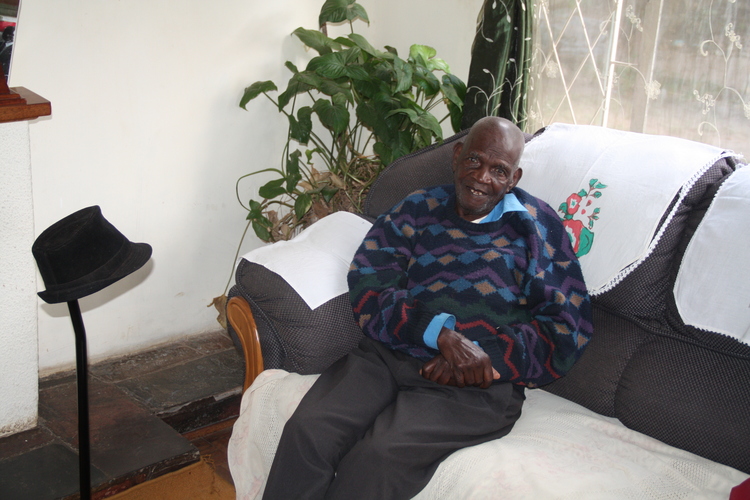
Melody Mashaire Features Correspondent
In 2014, when Mutambiranwa Chikuni (112) requested a birthday party, there was a logistical problem. He was 100-years-old, according to his national ID card, but his official birth date had been arrived at by approximation after he lost the original one during the Second Chimurenga. The wartime Registrar’s Office had just looked at his face and estimated that he was born in 1916.
However, Chikuni’s hazy recollections of growing pains under a young Rhodesia spanned much earlier than his official birth date.
“So one day, Baba’s friend, Mai Musoro, offered to go to Makombe (Registrar-General’s Office) to resolve his doubts,” Chikuni’s eldest surviving daughter, Florence Chikuni-Zambuko, told The Herald.
“The people at the office searched their files and discovered an earlier record which said Baba was born in 1904. They issued him a new national ID and gave him a centenarian card.
“We threw the party for Baba on November 1, 2014. We are grateful to have him as a repository of wisdom and the family guide. He defies his age,” Florence said.
It is still difficult to determine whether the 1904 date was not the result of another wild approximation given that Chikuni got his birth certificate as a teenager without a prior birth record.
His earliest recollections of Harare (then Salisbury) are closer to the ground than the developed city, further mystifying his actual birth date.
“When I came to Harare there were three shops and no roads. Mbare had not been built yet. I witnessed its construction from the ground,” he recalled.
Sun-basking in his daughter’s backyard in Derbshire, Waterfalls, Sekuru Chikuni barely looks his age.
He further defies the frailties of old age by going about without the aid of a walking stick or a compassionate arm.
Chikuni said he earned 30 cents on his first job and was not paid some months on the pretext that he was being sheltered and fed by his white employers.
“I was babysitting for a white family. That was my first job in Salisbury. Although I was already earning little, I was not always paid. The white government oppressed black people; servants were not treated well.
“We were supposed to be grateful for whatever stipend they gave us. For them, it was a big favour that they were accommodating us and feeding us,” he said.
There was not much to go back home to either. The Svosve people had been displaced from their land and “crowded in the sand” by the settlers.
Chikuni had come to Harare via a stint as a shoemaker in Chegutu.
“I went to Chegutu in 1919. My elder brother had called me saying there was no shoemaker there.
“I barely spent a year there as I soon moved to Harare. I worked at Prince Edward where I was doing laundry for white people’s children,” he said.
The job-hopping Chikuni soon moved to Meikles Hotel. During his stint there, he started going to night school.
“I had gone to school as a child. However, as I was working in Harare, I would go to school at 7pm. The leader of United Methodist Church gave us lessons at Matthew Rusike,” he revealed.
He moved from Meikles to Spar Water before going back to his roots in Svosve, Mashonaland East, possibly acting on the wisdom of the ancestors to marry within one’s own community.
His nostalgia for Svosve is, however, for everything rather than the dress code.
“During my childhood in Svosve, we used to wear goat skins. At night, we used the fire for warmth. I first wore clothes as teenager as the ways of the settlers were spreading,” Chikuni said.
“I married in 1933 after returning from Harare. My wife died recently aged 83. She lived long enough to see our great-great-grandchildren,” he said.
Chikuni attributes his long life to God’s grace: “It is all God’s doing. I cannot attribute it to myself. I eat what everyone else eats. I cannot say it is anything out of the ordinary,” he said.
The centenarian, who neither smokes nor drinks, had not been in hospital till he was diagnosed with prostate cancer in 2004. He successfully underwent treatment and is back to his age-defying streak.
Chikuni has recollections of three wars, “the Great War (First World War), Hitler’s War (Second World War) and the Second Chimurenga.”
“I was 14 years in 1918. The Rhodesians fought on the side of their mother country. Germans sprayed poison into the air as their forces were depleted and becoming cornered. Many people died.
“I have a clearer memory of the Second Chimurenga. We used to collaborate with “vanamukoma” (the liberation forces) by giving them information about the movements of the enemy.
“We also fed them. It was a service to the nation which they had sacrificed everything for. In fact, it was known that comrades do not eat vegetables,” he added.
He recalled how in 1976 and 1977, the Rhodesians locked them in a “keep” to cut their interaction with the comrades. They were only released when they said these people have run out of food.
Chikuni had eight children, three of whom are now deceased.
“My first born was born in 1934. I have over 100 grandchildren, great-grandchildren, great -great-children combined. My last born stays at my farm in Mt Darwin, Chesa,” he said.
Florence said Chikuni was “returning to infancy” due to advanced age, but was still of a sound mind and able body.
“Mum died in 2004 and I started living with him when he fell sick the same year.
“He had prostate cancer and we worried over him a lot then, but we thank God he was operated on and is now cancer-free.
“I thank God my father is healthy. The things he can do on his own surprise people given his age. He is really the envy of many younger people.
“He can bath on his own, do his own tie and does not mix himself up when talking,” Florence said.
Chikuni has hopped from one job to another since his teenage years, including working as an agricultural extension officer.



 Online Reporter