admin
admin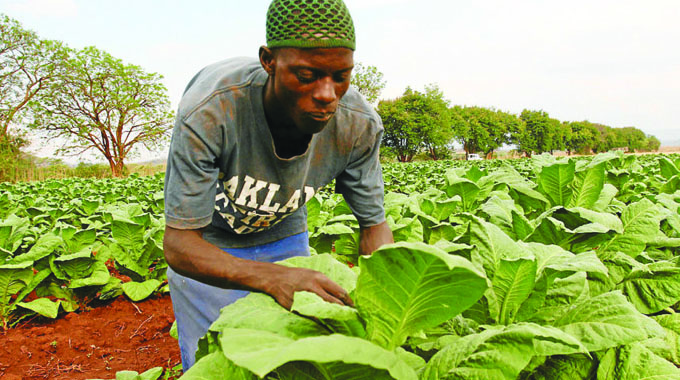
Elita Chikwati
Features Editor
Many irrigated tobacco farmers are reaping and curing the crop as they prepare for the opening of the 2023 marketing season.
The Tobacco Industry and Marketing Board (TIMB) is on the other hand carrying out crop assessment in all tobacco growing areas.
The assessment will be used to prepare a crop estimate for the marketing season as well as help determine the opening dates for selling.
Farmer organisations are also pushing for improvement in the marketing process and have made submissions to the RBZ to have foreign currency retention increased so there can be a smooth marketing season with no cases of side-marketing.
The marketing season brings joy to those growers who have done a good job as they get high prices while to some it will be a time of sadness due to unfavourable prices as a result of the quality of the crop on offer.
The issue of the quality of the leaf however depends on how the farmer would have adhered to the most important agronomic practices from the seedbed to the auction floor.
A number of tobacco growers have contemplated shifting to other cash crops especially due to the challenges they face when selling their crop.
The issue of delayed payments, middlemen and high inputs costs for contracted growers come into play.
Long back, the list of challenges also included spending several days camping at the auction floors while waiting for cash. This was since resolved by the Reserve Bank and TIMB and now farmers can sell their crop and get their money in no time.
Last season, farmers had a good crop and most of them were happy with the prices offered by buyers.
However, some contracted growers experienced challenges as the companies failed to honour the obligations of paying on time.
Some had to appeal to the TIMB for assistance so they could get their dues.
This resulted in the suspension of some contractors while others had their licences cancelled by the TIMB for failure to pay farmers their dues.
Such challenges de- motivate farmers.
This year the growers are anticipating a smooth marketing season where there will be an increase in foreign currency retention.
Last season, growers were paid 75 percent directly into their foreign currency accounts and this was treated as free funds while 25 percent local currency was deposited into the growers’ local bank accounts or e-wallets.
This season the growers have indicated that they are anticipating for a higher foreign currency retention with others calling for a 100 percent payment in foreign currency.
Submissions have already been done to the RBZ and farmers wait anxiously for the RBZ governor’s monetary policy where the issue will be addressed.
Tobacco Farmers Union vice president, Mr Edward Dune said high quality leaf was guaranteed because of the good rains.
“If history has to repeat itself we will have competitive prices for the crop especially for the early deliveries.
“We also expect a shorter season. Farmers expect a 100 percent foreign currency earnings for the issue of viability,” he said.
Other farmers said they were failing to make profit from the crop because of too much cartels on one cake in the industry.
“Surrogate contractors short changed farmers last season.
“If no action is taken, the industry will suffer and this will require the intervention of Government to save the sector which supports livelihoods for millions of people,” said Goromonzi farmer Mrs Onai Mubayi.
Tobacco Association of Zimbabwe president Mr George Seremwe said farmers were looking forward to a smooth marketing season where they do not experience challenges selling their crop and getting their money.
“Contractors should meet minimum input package and distribute the inputs early. Some farmers have bonding contacts from last season and this issue should be addressed by the TIMB.
“Some growers’ numbers had been suspended during the past years as they were not active and farmers are making efforts to renew.
“The TIMB has been co-operating in terms of re registering the farmers,” he said.
Some farmers have also suggested that the marketing season opens soon since they had an early season.
The farmers argue that by opening early they will get their money and invest in other businesses even for winter cropping season.
The late opening of the season has also been identified as one of the reasons why farmers fall prey to middlemen who approach them at the farms.
The farmers would be in need of cash to pay school fees and to cover other expenses. Thus farmers will be forced to sell their crop at a song to these middlemen who will then later sell at higher price at the auction floors.
Another advantage of opening early if farmers are ready is that post-harvest losses will be reduced as there will be less handling of the crop.
A number of farmers have incurred losses through poor handling of the crop as they wait for the opening of the selling season.
Thus it would be ideal to announce an early date of the official opening of the season if the TIMB crop assessment results indicate that farmers are ready.
The TIMB acting chief Mr Emmanuel Matsvaire said they were making frantic efforts to ensure a smooth season for farmers.
The board is also working on bringing order to the industry to make life easier for farmers and other stakeholders.
Strategies being implemented by the TIMB include getting balance in terms of selling points.
Last season the marketing was decentralised and this saw the establishment of 90 selling points.
“We had too many selling points and our intention is to reduce to 45 to reduce overhead expenses of running sales. For a contractor to be licensed, the company should have supported at least 1 000 hectares of tobacco in that area. Whoever has less than that will not operate an auction floor.
“We have received 180 applications and we now want to reduce the number of contractors to 45; 30 outside Harare and 15 within the capital city,” he said.
He said this move would also reduce cases of side marketing.
“We want to weed out those who get in the business for speculative purposes, we need to bring order and discipline to the sector,” he said.
The TIMB will also ensure contractors abide by the regulations of supplying adequate inputs to farmers and the board has since developed standards for the minimum input package.
The package will include supplying the farmers with protective clothing.
The 2022 tobacco marketing season progressed fairly well with the relaxation of Covid-19 regulations.
The season had its fair share of challenges, but the industry pulled through. Zimbabwean flavour tobacco was in high demand and average prices offered were firmer.
One of the major milestones last season was that through the Ministry of Agriculture, Lands, Water, Fisheries and Rural Development, the Tobacco Industry and Marketing (Prohibition of Side Marketing) Regulations, 2022 (SI 77 of 2022) was gazetted.
The SI which specifically focuses on tobacco side marketing when used in conjunction with administrative penalties, went a long way in curbing side marketing of tobacco. In Zimbabwe, about 150 000 farmers engage in tobacco production while close to one million people are directly dependent on the “golden leaf”.
Tobacco generates about 30 percent of the country’s foreign currency bringing in nearly US$1 million.



 Online Reporter