

 admin
admin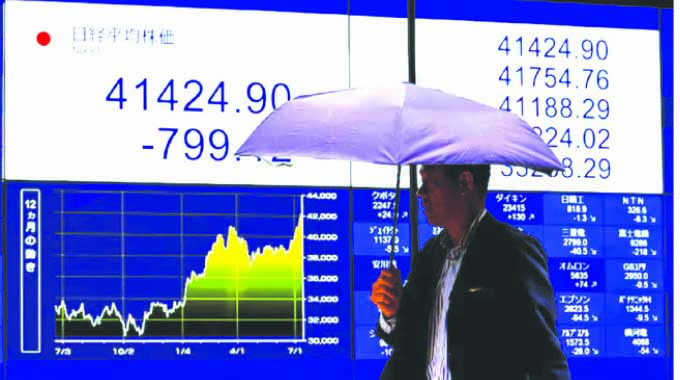
Global stocks drifted on Friday, masking a strong rotation on Wall Street out of big tech stocks and into small companies expected to benefit from rate cuts, while strong signals that Japan had propped up the yen kept currency trading cautious.
MSCI’s broad index of world shares was steady, while futures contracts on Wall Street’s S&P 500 share index and the tech-heavy Nasdaq 100 implied both indices would flatline in early dealings.
However, futures contracts on the US small-cap Russell 2000 index were 1 percent higher, building on a strong performance for this domestically-focused index on Thursday as shares in big tech groups like Apple.
Traders on Friday were looking ahead to easier financing conditions for companies in the world’s biggest economy after data on Thursday showed U.S. inflation had dropped unexpectedly to 3 percent in June, fuelling bets for a September rate cut.
The Federal Reserve has held its main funds rate at a 23-year high of 5,25-5,5 percent for almost a year, a period where rate cut bets have shifted rapidly on volatile economic data.
Barclays strategist Emmanuel Cau cautioned that most long-term U.S. investment institutions still expected rates to stay high for longer, so the small-cap stock bounce could be short-lived.
“Rotation on lower rates into under owned parts of the market, like small caps or bond proxies, seems to be the new pain trade,” he said.
Meanwhile, shares in big US banks JPMorgan Chase, Wells Fargo, and Citigroup, edged lower in pre-market trading after their earnings updates presented a mixed picture of current economic conditions.
Wild YEN
The dollar was steady against peers on Friday and slipped by only 0,2 percent against its Japanese counterpart to 159.2 yen, following a wild ride for the currency pair in the previous session .
The yen surged by almost 3 percent on Thursday in a move traders attributed to official intervention to pull the currency up from 38-year lows, as well the drop in U.S. inflation having loaded extra pressure onto the dollar.
While Tokyo did not confirm any move to prop up the flailing yen, the Bank of Japan’s daily operations report on Friday suggested between 3,37-3,57 trillion yen (US$21.18-22 billion) had been spent on strengthening the currency the day before.
Japan’s top currency diplomat Masato Kanda also said on Friday: “Currency interventions should certainly be rare in a floating rate market, but we’ll need to respond appropriately to excessive volatility or disorderly moves.”
Currency strategists at Bank of America, however, said yen interventions looked unlikely to halt the currency’s decline in the long term, noting Japan’s trade deficit and its retail investors’ tendency to park money abroad for higher expected returns.
Sterling bounce
Elsewhere in markets, Europe’s Stoxx share index hit a one-month high and headed for a second consecutive week of gains, helped by upbeat earnings from Sweden’s Addtech, opens new tab and Ericsson .
The 10-year US Treasury yield, a benchmark for global borrowing costs, was steady at around,.21 percent on Friday after dropping by almost 9 basis points (bps) in the previous session as the price of the debt instrument rose on rate cut hopes. – Reuters



 leeroy
 Online Reporter