Online Reporter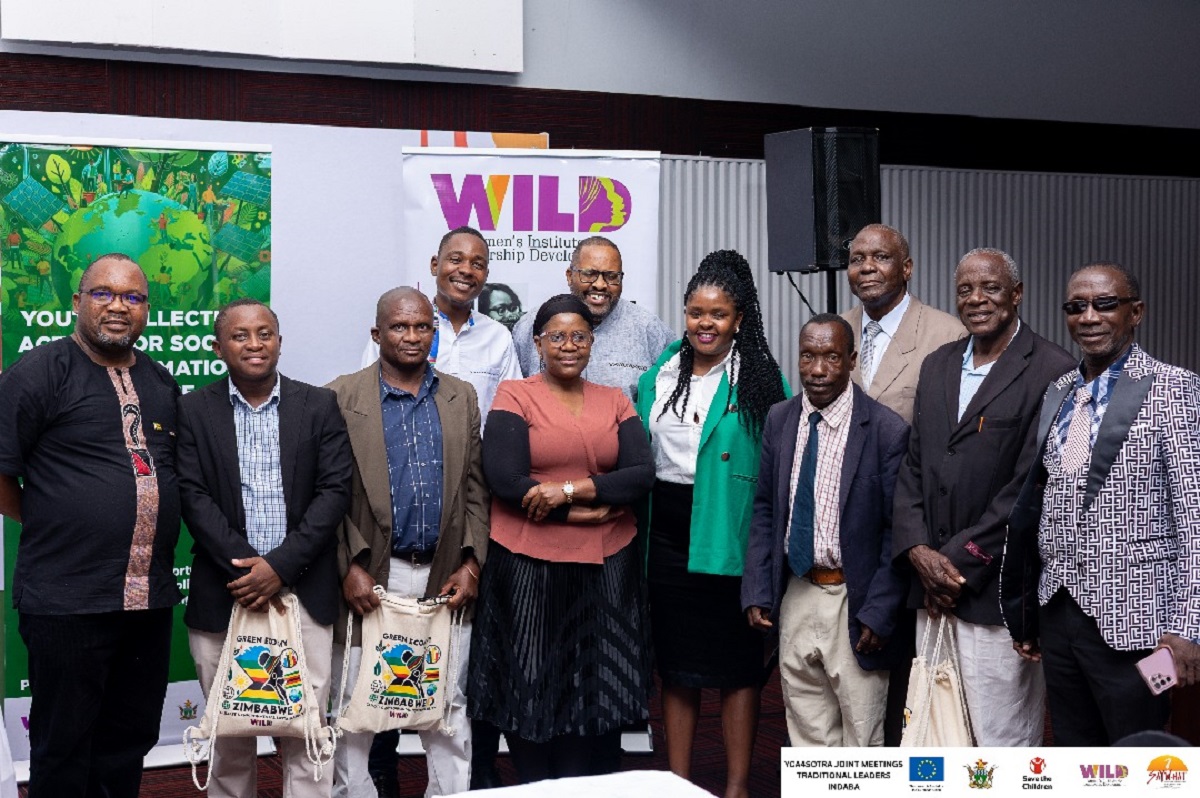
Trish Mukwazo
TRADITIONAL leaders have been identified as critical allies in the fight against environmental degradation and climate change, with experts calling for their deeper involvement in policy implementation and localised environmental governance.
This came out during the Climate Green Economy and Environmental Sustainability Traditional Leaders Indaba held in Bulawayo yesterday. The event, hosted by the Women’s Institute for Leadership Development (WILD), under the Youth Collective Action for Social Transformation (YCA4SoTra)Project implemented in partnership with Students and Youths working on reproductive Health and Action Team (SAYWHAT)and Save the Children funded by European Union.
It brought together stakeholders from Government ministries, traditional leadership, youth and women’s organisations to map inclusive climate solutions.
The event was hosted by the Women’s Institute for Leadership Development (WILD) under the Youth Collective Action for Social Transformation (YCA4SoTra)Project implemented in partnership with Students And Youths working on reproductive Health and Action Team (SAYWHAT)and Save the Children funded by European Union.
The Environmental Management Agency (EMA) said traditional leaders are not just custodians of culture and heritage but are also pivotal in driving environmental protection efforts at grassroots level.
“Traditional leadership plays a fundamental role in identifying environmental challenges and co-creating solutions. They are the first line of response in community-level environmental crises,” said EMA’s environmental planning and monitoring officer, Ms Orpah Ruzawe.
She said when traditional leaders document and track environmental issues, it becomes a powerful tool to monitor service delivery, reduce conflicts and promote collaboration between communities and local authorities.
“This approach strengthens community stewardship and fosters lasting partnerships. We cannot succeed without traditional leaders. Their involvement ensures that national environmental policies are implemented where it matters most, in the communities,” said Ms Ruzawe.
EMA, a statutory body under the Ministry of Environment, Climate and Wildlife, highlighted ongoing efforts to integrate traditional leadership into Local Environmental Action Plans (LEAPs), which guide community-level climate adaptation and resource management strategies.
Chiefs Council president Chief Mtshane Khumalo said traditional leaders have long been the backbone of local governance and remain vital in modern efforts to address environmental challenges.
“With historical roots that predate modern governance systems, traditional leaders have shaped national identity, fostered unity and safeguarded cultural heritage. Today, that role must evolve to include the preservation of our environment, which is under serious threat,” he said.
Chief Mtshane Khumalo noted that as custodians of both natural and cultural heritage, traditional leaders preside over land-use practices, resolve conflicts and shape values that influence community behaviour towards the environment.
However, he warned that modernisation, urbanisation and global cultural influences continue to erode traditional authority, making it more difficult for traditional leaders to assert their roles in governance.
In her welcome remarks Wild Executive Director Ms Samukeliso Khumalo said traditional leaders have historically served as vital conduits for community cohesion, unity and collective action.
She said their authority and respect within communities provide a unique advantage to foster inclusive dialogue, bridge generational gaps and integrate marginalised voices particularly women and youth into community development initiatives.
“Your involvement is critical to ensuring that development agendas resonate with local values and cultural heritage, thus achieving lasting sustainability,” she said.
Ms Khumalo added that traditional leaders are not mere custodianship of traditions but are also key actors in influencing policy formulation, implementation, and advocacy at various governmental and administrative levels.
“By actively participating in policy dialogues and decision-making processes, you ensure that community aspirations and indigenous wisdom are embedded in national strategies and development programs,
“Traditional leaders also play an essential role in sustainability efforts, particularly in leveraging opportunities provided by Environmental, Social, and Governance (ESG) frameworks,” said Ms Khumalo.
A key panel discussion titled “Strengthening Indigenous Leadership for Inclusive Climate Adaptation” sparked dialogue on how women and youth can be better integrated into environmental decision-making.
“Young women, in particular, face structural barriers despite their close interactions with the environment. Women want to lead environmental initiatives, but we are often excluded from the spaces where decisions are made,” said Mercy Mokwane, a youth climate justice advocate
Participants agreed that meaningful inclusion of all stakeholders, particularly traditional leaders, women and youth, is essential to achieving an environmentally sustainable future.
The indaba ended with a call for the formal recognition of traditional leadership in environmental policymaking and increased support to help communities implement locally tailored climate actions.