Sukulwenkosi Dube-Matutu [email protected]
MORE than 100 artisanal miners in Umzingwane District, Matabeleland South, have received specialised training as Government intensifies efforts to bring informal mining operations into the formal economy while improving safety in the sector.
The training programme, launched in the district through a partnership between Namib Minerals and its subsidiary How Mine, is aimed at equipping small-scale miners with technical skills and knowledge to operate safely, legally and sustainably.
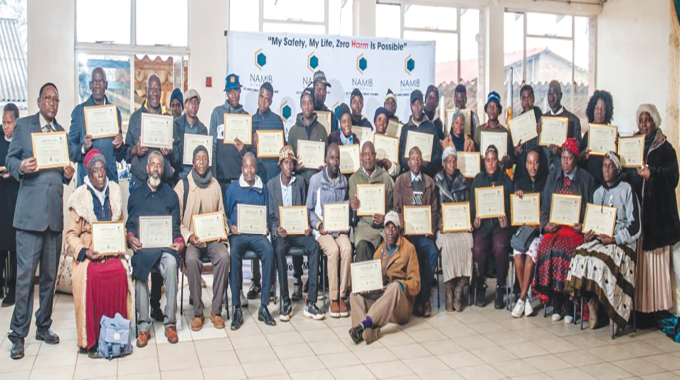
A total of 103 miners recently received certificates after completing the inaugural training programme held at Esikhoveni Public Service Training Centre.
The initiative comes as Government steps up efforts to curb illegal mining and encourage artisanal miners to register their operations, with formalisation viewed as a means of improving safety, productivity and access to opportunities rather than depriving communities of livelihoods.
Speaking during the handover of the certificates, Umzingwane legislator and Deputy Minister of
Defence, Brigadier-General (Rtd) Levi Mayihlome, said the long-term objective was to eradicate unregistered gold mining in the district.
“Allow me to talk about our long-term objective, which is to eradicate unregistered gold mining in
Umzingwane. This does not mean that we want to take away people’s livelihoods, far from it.
“We want to help people move from informal and unsafe operations towards registered, lawful, safer and more productive mining enterprises,” he said.
The training covered proper mining methods and ground support systems, hazard identification, shaft inundation management, emergency response, underground gas testing and regulatory compliance.
Miners were also trained on claim registration and pathways to obtaining blasting certification.
Brig-Gen Mayihlome said the programme was particularly important given the risks associated with mining where workers lacked adequate technical knowledge, equipment and safety practices.
“How Mine has generously made its expertise available to our artisanal miners. We are particularly grateful for this demonstration of selfless corporate social responsibility,” he said.
“Formal training can be expensive and inaccessible to many small-scale miners, making such partnerships with established mining operators important to the transition from unregulated operations.”
Brig-Gen Mayihlome said some artisanal miners acquired their skills informally from relatives, friends and fellow miners, leaving them vulnerable to hazards associated with unstable ground, dangerous substances and inappropriate use of mining equipment.
“We should not wait for a collapse before we ask whether the ground was properly assessed. We should not wait for somebody to be injured before we ask whether dangerous substances were properly handled. Prevention must become our first line of defence,” he said.
“Mining should be treated as a serious occupation that requires knowledge, discipline, technical competence and adherence to safety procedures. We should not wait for an accident before we ask whether a mining operation was safe.”
How Mine mine manager Mr Ophir Gwede said the programme was developed to address practical knowledge gaps among small-scale miners and reduce preventable accidents.
He said the initiative followed concerns over underground incidents and loss of life in informal and small-scale mining operations in Umzingwane.
“How Mine’s goal is to bridge the knowledge gap, minimise preventable operational hazards, and empower local miners with the tools and regulatory insights required to operate safely, legally, and sustainably,” said Mr Gwede.
He said the training focused on some of the highest-risk areas in small-scale mining, including ground support, hazard identification, shaft flooding, emergency response and underground gas testing.
It also covered regulatory compliance, claim registration and the process of obtaining mine blasting licences and full blasting certificates.
Mr Gwede said How Mine had embraced the initiative as part of its corporate social responsibility and commitment to improving safety in surrounding communities.
Brig-Gen Mayihlome also commended Namib Minerals for other community projects in his constituency and Bulawayo.
The projects include construction of classroom blocks at two primary schools, electrification of a district clinic, provision of borehole water to communities and donation of medical equipment to public hospitals in Bulawayo.
The training programme is expected to provide a model for collaboration between established mining companies, Government and artisanal miners in promoting formalisation while addressing safety challenges in the small-scale mining sector.
— @DubeMatutu