admin
admin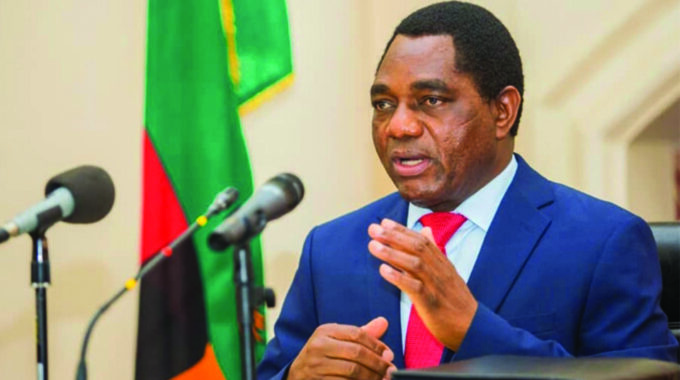
Zvamaida Murwira, Farirai Machivenyika and Richard Muponde
OUTGOING Chairperson of the Sadc Organ on Politics, Defence and Security (Sadc Troika) and Zambian President Hakainde Hichilema has commended the manner in which elections were conducted in several countries, including Zimbabwe, in the past year, saying the bloc should be proud of the peaceful transition of power in the region.
President Hichilema said this yesterday while virtually opening the Summit of the Sadc Troika at the New Parliament Building in Mount Hampden.
The summit was also attended by incoming Chairperson of the Troika, Tanzania’s President, Samia Suluhu Hassan, Namibia’s President Nangolo Mbumba and Democratic Republic of Congo’s President Felix Tshisekedi.
“As the Executive Secretary (Elias Magosi) said, elections are almost, if you like, the ultimate in our democratic dispensations, and elections can be difficult, elections can be emotional, but we’re very pleased that the elections that happened during our time or the year that has passed, were reasonably peaceful and delivered leaderships that Sadc can be proud of as a bloc, that we have maintained or managed to have a peaceful transition of leaderships from one team to another during the last year,” President Hichilema said.
During the period under review, elections were held in Zimbabwe, the DRC, the Kingdom of Eswatini, Madagascar and South Africa.
President Hichilema urged countries that are scheduled to conduct elections later this year to uphold peace and tolerance in their electoral processes like their predecessor sister countries.
“I must say that this is work in progress and we look forward to the elections that are coming in the latter part of this year. We want to encourage our member states, our citizens in our individual countries, to support electoral processes, to campaign, to conduct elections, as I say, pre-elections, during the elections, and post-elections in a peaceful and tolerant manner.
“That is what will keep our region stable, and allow space for economic and social development to play its critical part. We get elected into office to deliver because that’s what will improve the living standards in our individual countries, member States, and also as a bloc,” he said.
Earlier, the Sadc director of the Organ on Politics, Defence and Security Affairs, Professor Kula Theletsane, said Zimbabwe was one of the five countries that successfully held its general elections.
“In our efforts towards the consolidation of peace and strengthening democracy and good governance, five Sadc Member States successfully conducted peaceful general elections — the Democratic Republic of Congo, the Kingdom of Eswatini, the Republic of Madagascar, South Africa and Zimbabwe,” said Prof Theletsane.
“In all these elections, the SADC electoral observation mission played a central role in observing the elections based on the provisions of the SADC Treaty, the Protocol on Politics, Defence and Security Co-operation, and the SADC Principles and Guidelines governing democratic elections. To this end, I would want to congratulate the governments and the people of the five member states for the successful elections which allowed citizens to exercise their democratic rights and freedom of choice.”
This puts to rest the call by some local opposition elements and civic society that had, in the run up to the Sadc summit, sought to discredit the country’s elections with some calling for a change of venue.
There had also been some expectations by the same organisations that Sadc will direct a re-run of the elections with some calling for illegal protests at the summit.
Mr Magosi had earlier also expressed concern at the dire humanitarian situation caused by the conflict in eastern DRC.
“Rampant attacks and hostilities perpetrated by armed groups continue further afflicting and burdening the plight of the vulnerable population. The humanitarian situation is in an increasingly sad state, requiring our urgent and well-concerted action,” Mr Magosi said.
Sadc Ministerial Troika chairperson and Zambia’s Foreign Affairs and International Co-operation Minister, Mulambo Haimbe, said while the region was enjoying relative peace, there was a need to remain vigilant for possible threats to peace and security.
Minister Haimbe also expressed concern about the security situation in the DRC.
“Regarding the situation in the DRC, we remain greatly concerned with the continued attack and hostile activities perpetrated by armed groups. We are particularly concerned with the loss of lives of innocent people, including women, children and elderly, as well as the forced displacement of civilian populations triggered by re-emerging of armed groups, including the M23 rebels,” he said.
Minister Haimbe commended member states for committing resources and military support to help in restoring peace in troubled spots in some member countries such as DRC and Mozambique’s Cabo Delgado region.
He said this was despite the fact that member states were grappling with the financial impact of the Covid-19 pandemic and other economic difficulties.
“Yet, despite these challenges, our member states stepped up to support our brothers and sisters in modern day to restore peace and security and pave the way for the people to enjoy their lives, freedom and developments. While we celebrate the progress made and the groundwork we have laid, we must remain vigilant against any threat to peace and security,” Minister Haimbe said.


 Online Reporter