admin
admin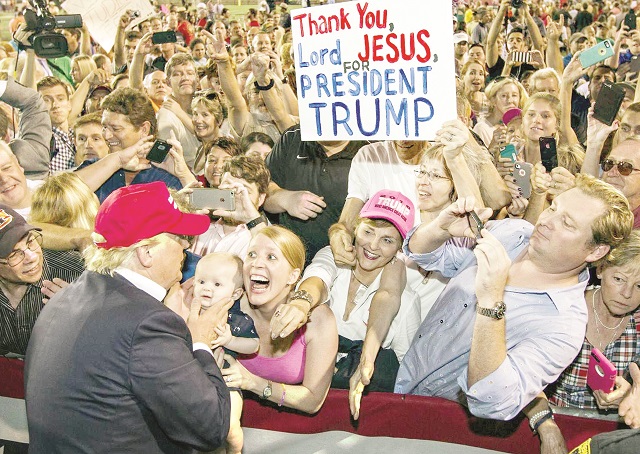

Saul Gwakuba Ndlovu
On November 8, Americans elected their 45th president, Mr Donald Trump, a New York real estate multi-billionaire and political right-winger of the Republican Party.
Some 63 percent of male and 52 percent of female voters supported him against Mrs Hillary Clinton of the Democratic Party and former Secretary of State. Most of Mr Trump’s electoral supporters were working class people many of whom saw salvation in his undertaking to deport illegal immigrants.
Mr Trump’s election campaign war-cry was that he would make “America great again” should he win the presidential election. Among the promises he made to his country were the following:
*His administration would deport all illegal immigrants
*It would erect a wall between the United States and Mexico to stop Mexicans from illegally getting into the United States; while it is finding out what fundamental Islam is all about;
*His administration would suspend the admission of Moslems into the United States while it investigates in detail about Moslemic fundamentalism;
*It would require some of its allies such as Japan and South Korea to shoulder their own defence expenses. The United States has 54 000 armed forces in Japan.
A look at Trump’s pronouncements indicates that to him, the United States is no longer as great as it used to be, hence his statement: “I’ll make America great again!”
Historically, America has been the world’s greatest nation for many years; economically for centuries, militarily for many decades but particularly since August 1945 when it dropped two atomic bombs on Japan, resulting in Tokyo’s surrender to end the Second World War.
The location of the United Nations (UN) in the United States makes that country the virtual capital of the world in that leaders of all of the world’s independent nations go to that country every year to discuss important international issues.
Its prominent role in the North Atlantic Treaty Organisation (Nato) has increased since that western European-based military grouping was founded in 1946.
In the field of global scientific exploration the United States has been in the forefront since the 1950s, but moreso since July 1969 when it landed astronauts on the moon.
Its rival in that field at that time, the Union of the Soviet Socialist Republics (USSR) ceased to exist virtually since August 1991 when the three Baltic republics, Latvia, Lithuania and Estonia, staged an abortive coup against the USSR’s reformist leader, Mikhail Gorbachev.
When in December that year, the Ukraine, Russia and Belarussia declared the USSR dead, the world had one major power, the United States, to look at. However, outer space exploration has now been internationalised as the USA, Russia, China, co-operate in outer space programmes.
Well, these are an outsider’s view as compared to those of a citizen of that federal state, the USA.
Mr Trump will on January 20, 2017 become the United States’ first and most important citizen when he is installed president to replace Barack Obama.
One cannot begrudge him for promising to deport everyone who is living in the United States unlawfully. Every country has immigration laws that have to be respected.
It does not make any sense to say the vast majority of the people of the United States are either immigrants or descendants of immigrants.
Nor does it make an illegal immigrant’s stay in any country legal just because he or she has been in that country for a decade or more.
Long occupation or possession of a stolen property does not minimise the legitimate ownership of that property nor does it legalise the theft.
It is important to point out that the August the United Kingdom referendum showed the majority of that island’s population to be in favour of pulling out of the European Union made that decision precisely because they were opposed to the EU’s immigration policies, and want Britain to take a closed border stance against immigrants.
The UK could not do so as a member of the EU whose immigration laws are based on open border policies.
That brings us to the factors that compel people to desert their respective countries for the USA or other countries in Western Europe.
A focus on African and Islamic countries shows that a common negative factor is political instability. In Asia, that factor is caused by the politico-cultural tension and differences in countries such as Afghanistan, Pakistan, Yemen, Indonesia, Iraq and one or two former USSR Islamic states and Cambodia.
In Africa, the negative factors are mismanagement of national economies, ethnic conflicts (Ethiopia, Burundi, DRC), poor governance, adverse weather conditions (droughts, desertification) and politico-culturally generated insecurity as is the case in Nigeria and also in a couple of Sahelian nations where Boko Haram is currently causing trouble.
We should always bear in mind that Pakistan was separated from India on insistence by Muslims in 1947 when the sub-continent became independent.
Even in their own Islamic state, they find it well-nigh impossible to live with Christians, a cultural minority whose tolerance of other cultural groups is a well-known integral part of their doctrine.
Why some of those Pakistan-Muslims would now wish to live in the United States and elsewhere in Europe where the predominating religion is Christianity is probably one of the things Mr Trump and his US Republican Party colleagues would like to find out.
We should remember that the September 11, 2001 terrorist attack in New York was an unforgettable event, but some Muslims called it a great victory!
It is such deeds that literally turn some people into extremists, into passionate religious fanatics. We should understand the feelings of Mr Trump and his supporters in the light of what has occurred in the United States and also what is occurring in various parts of the world today.
Of course, we all know that in a genuinely democratic political dispensation, voters elect their representatives freely, fairly, without let or hindrance whatsoever. The results reflect a government they want, whether it is liberal or authoritarian it would be their own electoral creation.
In the United States, Mr Trump promises to deport millions of unlawful immigrants, and in that way create jobs and even accommodation for American citizens. Surely the ordinary American, and not those of the elitist or upper class, was bound to support such a party. That is why Mr Trump won.
In most African countries, population growth rates are much higher than those of relevant national economies. That has resulted in high unemployment levels, forcing those with internationally acceptable professional qualifications to emigrate.
It is an unfortunate reflection on most African governments that they do not have population growth controlling policies. Most of those countries deal very closely with China, and publicly praise its economic policies and social programmes, but say nothing whatsoever about that country’s population growth controlling measures.
It is obvious that xenophobic organisations will sprout sooner than later in Europe, North and South America, Australia and New Zealand, Japan and in the Balkan and Aegean nations and the targets of the hatred will be the black Africans.
In effect, the results of the August UK referendum mentioned above, and the recent USA presidential elections were xenophobia expressed through the ballot box.
The election of Mr Trump to the US presidency should serve as a wake-up call to the entire African continent.
African governments should create realistic economic development plans and programmes based on controlled population growth rates.
It does not reflect any semblance of wisdom at all for us to spend 70 percent of our time nostalgically (talking about the past), 20 percent of it discussing our usually socio-economically stagnant present, and only 10 percent talking about the future. That is what one notices in most African countries.
Mr Trump’s electoral victory has ignited a very passionate debate in the Zimbabwean print media, and criticism of that man’s declared policy runs through almost every sentence.
American political leaders are elected by American voters. They represent American economic, social, cultural and political interests, not Zimbabwean.
Saul Gwakuba Ndlovu is a retired, Bulawayo – based journalist. He can be contacted on cell 0734 328 136 or through email. [email protected]


 Online Reporter