Ray Bande
Senior Reporter
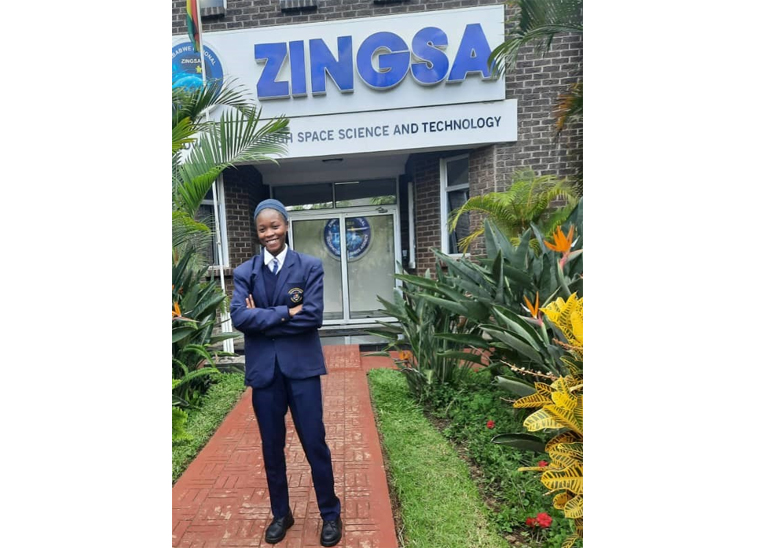
A ST Augustine’s Form Six learner, Shalom Makumbirofa, has earned the honour of representing Zimbabwe in the prestigious Space Kidz India (SKI) aerospace education programme after excelling in the Mission ShakthiSAT Zimbabwe Selection Examination.
Space Kidz India, based in Chennai, is an internationally recognised aerospace education organisation supported by ISRO and IN-SPACe.
Its ambitious initiative aims to train 12 000 girls aged 14 to 18 from 108 countries in designing, building, and launching satellites.
The programme’s objectives include developing student-built satellites — one destined for Low Earth Orbit via ISRO’s Sriharikota launch site, and another as part of a pioneering lunar mission.
Billed as one of the world’s first all-girls international lunar satellite missions, the project embodies the philosophy of “Shakti,” meaning woman power, by bridging the gender gap in STEM and giving girls hands-on satellite engineering experience.
Zimbabwe is among the participating nations, with many girls trained locally before one outstanding learner is selected to represent the country in India.
This year, that distinction belongs to Shalom, whose achievement highlights both her personal excellence and Zimbabwe’s growing presence in global aerospace education.
Space Kidz India has already delivered more than 27 student-led space missions, including AzaadiSAT with 750 rural Indian girls.
The LEO satellite is scheduled for October 11, 2026 from ISRO, with the Moon payload to follow.
Chief Manicaland Provincial Education Director, Mr Richard Gabaza, hailed Shalom’s achievement, and said: “This is something we cherish as a sector, the participation of the girl child in Science subjects. We are biased towards STEM as a country, and the inclusive participation of learners, let alone, the success is something we genuinely celebrate. We urge more girls to take up Science subjects and excel just like what this St Augustine’s High School girl child has done,” said Mr Gabaza.
The school’s Responsible Authority, Bishop Eric Ruwona, said: “Having a St Augustine’s High School learner representing Zimbabwe in STEM competition in India makes us proud as a church. Many associate church-run institutions with mediocrity. With us, we believe in excellence in whatever we do. It is therefore no surprise that the first school to offer secondary education to Native Africans in Zimbabwe has a learner representing Zimbabwe at a Science, Technology, Engineering, and Mathematics competition in India.”
The headmaster, Mr Nobert Kutoka, said: “We proudly celebrate Shalom Makumbirofa for emerging as the top performer in the Mission ShakthiSAT Zimbabwe Selection Examination, earning the prestigious honour of representing Zimbabwe in India. As Shalom embarks on this incredible international journey, the entire St Augustine’s family stands proudly behind her, confident that she will fly the country’s flag high, and inspire many young minds to dream beyond borders. Shalom, your success is our pride, and your journey is just beginning. We are very proud to be associated with the programme run by Mission ShakthiSat in promoting the girl child involvement in Science and Technology as highlighted in the Heritage Based curriculum’s STEM component.
“The achievement by our ever hard working girl Shalom is a milestone in raising the flags of the school, Mutasa District and Manicaland Province at large as she goes on to represent Zimbabwe on the international forum alongside other 108 girls from different countries across the world. Our gratitude also goes towards her mentor, Ms Diana Chowa. Our success in various competitions stems from teamwork and support involving various stakeholders that include MoPse, SDC, the Responsible Authority and the parents. At St Augustine’s High, excellence is our business, and we always thrive to be second to none,” said Mr Kutoka.
Phase One comprises online STEM training: 21 modules and 365 lessons delivered over 120 hours, covering Physics, Mathematics, Electronics, Coding, Systems Engineering, Orbital Mechanics, Payload Development and Satellite Systems.
Phase Two involves hands-on experience in India, where each country’s “Woman Ambassador/Devi” selects one outstanding student.
The 108 girls will travel to India, usually between August and September 2026, for two weeks of payload integration, satellite building, testing and coding.
Tsambe girl rockets to global space stage