Online Reporter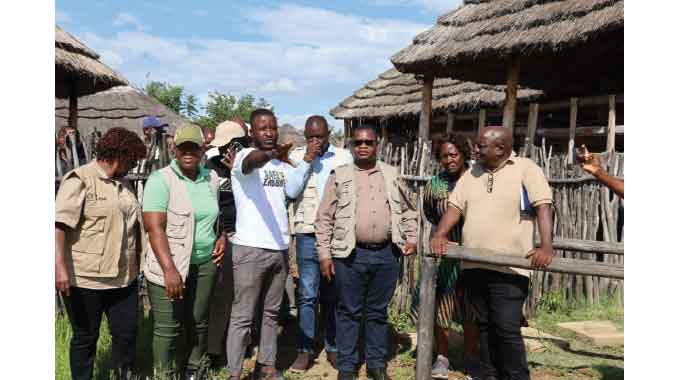
Theseus Shambare recently in MHONDORO-NGEZI
SMOKE rises gently from a clay stove as wooden spoons work their way through thick sadza, dried vegetables and slow-cooked traditional meats.
Outside, chickens and goats roam freely, while fresh vegetables are plucked straight from the soil and tossed into simmering pots.
On this stretch of communal land in Mhondoro-Ngezi District, Mashonaland West Province, KwaTerry is not just serving food — it is serving a new idea of rural enterprise.
For 33-year-old Terrence “Terry” Maphosa, this is where his vision comes alive.
A political science graduate with an eye for opportunity, Terry could have pursued a conventional career in Harare.
Instead, he returned to his rural roots, turning what others saw as disadvantage, distance from towns, lack of infrastructure and limited capital, into his greatest asset.
“I grew up here,” Terry explained, as he led his visitors around the area.
“I know this land, its rhythms, its food, its people. City life taught me to appreciate how authentic rural life really is. I wanted to show that one does not need a city address to make one’s dreams real.”
When he first spoke of opening a restaurant focused solely on Zimbabwean traditional cuisine, he said, many doubted him.
Friends, family and even neighbours questioned why anyone would travel the distance to a rural area just to eat.
Terry, however, saw possibilities where others saw obstacles.
Betting on his passion for food and culture, he abandoned the search for a desk job aligned with his degree and embarked on a culinary journey that is now drawing national attention.
Communal land as capital
Kwa Terry’s enterprise challenges the stereotypical view of rural Zimbabwe.
Where others see subsistence plots and scattered livestock, Terry sees a fully integrated business model.
The land he inherited is now a multi-purpose hub: plots grow vegetables, a small orchard produces seasonal fruits, chickens and goats roam freely and a modest kitchen churns out traditional dishes for locals and visitors alike.
“This is what communal land can do if you use it creatively,” Terry said.
“You do not need large commercial farms to create something sustainable and impactful.”
By turning “what we already have” into tangible value, KwaTerry has created a blueprint for rural enterprise: one where farming, food production and entrepreneurship coexist harmoniously.
Farm-to-table
At KwaTerry, farm-to-table is more than a buzzword but an actual business practice.
Ingredients are grown on-site or sourced from neighbouring smallholder farmers who now have a ready market for their produce.
Livestock is raised locally, while traditional staples like sadza, muriwo, roasted meat and mahewu-based beverages are crafted with minimal imports.
His most popular dish is sadza rezviyo with fish, which he has playfully dubbed “mugwazvangu” — loosely translating to “fighting alone with food.”
Terry also pairs his traditional carbs with wild game, including kudu, impala and other locally sourced meats.
For many older patrons, these dishes evoke nostalgia, prompting stories of the old days when hunting was a way of life and meals were deeply connected to the land.
“When you control your ingredients, you control quality and authenticity. Our customers taste the land in every bite,” said Terry.
This model not only reduces costs but also empowers local suppliers.
Farmers who once struggled to find buyers now supply KwaTerry, confident that their produce will be appreciated and valued.
In essence, Terry’s enterprise has become a hub where local agriculture meets culinary innovation.
Trending with purpose
Remarkably, KwaTerry’s influence extends beyond the communal land.
Despite its rural location, the restaurant has become a consistent feature on Zimbabwean social media, trending not for controversy, but for culture, food and enterprise.
Videos of steaming sadza, elders demonstrating traditional cooking methods and the playful chaos of goats and chickens wandering among diners circulate widely on platforms like Facebook, X and WhatsApp.
Even though some online followers jokingly call him “mukomana weshena”, Terry takes it in stride.
“I do not post to chase trends,” he said.
“I post what we are already doing. The culture speaks for itself. Social media is not about filters or face powders — authenticity sells too, and that is what we keep it real here.”
This approach demonstrates KwaTerry trends for the right reasons, amplifying culture, heritage and rural enterprise rather than drama or gimmicks.
The restaurant has also become a magnet for diverse visitors.
Socialites, local Premier Soccer League teams and families from across the country come to experience authentic rural dining.
Schools now schedule field trips for heritage-based lessons, turning abstract classroom concepts into living experiences of Zimbabwean culture, agriculture and communal living.
“Children must see culture, not just read about it,” Terry said.
Youth, jobs and community impact
KwaTerry’s growth has created opportunities beyond the plate.
Eleven local youths are now employed, learning skills ranging from cooking to farm management, marketing and hospitality.
Employees like Shylene Maphosa and Alick say the experience has transformed their perception of rural life.
“I used to think success only happens in Harare,” Shylene reflected.
“Now I see that you can build a future here and it can be exciting, profitable and meaningful.”
Local suppliers benefit from consistent demand, while school groups and social visitors generate additional income streams for the surrounding community.
Skills transfer is central to Terry’s mission: his team not only executes his vision but is groomed to replicate it elsewhere.
National recognition
KwaTerry’s success has not gone unnoticed.
During a recent visit, Lands, Agriculture, Fisheries, Water and Rural Development Permanent Secretary, Professor Obert Jiri, hailed the enterprise as a model for rural development.
“This is rural enterprise par excellence,” said Prof Jiri in an interview.
“Terry’s model shows our youths that they do not need vast commercial farms to realise their dreams.
“They can transform communal land into viable business entities that benefit themselves, their communities, and the nation.”
Prof Jiri highlighted how the restaurant aligns with Vision 2030, promoting agro-tourism, traditional foods, nutrition and youth empowerment.
“This is the agro-tourism spearheaded by our First Lady Dr Auxillia Mnangagwa. KwaTerry exemplifies how local initiatives can advance national development goals while retaining cultural authenticity,” he said.
KwaTerry’s enterprise is quietly subverting Zimbabwe’s historical economic patterns. Traditionally, raw commodities were exported, only for processed goods to be imported — a cycle that stifled local value addition.
Terry’s model flips this script: produce, process and consume locally.
“We grow, we cook, we serve, all on communal land.
“This is how communities reclaim economic agency,” he said.
Subtle but powerful, this shift demonstrates that rural Zimbabwe can be a site of innovation and self-sufficiency.
Of course, the journey is not without hurdles.
Capital constraints limit expansion, infrastructure gaps make transport and storage difficult and scaling operations while maintaining quality remains a constant challenge.
Yet, these obstacles have not deterred Terry. They have merely sharpened his focus on sustainable, incremental growth. “We take one step at a time. Each challenge is an opportunity to improve,” he said.
Agro-tourism huts
In a bold move to enhance visitor experience, Terry has constructed traditional huts around the restaurant that double as overnight lodges.
Guests can now spend a night away from city pressures, surrounded by nature, heritage and farm life.
The huts reinforce KwaTerry as an agro-tourism destination, offering a full-circle cultural immersion that combines food, farming and lifestyle.
KwaTerry stands as more than a restaurant.
It is a vision made tangible.
It embodies youth leadership, digital engagement for good, community empowerment and rural enterprise innovation. “If one young entrepreneur can turn communal land into a culinary landmark, imagine what hundreds could do,” Terry mused.
Indeed, KwaTerry is not just serving meals; it is serving an idea: that Zimbabwe’s rural spaces, often dismissed or overlooked, can be sites of creativity, wealth creation and cultural preservation. In Mhondoro-Ngezi, that idea is already taking root.