Online Reporter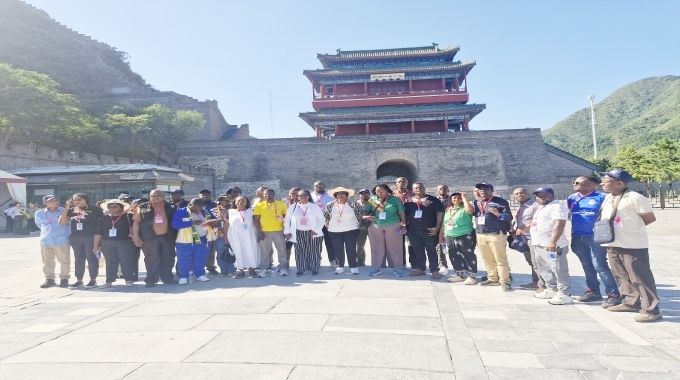
Vusumuzi Dube in Beijing, China
THERE is something striking about standing on the Great Wall of China and thinking about Great Zimbabwe.
Thousands of kilometres and centuries separate the two monuments. One stretches across mountains and valleys in northern China, while the other rises from the granite landscape of south-eastern Zimbabwe.
One was built primarily as a vast defensive system, while the other emerged as a powerful stone-built city and centre of political, economic and spiritual life.
Both are monumental statements of what human beings can build with stone, earth, skill, organisation and a shared sense of purpose.
Perhaps most importantly for two countries that have increasingly deepened their relations, both monuments remain much more than archaeological structures.
They are living symbols of national identity, history and pride.
That connection became particularly apparent when Zimbabwean senior Government officials visiting China for the Ministerial Seminar for Senior Public Management Officials of Zimbabwe took a tour of the Great Wall.
The seminar, organised by the Academy for International Business Officials (AIBO), an educational and training institution directly under China’s Ministry of Commerce, has brought the Zimbabwean officials into contact with China’s development experience, governance systems and institutions.
But on the Great Wall, the lessons were not confined to classrooms or formal presentations.
They were written into the stones beneath the visitors’ feet.
The Great Wall of China is not, strictly speaking, one continuous wall built at one time.
It is a vast network of fortifications constructed, rebuilt and extended by successive Chinese states and dynasties over many centuries.
The earliest sections date back to ancient periods, while around 220 BC, under Qin Shi Huang, earlier defensive walls were linked into a more unified system. Construction and rebuilding continued through subsequent dynasties, with the Ming dynasty (1368–1644) responsible for much of the masonry that visitors see today.
UNESCO describes the entire Great Wall system as extending for more than 12 000 kilometres and incorporating walls, watchtowers, shelters, fortresses and passes.
Its architecture follows the landscape and the wall climbs steep ridges, bends around mountains and crosses difficult terrain. Watchtowers provided observation points, while fortresses and passes strengthened the defensive network.
Great Zimbabwe tells a different architectural story.
There is no sprawling defensive frontier stretching for thousands of kilometres. Instead, there is a concentrated monumental settlement built from granite blocks without mortar.
Great Zimbabwe was constructed between about 1100 and 1450 AD, growing into a major centre of civilisation.
At its height, the settlement was an important political and trading centre, with its population exceeding 10 000 people in the 14th century.
Its most famous structure, the Great Enclosure, is a sweeping elliptical stone construction containing living areas, a community space and a narrow passage leading towards a tall conical tower.
The precision of its dry-stone masonry is one of the monument’s defining features.
The stones were carefully laid in regular courses, producing walls that remain among the most impressive achievements of precolonial African architecture.
The word Zimbabwe itself comes from the Shona word dzimbabwe, commonly translated as “houses of stone”, an appropriate description for a civilisation whose monumental architecture continues to define the country’s identity.
The Great Wall was shaped by the need for defence. Great Zimbabwe was shaped by the development of a powerful society.
The Great Wall represents generations of labour, engineering and strategic thinking. Great Zimbabwe represents generations of skilled stone masonry, settlement planning, political organisation and craftsmanship.
In both cases, the landscape became part of the architecture.
At Great Zimbabwe, granite hills and natural rock formations were incorporated into the settlement. On the Great Wall, mountains became foundations and pathways for an immense defensive structure.
The result is architecture that cannot be separated from geography. The stones tell a story, but so does the land around them.
The Great Wall has become one of the China’s most recognisable symbols. UNESCO describes it as having exceptional symbolic significance in Chinese history and as a national symbol associated with safeguarding the security of the country and its people.
Great Zimbabwe occupies a similarly powerful place in the national imagination.
The Zimbabwe Bird, carved from soapstone and associated with the ruins, has become one of the country’s most recognisable national symbols. The site itself stands as testimony to the achievements of the Mutapa civilisation and to the sophistication of African societies that flourished centuries ago. Archaeological discoveries, including imported beads, porcelain and coins, also demonstrate that Great Zimbabwe participated in long-distance trade networks linking it to the wider world.
In both countries, the monuments have become more than remnants of the past. They have become ways of explaining the present.
Perhaps the most memorable similarity for the Zimbabwean delegation was not architectural at all.
As the officials walked along the Great Wall, they encountered ordinary Chinese visitors enjoying the same heritage site.
There were smiles. There were greetings. There were photographs and despite the language barrier, the message was unmistakable.
“Welcome to the Great Wall, enjoy!”
Some locals appeared particularly eager to interact with the visitors, with smiles and gestures bridging the gap between languages.
Others encouraged the Zimbabweans as they tackled the gruelling climb towards the higher sections of the Wall, offering gestures of support as if encouraging fellow travellers on the same journey.
Then came the selfies. Visitors and locals posed together, capturing unexpected encounters between strangers from different parts of the world. Some Chinese tourists were eager to take photographs with the Zimbabwean officials and share the moments with them.
Visitors to Great Zimbabwe similarly encounter a monument that has become a focal point for tourism, history, education and cultural identity.
The Great Zimbabwe ruins are still used by contemporary communities for spiritual purposes, underlining the fact that heritage can remain connected to living traditions rather than existing only as something preserved behind glass.
That is where the comparison between the two monuments becomes especially interesting.
The Great Wall attracts visitors who walk, climb, photograph and marvel at its scale.
Great Zimbabwe attracts visitors who walk among its granite walls, study its architecture, contemplate its history and encounter a monument deeply connected to Zimbabwean identity.
In both places, the ancient structure becomes a platform for modern human connection.
Reflecting on the experience after the tour, Deputy Minister of Public Service, Labour and Social Welfare Mercy Dinha who is leading the Zimbabwean delegation noted the similarities between the two monuments.
“The significance of the Great Wall could therefore be appreciated not simply as a Chinese experience but also through the Zimbabwean experience of Great Zimbabwe where it is also a tourist attraction back home,” she said.
Both monuments demonstrate how countries can preserve the physical evidence of their past while transforming those places into attractions that introduce the world to their cultures.
A Chinese visitor taking a selfie with a Zimbabwean tourist on the Great Wall may appear, at first glance, to have little connection with a photograph taken at Great Zimbabwe.
But beneath the smiles is the same instinct to preserve a moment, share an experience and connect the present with a place that has survived the passage of time.
That may ultimately be the most beautiful similarity between Great Zimbabwe and the Great Wall of China.
They were built in different centuries, by different peoples, for different purposes and across vastly different landscapes, but today they serve a common human purpose.