Vusumuzi Dube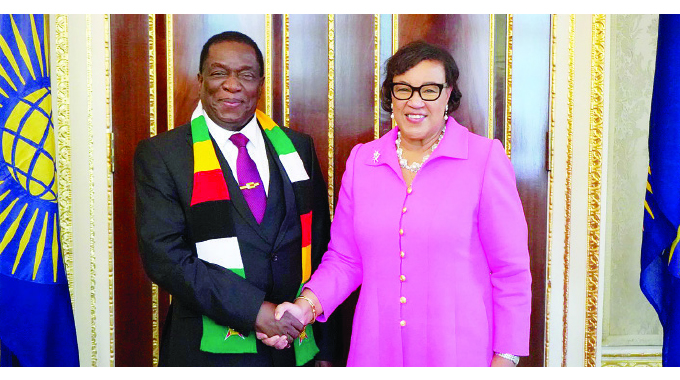
Prosperity Mzila
The United Kingdom’s invitation for President Emmerson Mnangagwa to attend the coronation of King Charles III recently became a first after an impasse of 23 years since the imposition of the illegal sanctions on Zimbabwe.
This drew mixed reactions from the citizens as some felt this was a step in the right direction, while those who stood to lose from the thawing relations between the two countries tuned into hypercritical mode, just to discredit and cast aspersions of doubt at the light that is finally glowing at the end of what was a very dark and long tunnel.
A journey of a thousand miles starts by taking the first step, for both Zimbabwe and the UK.
The coronation presented an opportunity for them to take their first steps and they did, the UK invited and Zimbabwe attended.
The coronation presented a bridge to mend the broken bilateral relations between the two countries.
It is therefore correct to say the gesture to invite and to attend supersedes the seating arrangements and the activities on the sidelines.
The ice has finally been broken paving way for warm bilateral dialogue. Both countries have a lot to gain as such, they both have a responsibility to nurture the efforts invested by taking the first step.
The noise on the social media streets about the seating arrangements at the Westminster Abbey Cathedral, during the coronation, exposes the shallowness of mind for those who chose to ignore the meaning behind the invitation and acceptance.
For the majority of us who are aware of the significance of reciprocity of the two nations in this regard, we applaud President Mnangagwa’s focus and pursuit of the country’s foreign policy on engagement and re-engagement as it has led to the thawing of relations between Zimbabwe and the West.
It boggles the mind how one can prefer to highlight an insignificant seating arrangement where history is being made.
The thawing of relations between Zimbabwe and the UK is a phenomenal occurrence that will be inked in the books of history.
As for the seating arrangement of the day, I doubt even Prince Harry who sat at the lower third row of the Westminster Abby would care to remember.

As the global geopolitical landscape shifts, new alliances are being forged and strengthened, it is then up to individual states to work towards mending relations for their benefit.
During the Second World War, Switzerland remained neutral, no war was fought on its soils and no destruction was met on its infrastructure.
This can be achieved by identifying and cultivating that advantage through forming synergies with other nations.
President Mnangagwa has emphasised that Zimbabwe is a friend to all and an enemy to none, this means whoever is willing to work with Zimbabwe at equal footing is welcome, because Zimbabwe is open for business.
On the sidelines of his visit, President Mnangagwa managed to meet prominent people within the British Government such as the UK Minister of State in Foreign, Commonwealth and Development Office (FCDO), Andrew Mitchel and the Commonwealth Secretary-General, Mrs Patricia Scotland, where he had the opportunity to discuss diplomatic relations between Zimbabwe and the UK as well as trade and investment opportunities between the two countries.
The re-joining of the Commonwealth club and the full restoration of relations was discussed.
It has to be known that Zimbabwe, in its quest to become an Upper Middle-Income Economy by 2030, would need to reach out to every nation, the UK included.
The President’s visit to the UK was therefore an important step towards the socio-economic development of the country as Zimbabwe continues on its engagement and re-engagement agenda.
The visit also dovetails with the country’s foreign policy of being a friend to all and an enemy to none.
It should be acknowledged that there is a lot of history between Zimbabwe and Britain, estranged in many instances.

Therefore, President Mnangagwa’s invitation to King Charles III coronation marks a new chapter. It is an endorsement of the engagement and re-engagement policy.
It is an indication that Britain is willing to see relations improving. It is evident that the UK is responding to changing political circumstances within their own country.
After all, King Charles III was in Zimbabwe as the Prince of Wales in 1980 when the country’s flag was being hoisted and the Union Jack lowered, ending years of British colonial rule.
Likewise, it was, therefore, necessary for Zimbabwe to reciprocate the gesture by attending the King’s coronation.
Furthermore, it is good for Zimbabwe to re-join the Commonwealth club as it enables the country to be part of a mutually supportive community, which will help Zimbabwe’s trade activities as it stands to gain 54 countries as trade partners who have a potential to boost the country’s economy by opening up new markets for “Buy-Zimbabwe” products.
This supersedes the seating arrangement at Westminster Abbey. President Mnangagwa has a duty to advertise the opportunities in Zimbabwe such as the beautiful flora, fauna and minerals to investors and global markets; the Commonwealth presents that lucrative platform among other economic blocks.
It is therefore evident that the noise about the President’s seating arrangement came from those who stand to benefit from the isolation of Zimbabwe.
That period is gone; President Mnangagwa is focused on ensuring that Zimbabwe becomes part of the continental and international community and that it stands to benefit from those synergies just like any other country whose economies are blossoming due to mutually beneficial arrangements with other nations.
The world is shifting towards green fuel and Zimbabwe is home to Africa’s largest lithium reserves, the fifth largest in the world which should be open to every investor across the globe.
This can only be made possible if the President, who is our flag carrier, continues to re-engage the country’s estranged partners.
This will go a long way towards the development of the country as well as putting it back on the global map as the country continues to push for an Upper Middle-Income Economy by 2030.



 Online Reporter