Online Reporter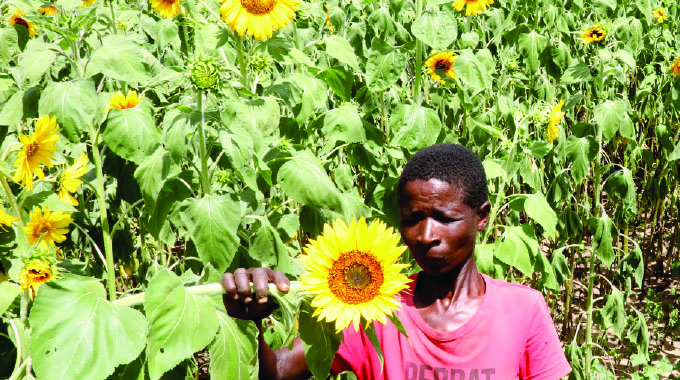
Raymond Jaravaza, [email protected]
FARMERS in the Dundubala area of Umguza District, Matabeleland North Province, have embarked on a successful sunflower project to increase their financial earnings from the cash crop and contribute to cooking oil import substitution.
Sunflower production was not popular in the past but has been gaining momentum as local farmers venture more into cash crop production while reducing dependence on maize farming.
Last year, the Minister of Lands, Agriculture, Water, Fisheries and Rural Development, Dr Anxious Masuka, decried the country’s reliance on crude oil imports and stated that the Government had engaged the Agricultural and Rural Development Authority (Arda) to drive sunflower production, working closely with farmers.
Agronomists say the Matabeleland North region has suitable soils and climate for successful sunflower production.
“The crop is also drought-tolerant, and recent market indications show that its pricing is attractive compared to other cash crops,” said Mrs Zenzele Ndlovu, an agronomist for the province.
Mrs Siphengani Ndebele, a local farmer in the Dundubala area of Umguza District, said she planted two hectares of sunflower, which is thriving, thanks to the good rains the area has been receiving since the beginning of the year.
This season marks the third time that the mother-of-four has tried her hand at growing sunflower, and she is optimistic about achieving a good harvest this time.
“This is the third season that I’m trying my hand at sunflower production, but last year was very bad as we received very little rainfall,” said Mrs Ndebele.
“The Ardas (Agricultural and Rural Development Advisory Services) officer told me not to give up this year and said the country was expected to receive more rain, so I planted two hectares. The crop is doing well, and I expect to get a good harvest,” she added.
Sunflower yields in Zimbabwe can range from 1,5 to 3,5 tonnes per hectare, depending on the variety and farming practices.
“In the first season when I started growing sunflower, I harvested just over a tonne from one hectare. The money that I received from GMB (Grain Marketing Board) was good, and this year I’m expecting to harvest more and earn more money,” she said.
Last year, GMB was buying sunflower at US$696 per tonne, with US$418 paid in foreign currency and US$278 in local currency.
“After harvesting, I will deliver the best grade to GMB and keep some of the sunflower as stock feed for chickens.
One of my neighbours owns a sunflower pressing machine, so I will keep a small portion for cooking oil,” said Mrs Ndebele.
She said there were about six farmers in her village who had planted sunflower, and their crops were doing well.
At Redwood village in Umguza, another farmer, Mrs Marjorie Mlilo, has also joined the sunflower production drive. She has also planted two hectares.
“In the past, I used to grow sunflower for stock feed and cooking oil only, but I realised that the crop is more profitable than maize. This year, I planted two hectares, and I hope to get at least three tonnes. The money I will get from GMB will go a long way in paying school fees for my four children,” said Mrs Mlilo.
Sunflower production is one of the focus areas under the Presidential Input Scheme Programme, which has seen the Government providing sunflower inputs to support farmers.
These interventions are expected to reduce imports of crude (cooking) oil, as the country has been importing between 55 000 and 65 000 tonnes annually at a cost of millions of dollars.
Last year, over 23 000 hectares were put under sunflower production, compared to over 20 000 hectares in 2023, as the Government sought to ensure local production of the crop to minimise the importation of sunflower products such as cooking oil.
However, the hectarage planted last year was still far from the set national target of 160 000 hectares.
The prioritisation of local sunflower production comes against the backdrop of the country spending approximately US$300 million on sunflower cooking oil imports.
Meanwhile, prospects for a good harvest are bright in southern Africa following the above-average rainfall received this season, according to the Food and Agriculture Organisation (FAO).
Significant rainfall improvements since January have boosted cropping prospects in parts of Namibia, Zimbabwe, Zambia, Malawi and Mozambique.
“Looking ahead to 2025, favourable rainfall in southern Africa is expected to support a rebound in crop yields following significant declines in 2024,” said the FAO.