Online Reporter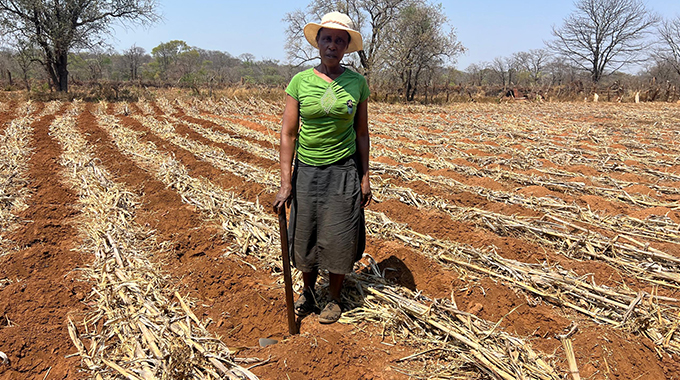
Sukulwenkosi Dube-Matutu, [email protected]
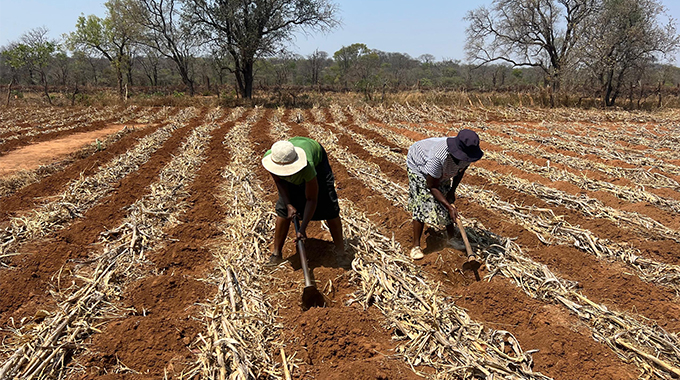
A farmer from Irisvale in Umzingwane District, Matabeleland South Province, Ms Patricia Ncube, has embraced the climate-proofed Pfumvudza/Intwasa programme and prepared five plots, which she plans to cultivate with traditional grains this farming season.
Ms Ncube began preparing her plots in April, taking advantage of the moist soil conditions. She said adopting the Pfumvudza/Intwasa principles and other conservation farming techniques has helped her achieve consistently good harvests over the years.
Through her farming efforts, she has managed to acquire goats and chickens, sustaining her family with income earned from crop production.
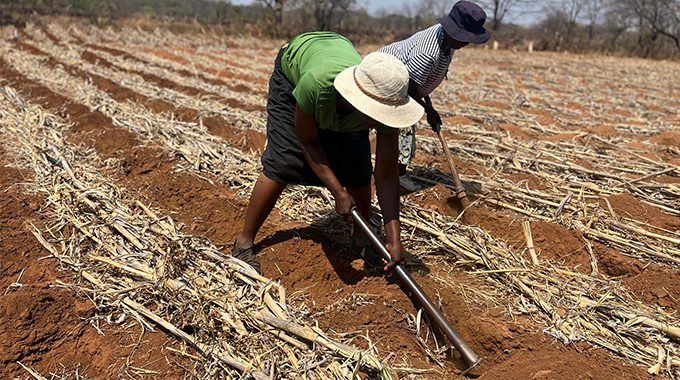
Pfumvudza/Intwasa is a holistic conservation agriculture model that promotes precision farming and efficient land use. It moves away from conventional rain-fed, large-scale ploughing to a more focused and climate-resilient approach, and has been credited with helping Zimbabwe avert food shortages in recent years.
“I have managed to prepare five plots under the Pfumvudza/Intwasa programme, and once we receive rains, I will begin planting. My area is dry, so I started digging my holes in April, taking advantage of the moisture. Although I hadn’t finished harvesting, I dug my basins in between the previous crop. This helped me significantly because right now the soil is too hard to dig,” said Ms Ncube.
Ms Ncube added that she did not remove stover from her last cropping season.
“I simply crushed it so I could use it as mulch for this season. Farming the Pfumvudza way has really worked for me.
I’ve been practising it for the past seven years, feeding my family and acquiring assets,” she said.
She also applied the ripping method on a section of her field, which helps retain water in the soil. Ms Ncube plans to plant groundnuts and small grains, with the groundnuts serving as live mulch for the small grains.
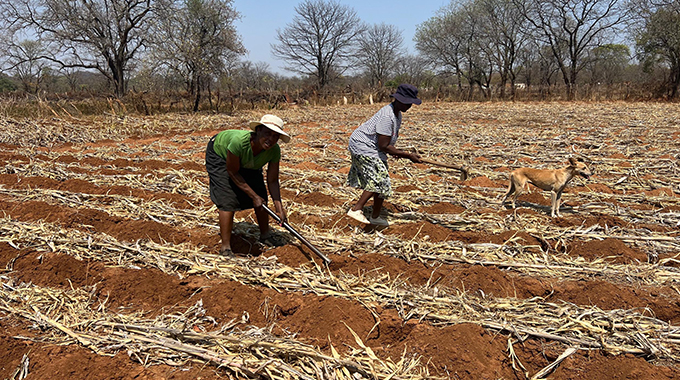
“Other crops that can be used as live mulch include pumpkins, melons, groundnuts and African peas,” she said.
Agricultural and Rural Development Advisory Services’ Provincial Director for Matabeleland South, Mrs Shupikai Sibanda, said over 200 000 Pfumvudza plots have been prepared in the province out of a target of 500 000.
She said agricultural business advisers were working closely with farmers to accelerate land preparation, encouraging each farmer to prepare five plots — two for cereals, one for oilseeds and two for fodder.
“As a province, we are targeting about 500 000 Pfumvudza plots and right now we are at around 200 000, which is equivalent to just over 12 000 hectares. We are urging our farmers to get ready because it is predicted that the rains will come shortly. If farmers are prepared in time, this will benefit them. This year’s farming season is expected to be better in terms of rainfall, and farmers should take full advantage of this opportunity,” said Mrs Sibanda.
Mrs Sibanda said the province still faces a challenge regarding mulch, but urged farmers to make use of crop residues from the previous season.
“Farmers are encouraged to start land preparation early in future seasons. The province continues to record more farmers taking up Pfumvudza, which is essential in ensuring food security,” she said.
Meanwhile, farmers across the country have intensified preparations for the summer cropping season, supported by the Government amid predictions of normal to above-normal rainfall.
The Government is set to distribute key agricultural inputs under the Presidential Input Support Programme, which anchors the Pfumvudza/Intwasa model and is expected to benefit three million households nationwide.
Farmers have so far prepared over five million plots, representing 50 percent of the national target for the season. Last year, 11.9 million plots were prepared, and authorities are targeting 15 million plots this season if current momentum continues.
The Government aims to achieve cereal production of over 3.2 million tonnes from 2.5 million hectares — a major step towards national food and nutrition security, while enabling farmers to produce surpluses for household and local market consumption.
Under the Pfumvudza/Intwasa model, land preparation involves marking and clearing small plots measuring 39 metres by 16 metres, digging planting holes or basins, applying manure or fertiliser, and covering the soil with mulch to conserve moisture. — @DubeMatutu