Chronicle Editor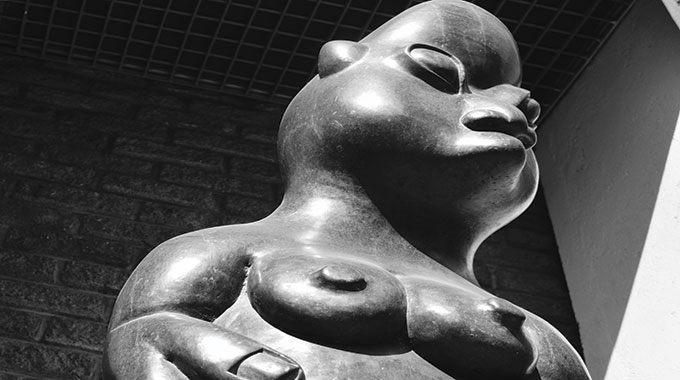
Tafadzwa Gwetai
PEOPLE have been creating from as far as history can be traced.
The distinguishing aspect of why and how help us understand clearer the purpose of creation.
The why is the reason for the creation of the object and for whom the creation was made.
The how is the technical aspect that went in the making of the object. Objects can be created with the specific objective of function and intended end user of the object in mind.
The aesthetic element is thus brought into question and this is when the whole contribution towards the creative process becomes one.
Art, as we love to call it, is a very crucial and powerful means of communicating thoughts but is a field that engages engineering, knowledge of chemicals and a firm understanding of the context in which they are being created.
Art has often been given an aesthetic quality and contribution to industry merely as a glossing over engineered work as a final touch.
The aim is to re affirm the position of the artiste as a creator and intellectual inventor of societal industry and change.
African art has always had the sole intention of being functional.
The extent of functionality depends on the use as a practical tool and as well as a tool that acts as a diviner between the spirit world and the physical world.
This brings us back to the idea of the why and how.
I believe the creation process of art should be justified as that of the design processes of making mechanical or industrial equipment.
The similarity is in the end user for whom the creation was made. In mechanical engineering terms, there are terms such as “form follow function”.
This serves as a guide to the intended output.
The form of the object that is being designed must be in sync with the purpose of the creation. Analysed from an engineering perspective, the objective is to create a user friendly functional and aesthetic object that serves the needs of man.
The artist is equally challenged with the design elements and the functional considerations when creating their forms of art.
All forms of art do possess this quality where the objective and target audience/ market or end user are taken into serious consideration.
In the context of art there is an extra line of thought that engages the spiritual element and the realm of personal feelings and that of individuals’ taste and uniqueness.
Unlike in an industrial setting where production is in mass fine art possesses the quality of authentic feeling and spiritual references and humanistic elements.
Artists have always tried to maintain a firm distinction that classifies them in the “fine arts” category.
The three classical branches of fine art are painting, sculpture and architecture. “Fine art” is considered to be an art form that exists within itself, the visual object with no functional purpose except to be admired and viewed upon as an aesthetic object.
The visual arts in its broads sense are art forms such as painting, drawing, printmaking, sculpture, ceramics, photography, video, film making, design, crafts, and architecture. Many artistic disciplines (performing arts, conceptual art, textile arts) involve aspects of the visual arts as well as arts of other types.
Creations that are designed to be seen.
Fine art is art developed primarily for aesthetics or beauty, distinguishing it from decorative art and “craft art”, which also has to serve some practical function. Fine art was viewed as the highest form of “art” because it factored in feelings, emotions and allowed the full expression and display of the artist’s imagination.
In the African context, traditionally art was created with a functional purpose.
Both as a utilitarian object that could be used regularly in the home or during ceremonies and as a symbol of spiritual presence or ancestral recognition.
Art in Zimbabwe and throughout Africa lost most of its spiritual agenda as a direct result of its encounter with colonialism, diverse new cultures exploring the African continent and Christianity in the 19th and 20th centuries.
Missionaries harmed the local cultures by demanding destruction of anything they regarded as anti-Christian, in particular masks, stone or wood carvings thought to have divining, godlike, spiritual powers.
The ironic aspect is that these are the same people who desire the same objects for that exact same potential “power” within them.
Art from Africa is still a great source of inspiration and is sought after by international galleries and collectors to study our beliefs and state of mind.
Shona sculpture in essence has been a fusion of African folk narratives with European influences.
World renowned Zimbabwean sculptors include Nicholas, Nesbert and Anderson Mukomberanwa, Tapfuma Gutsa, Henry Munyaradzi, Chimbumu Shake, Kafara Martin Bernard Matemera and Locardia Ndandarika.
I decided to focus on stone as an example of how the journey of the Zimbabwean and African identity has been gradually fading away.
Stone is who we are and that is what the essence of Zimbabwe is based upon.
Our history and pride was once boldly told through stone. The story was told with purpose until what they believed in was taken from them.
Artists from this generation have a great opportunity to reclaim what was almost lost entirely and refocus their gaze to Africa.
Enough of our knowledge, thoughts, feelings, ideas, escape our continent before people at home get to learn the story that is being told by our artists.
Our artists from Zimbabwe have found their voices on the canvases they paint on, their colours have been understood by our local academia and local people appreciation in general.
We have seen an increase in local awareness of what stories our artists are telling.
Artists such as Admire Kamudzengere, Portia Zvavahera, Virginia Chihota, Gareth Nyandoro, Charles Bhebe, Misheck Masamvu, Georgina Maxim, Neville Starling, and Masimba Hwati have taken it upon themselves to narrate our contemporary existence, giving us as Zimbabweans a chance to reflect on who we are and who we could be.
A chance to revisit and reclaim an African strength and purpose before we are all lost.
These artists’ creations interrogate our existence and re-engage the functional quality that African art stands for while at the same time the creations are artistic poetry with shape, form and colour.
The spoken word is another genre that has the same qualities as fine art and has been behind the scenes of every traditional ceremony and serves its functional contribution to the entire ceremony.
The poet with their spoken words gives more life and verbal relevance to the entire experience.
Image courtesy of House of Menka Artist — Bernard Matemera. Remember, ‘‘Legalise Art’’, promote, permit, admit, validate, legitimise. [email protected]/mailto:[email protected]



 Online Reporter