Gay Mufambi
IN the contemporary geopolitical landscape, the true mettle of a political movement is tested not by the absence of internal debate, but by its capacity to channel diverse viewpoints into a singular, unyielding force for national development.
For ZANU PF, this internal dynamic has frequently been misconstrued by external detractors who mistake robust democratic engagement for factional division. The reality, however, remains clear: ZANU PF’s unity of purpose overrides any temporary disagreements.
This ideological cohesion is not an overnight phenomenon; it is an enduring institutional characteristic forged in the crucible of the liberation struggle and continuously refined through decades of governance. The recently concluded 23rd National People’s Conference held in Chinhoyi stands as a modern testament to this political maturity, demonstrating that while individual perspectives are welcomed, the collective revolutionary trajectory remains unshakeable.
The Crucible of Liberation: Unity Forged in Struggle
To fully comprehend the depth of ZANU PF’s contemporary unity, one must look back at the historical framework of the Second Chimurenga. The armed liberation struggle was never a monolithic, friction-free endeavour. ZANU itself was born of disagreement: in August 1963, differences over how the struggle should be waged, and over the leadership’s earlier posture towards the 1961 Constitution, split ZAPU and gave rise to the Zimbabwe African National Union under the rallying cry, “We are our own liberators.” Following the banning of the nationalist parties and Ian Smith’s Unilateral Declaration of Independence in November 1965, the struggle was prosecuted from external bases in Zambia, Tanzania and, later, Mozambique, where different military strategies and political philosophies regularly clashed.
Internal friction was most visible during moments of immense pressure. The détente exercise of 1974, engineered by Pretoria and Lusaka, sought to herd the nationalists into a settlement with Smith, and Ndabaningi Sithole’s willingness to renounce the armed struggle cost him the confidence of his comrades. Even then, the movement respected procedure: Cde Robert Mugabe counselled the detained executive not to depose the party President in prison without consulting the wider membership. The assassination of National Chairman Herbert Chitepo in Lusaka on 18 March 1975, the subsequent jailing of the ZANU leadership in Zambia and the Mgagao Declaration of 1975 all tested the movement severely. Out of that turbulence emerged a realigned leadership, with Cde Mugabe, who had crossed into Mozambique with Edgar Tekere and Chief Rekayi Tangwena in April 1975, firmly established at the helm by the end of 1976. Furthermore, the operational dynamics between ZANLA and ZIPRA forces highlighted distinct organisational cultures and tactical approaches to dismantling the racist, minority Ian Smith regime.
Despite these complex internal contestations, a profound political maturity consistently prevailed. The liberation cadres understood that a fragmented front would only prolong colonial subjugation. Early attempts at military unity, such as the Zimbabwe People’s Army (ZIPA) formed in November 1975 under a joint ZANLA–ZIPRA command, faltered, yet the lesson was never abandoned. On 9 October 1976, encouraged by the Frontline States and President Julius Nyerere in particular, ZANU and ZAPU sealed the Patriotic Front alliance, marrying distinct revolutionary currents into a unified political and negotiating force.
When the liberation movements arrived at the Lancaster House Conference, which opened on September 10, 1979 under the chairmanship of Lord Carrington, they did so not as fractured splinters, but as a consolidated front. Across 47 plenary sessions, contentions over land compensation, the reservation of 20 of the 100 House of Assembly seats for the white minority, and the ceasefire and transitional mechanisms were debated with intensity. The Patriotic Front accepted the land compensation clause only after vague assurances of a future multinational fund, yet the overarching objective of total independence and majority rule reigned supreme. The agreement was signed on December 21, 1979 and elections followed on February 27–29, 1980. This capacity to sublimate individual or factional preferences for the greater national interest delivered Zimbabwe’s independence on April 18, 1980.
The same spirit outlived the war. Conscious that united we stand and divided we fall, the nationalists buried their differences and signed the Unity Accord in 1987. The liberation era thus established a lasting precedent: internal debate strengthens the democratic fabric of the movement, but the final output is always an unbreakable collective front.
Chinhoyi 2026: A Showcase of Modern Internal Democracy
Decades after the attainment of independence, this liberation-era ethos continues to guide ZANU PF’s operations. The recently concluded 23rd National People’s Conference, hosted at the Chinhoyi University of Technology in Mashonaland West Province, provided a perfect modern parallel to the historical struggles of the past. Operating under the theme, “From Resolutions to Results: Consolidating Economic Development and Deepening Empowerment Towards Vision 2030,” the conference brought together thousands of delegates from the cell level up to the Central Committee and Politburo.
The Chinhoyi conference was not an exercise in passive conformity. True to its identity as a mass revolutionary party, ZANU PF created an environment where structural wings including the Main Wing, the Women’s League, the Youth League, and the Veterans of the Liberation Struggle League could voice their specific perspectives. Delegates engaged in candid, rigorous deliberations concerning economic policies, currency stabilisation, agricultural productivity, infrastructural development, and the party’s constitutional roadmap.
Every province presented its unique challenges and aspirations. Debates on how to accelerate the realisation of an empowered upper-middle-income society by 2030 were intense, with different structures offering varying modalities for policy execution. This free expression of ideas is exactly what defines true internal democracy. Rather than top-down commandism, the conference allowed the grassroots to shape the party’s forward-looking agenda. However, in line with established revolutionary tradition, once these diverse perspectives were thoroughly debated and synthesised, they culminated in a single, unified set of resolutions. Every delegate, regardless of their initial stance, left Chinhoyi bound to a common path, proving that the party’s internal systems possess the structural resilience to absorb divergent views and produce a unified national vision.
The Presidential Perspective: Divergence as a Catalyst for Growth
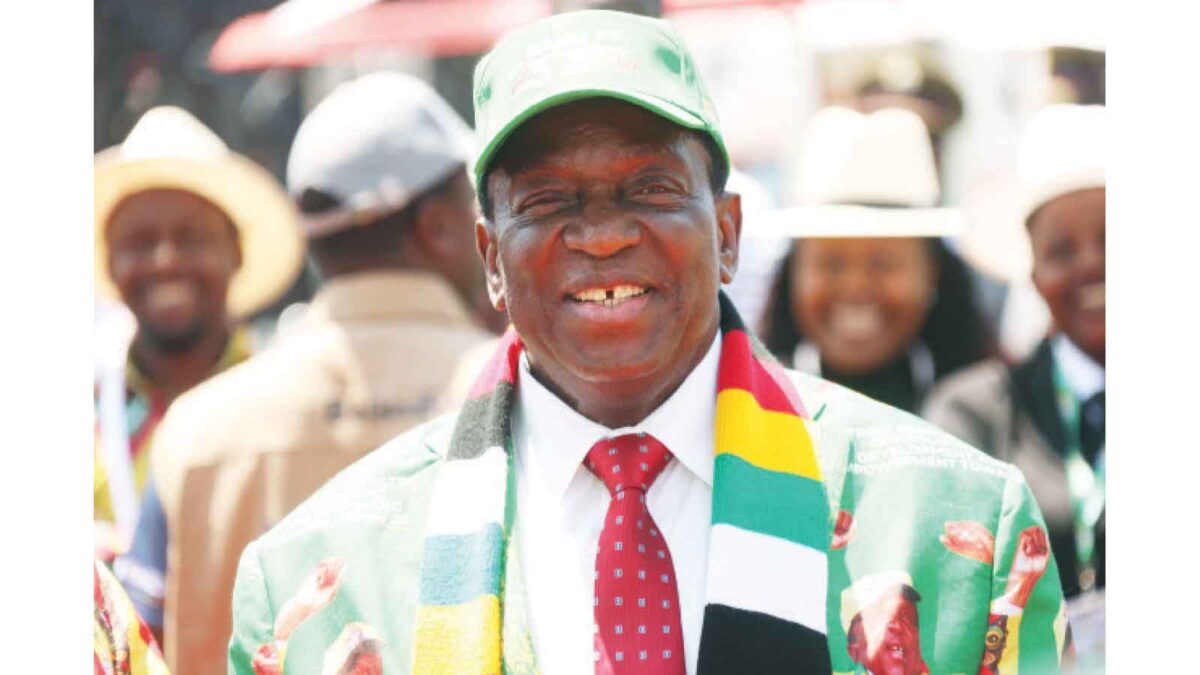
The definitive validation of this democratic maturity came directly from the party’s leadership. Speaking to ZBC Chief Correspondent Reuben Barwe immediately after concluding the business of the Conference the President and First Secretary, Cde Mnangagwa, explicitly addressed the value of internal debate within the revolutionary movement.
Reflecting on the successful conduct of the conference, President Mnangagwa emphasised the supreme nature of the party over the apparatus of state governance, observing:
“The party is supreme. Only the party can form a government; I’m not aware of Governments forming parties. So this is correct, the party is supreme, the party leads…”
He defended differing opinions as a sign of organisational health rather than instability, noting that a party in which everyone agrees on everything would point to deeper underlying problems. Summarising his satisfaction with the conference, he affirmed:
“As we leave Chinhoyi, I am satisfied that everything went according to expectations… You should have a situation where there are divergent views, but at the end of the day, you agree on a common trajectory.”
This constructive friction ensures that policies are thoroughly vetted before implementation and that party structures are aligned behind governance outcomes. It is, in essence, the Lancaster House and Unity Accord tradition at work: debate as vigorous as ever, but a single trajectory once decisions are made.
As the party moves from resolutions to results, the ultimate goal remains the realisation of Vision 2030 through collective national effort. On that score, ZANU PF’s unity of purpose remains what it has been since the liberation struggle: its unshakable foundation.
Gay Mufambi is a Development Practitioner and Academic Researcher who writes on governance, constitutional law and African development. He can be contacted on +263 775 662 662 or by email at [email protected].