Online Reporter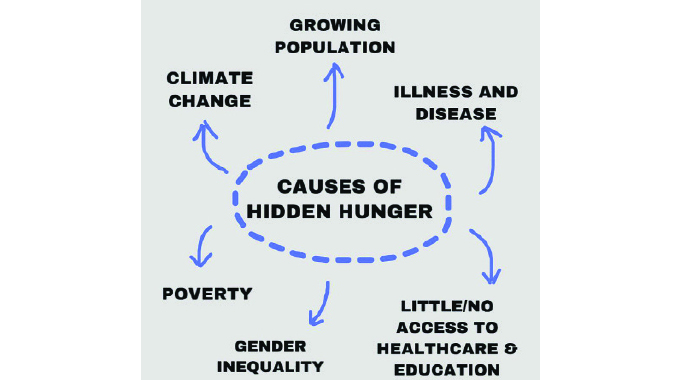
Rumbidzayi Zinyuke-Health Buzz
In many Zimbabwean homes the common meal, sadza and leafy greens, is served with care and love. Children eat heartily, their bellies are full, and their laughter echoes in schoolyards and playgrounds.
Yet beneath this apparent nourishment lies a silent crisis eroding the health and potential of the next generation; hidden hunger.
Defined by the World Health Organisation (WHO) as a form of malnutrition caused by deficiencies in essential micronutrients such as iron, zinc and vitamin A, hidden hunger affects millions across sub-Saharan Africa.
Unlike visible hunger, hidden hunger doesn’t always present with clear signs. Children may appear healthy, yet their bodies are starved of the nutrients essential for proper physical and cognitive development.
What makes this condition especially insidious is how easily it escapes detection. A child may seem well-fed but struggles academically, falls sick often, or experience stunted growth and development.
For many families, the root of the issue lies in a mix of poverty and limited knowledge. Economic hardships restrict access to diverse, nutrient-rich foods, while a lack of nutrition education means available resources may not be optimally used.
The statistics are sobering.
According to the 2023 Global Nutrition Report, nearly 60 percent of children under five in sub-Saharan Africa are at risk of at least one micronutrient deficiency. In Zimbabwe, the picture is equally bleak. The 2024 Zimbabwe Livelihood Assessment Committee (ZimLAC) report shows that approximately 27 percent of children under five are stunted, a stark indication of long-term nutritional deficiencies that impair both growth and brain development.
Whether in urban or rural settings, diets heavily reliant on carbohydrates, particularly sadza made from maize, lack the diversity and nutrient density required for healthy growth.
Among the most pressing concerns are high rates of anaemia and vitamin A deficiency. A UNICEF Zimbabwe report estimates that over 40 percent of children aged 6 to 59 months are anaemic. About one-third of preschoolers are affected by vitamin A deficiency. These conditions increase susceptibility to infections, hinder cognitive development, and contribute to poor academic outcomes.
Dr Batsi Chipurura, a food scientist at the University of Zimbabwe’s Department of Nutrition, Dietetics and Food Sciences, recently underscored the magnitude of the crisis.
“There are about three minerals that are important for our immune system. These include vitamin A, iron, and zinc. These are minerals and vitamins of public health significance in Zimbabwe. An estimated 250 preschool children are vitamin A deficient,” he said.
Dr Chipurura and his team conducted a ground-breaking study comparing the micronutrient content of commonly consumed exotic vegetables, such as lettuce and rape, with wild indigenous vegetables like Black Jack (Bidens pilosa), Amaranth (Amaranthus hybridus), and Cleome (Cleome gynandra).
The findings were striking.
Black Jack contains 17.5 mg of iron per 100 grams, more than double the amount in rape (8 mg) and nearly seven times more than lettuce (2.5 mg). Zinc levels followed a similar trend: Black Jack boasts 22 mg, compared to 0.6 mg in rape and 9 mg in lettuce. Wild vegetables also outperformed cultivated ones in copper and vitamin C content. Black Jack contains 70 mg of vitamin C, while lettuce and rape provide just 10 mg and 12 mg, respectively.
The study extended to fruits, revealing that indigenous varieties such as baobab (Adansonia digitata), marula (Sclerocarya birrea), and wild loquat (Uapaca kirkiana) are significantly richer in key micronutrients than popular exotic fruits like bananas and peaches. Baobab stood out with over 555 mg of vitamin C per 100 grams, a stark contrast to the 9 mg in bananas and 12 mg in peaches. Iron and zinc content in baobab and marula were also markedly higher, making these fruits valuable yet underutilised tools in the fight against child malnutrition.
These findings are more than academic, they have practical significance for households grappling with food insecurity and limited access to supplements or fortified foods.
“Many rural communities in sub-Saharan Africa depend on wild fruits and vegetables for food and nutrition security, medicine, and income, especially during periods of drought and famine. The medicinal uses of baobab pulp, for example, are due to its phytochemicals and micronutrients,” Dr Chipurura added.
While bananas are widely consumed and easily accessible, their limited micronutrient profile underscores the need for dietary diversity and the inclusion of indigenous foods.
To address these challenges, Zimbabwe has introduced a mix of interventions.
Food fortification programmes now enrich staples like maize meal, flour, and cooking oil with essential vitamins and minerals. These efforts, supported by government policies and international partners, hold promise, especially when paired with community-based nutrition education.
School feeding programmes have also emerged as a vital tool in combating hidden hunger. Meals featuring eggs, leafy greens, beans, and seasonal fruits do more than just fill stomachs, they provide the nutrients children need to learn and thrive. By sourcing food locally, these programmes nourish students while supporting smallholder farmers and enhancing community food security.
Improving maternal and child health remains a critical priority. Research shows the first 1 000 days of a child’s life, from conception to age two, offer a crucial window for setting the foundation for lifelong health. Promoting exclusive breastfeeding for the first six months, introducing complementary foods on time, and ensuring regular supplementation of iron and vitamin A can significantly reduce hidden hunger during this critical period.
Ultimately, tackling hidden hunger requires more than technical fixes. It calls for a mindset shift, one that values not just the quantity, but the quality of children’s diets. It also requires political commitment, sustained investment, and the empowerment of families through education and support. When caregivers understand and can act on the importance of balanced meals, the cycle of hidden hunger can be broken.
The call to action is clear: to confront hidden hunger head-on, Zimbabwe must rethink its food systems and reconnect with indigenous knowledge.
By valuing and integrating traditional vegetables and fruits into everyday diets, the country can strengthen its resistance to malnutrition and build a healthier, more resilient generation.
Hidden hunger may be invisible, but its consequences are not. Fortunately, Zimbabwe already holds the keys to the solution, rooted in its own soil. It’s time to nourish not just the stomachs, but the future.
Feedback: [email protected]