admin
admin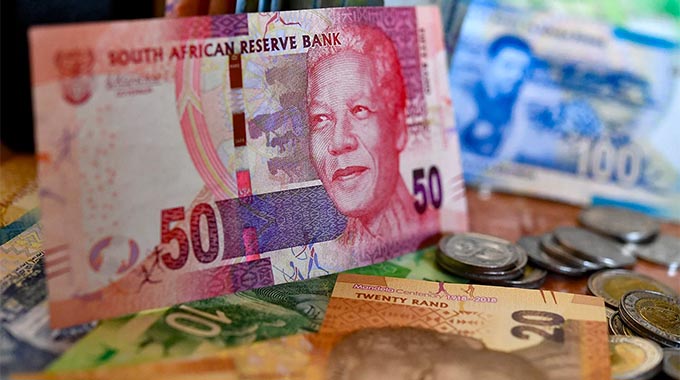
Dr Gift Mugano
The South African Rand has depreciated against the United States Dollar by more than 100 percent since September 23, 2011.
On September 23, 2011, the rand traded at an average rate of R6,5 to $1. To date, as of yesterday, it traded at an average rate of R14,5 to $1. This trend has created significant stress on the Zimbabwe economy. For instance, our exports to South Africa have become expense because of the weakening of the rand before we bring in other microeconomic factors like low capacity utilisation, high cost drivers and unreliable supply of key enablers like electricity.
For the layman, from the export front, what this means is that for a South African importing company (importing from Zimbabwe), in 2011, the company would need R6,5 million to import goods worth $1 million.
Today, the same importer requires R14,5 million for the same goods worth $1 million. This obviously poses serious cash flow problems for the South African importing companies. Under this circumstance, they will obviously go for import substitution. This is the reason why our exports to South Africa have declined by 37 percent this year.
The same applies to diaspora remittances particularly from South Africa. The same illustration applies. For instance, if a Zimbabwean resident in South Africa was sending home say R13 000 in 2011, he/she would have sent an equivalent of $2 000. Today, the same R13 000 is now worth just below $897. From this analysis, we will certainly see our remittances especially from South Africa going down in real terms.
This is a real concern for Zimbabwe in the face of the use of the multiple currencies with the US dollar being the “official currency”. The sources of the US dollar, which are almost within our control, are exports, remittances, exports and to some expend foreign direct investment – although it is very difficult for us to push FDI inflows to the level we want.
It becomes necessary to unpack the reasons why the South Africa rand has depreciated and look at the outlook.
Why has the rand
weakened so much?
All emerging market currencies are suffering as investors move their money from emerging countries’ financial markets back into developed countries such as the United States. During the 2008 financial crisis, most emerging countries experienced high levels of foreign direct inflows (FDIs) as investors realised emerging countries were still growing at significant rates. As investors placed their monies in emerging countries, those countries’ currencies became stronger.
2014 saw some improvement in the economies of developed countries. The US – the biggest economy in the world – had taken the stance to stimulate its economy though the Fed’s purchase of government and other securities to pump money into the system. This is known as quantitative easing. This kept US interest rates at an all-time low. Low interest rates mean a low return on investment and investors looked to developing countries for higher returns.
Chinese economy also changed its economic model from the one that is powered by exports and foreign direct investments to services supported by efforts to grow income particularly for the rural folk. This, in itself, in a way resulted in reduced demand for some commodities from South Africa which are used to produce goods for export market like iron and steel.
With reductions in imports by China, this put pressure on South Africa foreign reserves as exports were subdued thereby resulting in depreciation of the currency.
In the same vein, as China is rebalancing its economy, with the USA’s economy booming, China in a way left a gap which was filled by the US thereby strengthening its currency.
In the same vein, geopolitical issues in the Eastern Europe, that Russia, Ukraine and Greece and now France has led capital flight to the USA and again strengthening the dollar.
As long as the dollar is getting strong, the other currencies like the rand will be getting weaker!
What happened next?
The US economy has since improved. Employment figures are on the rise and the country’s macroeconomic fundamentals are back on track: a stronger US dollar, good employment numbers and the possibility that the US central bank – the Fed – will increase interest rates again. With a big, stable and trusted economy, the possibility of a rate hike is all that is needed to see FDI redirected from emerging economies back to the US.
How is this linked to the rand?
FDI has a direct impact on the rand. When investment leaves the country it means the demand for local currency has declined. When there is a lower need for the rand, it depreciates in value and weakens. South Africa is not a goods-producing country so it doesn’t necessarily benefit from the less-valued rand and because they do not produce goods that are rand priced/driven.
Hence, there is no demand for the rand to buy the goods the country does not produce. The rand is extremely liquid and is influenced by FDI and currency trades. At the moment, it is not an attractive currency.
What is the Outlook?
Going forward, in the short term to medium term, we don’t expect to see the rand gaining against the US dollar. The original forces which have led to the strengthening of the US dollar against major currencies such as rebalancing of the Chinese economy and geopolitical issues in Europe especially in France, Russia, Ukraine and Greece are likely to be sustained especially after the recent bombings in France and Russia involvement in Syria at the advantage of the USA. At the moment the USA will be seen as safe heavens and obviously capital will move to the USA thereby continuously strengthening the dollar.
What should we do?
Our way out is to devalue the US dollar by cutting costs so that we raise competitiveness of our exports. This requires Ministry of Finance to cut the cost of the wage bill way from 83 percent of total budget to way below 40 percent.
All the cost drivers must be lowered. Honestly, we have no luxury of continuously letting the Environmental Management Authority (EMA), National Social Security Authority (NSSA), local authorities continuing charging unreasonable fees with nothing to show
off.
We also have to cut the other cost drivers such as finance costs, wages and salaries and utilities and minimising the costs of police on the road by cutting down numerous roadblocks which has made it very difficult to cut the transport cost by business.
This can be done through an organised framework under social contract under the Tripartite Negotiation Forum (TNF). However, cutting costs without supply side support is devastating and can perpetuate suffering.
Dr Mugano is an Economic Advisor, Trade and Competitiveness Expert, Research Associate at Nelson Mandela Metropolitan University (SA) & Lecturer at the Graduate School of Management (University of Zimbabwe). Feedback: Email: [email protected], cell: +263 772 541 209.


 Online Reporter