admin
admin
Patrick Chitumba, Midlands Bureau Chief
FOR Mrs Eva Sango (54) of Mkoba 11 suburb in Gweru in the Midlands, her one-hectare piece of land has been her source of mealie-meal since time immemorial.
Every summer, she toils on the land in anticipation of good rains, which ultimately translate to a bumper harvest.
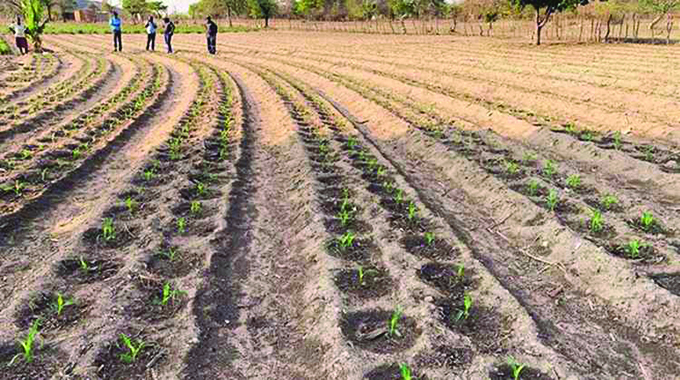
A Chronicle news yesterday caught up with Mrs Sango as she was busy digging holes as part of preparations for the 2022/2023 farming season under the climate-proofed Presidential Inputs Scheme, popularly known as Intwasa/Pfumvudza.
Intwasa is a concept aimed at climate-proofing agriculture by adopting conservation farming techniques and involves use of small plots and applying the correct agronomic practices for higher returns.
According to the Meteorological Services Department (MSD), although there are chances of normal to below normal rainfall in regions two and three at the very start of the season. The outlook is generally positive for the Zimbabwean farmer.
The MSD also warned that there could be prolonged dry spells during the season and tropical cyclones highly likely. There could be major storms and flash flooding with dams and rivers likely to fill.
There are now five weather radar sets that can cover the country and track storms and automatic stations are filling gaps in the recording network.
Mrs Sango is one the urban farmers who are utilising open spaces in the city for agricultural purposes.
“Year in and year out, I concentrate on maize on this piece of land. In a good year, I get about 500kg of grain enough to take me through to the next season,” she said.
Urban farmers are cultivating tracts of land designated for future infrastructural development.
Mrs Sango is one of the people in urban and peri-urban areas set to benefit from the Presidential Input Scheme.
“I have done my holes and now waiting for the inputs and we were told that we will get them this week,” she said.
Another urban farmer is Mrs Takudzwa Marweyi (66) from Mkoba 3 suburb who is cultivating in an open space in the industrial area.
Mrs Marweyi, a mother of three, is also taking care of two grandchildren.
Yesterday, she was busy doing her Pfumvudza/ Intwasa holes and is also looking forward to receiving inputs.
“I heard that the Government is giving out agricultural inputs for us urban and peri-urban farmers as part of measures to increase food production in the country. We are very grateful for that,” said Mrs Nyanyiwa.
Under Intwasa/Pfumvudza, registered urban and peri-urban farmers are benefiting from the scheme.
In an interview on Friday, Zimbabwe Farmers’ Union (ZFU) director Mr Paul Zacharia said urban and peri-urban farmers have started benefiting from the Pfumvudza/Intwasa inputs.
He said urban and peri-urban farmers who have registered with ZFU started receiving inputs last month.
“Urban and peri-urban farmers doing Pfumvudza/ Intwasa started receiving inputs last month. We have thousands of these farmers participating under this scheme,” said Mr Zacharia.
He urged farmers to contact their local authorities for them to get direction in terms of the utilisation of land to avoid farming in wetlands.
“It is important for farmers to take note of that because farming in wetlands causes irreparable damage to the environment through the use of different agricultural chemicals. We are talking of proper farming methods that are recognised by laws of local authorities,” he said.
“We don’t allow stream bank cultivation, we don’t allow pollution of water sources, and equally we don’t condone farming in all undesignated areas. Farmers should follow the dictates of their local authorities.”
This year the Pfumvudza/Intwasa programme has been extended to 3,5 million households, including a special smaller pack for 500 000 urban farmers.
Government has already released $20 billion towards the programme. This year’s target means an additional 1,2 million households will benefit from the Pfumvudza/Intwasa programme, after 2,3 million households participated last year.
Under the programme, each farming household will get an input package comprising 10kg maize seed, 5kg sorghum, 2kg pearl millet, 5kg soya beans, 2kg sunflower/castor beans and 5kg of either sugar beans, 5kg cowpeas or roundnuts.
Some farmers will get 5kg of summer wheat, long season variety, 2x50kg of Compound D fertiliser, 1x50kg top dressing fertiliser and chemicals for fall armyworm or stalk borer control.
The seed type and varieties will depend on the farming region. The programme contributed 33 percent of the country’s maize output last year.
The country requires 2,2 million tonnes of maize for human and livestock consumption and the three million tonnes target will position Zimbabwe as a significant player in grain production in the region.
This year farmers are expected to plant 2 million hectares of maize. For sorghum, the Government has set a target of 380 000 hectares to produce 304 000 tonnes while 250 000 ha are set to be put under pearl millet to produce 150 000 tonnes.
Farmers adopted the Pfumvudza/Intwasa concept based on the principles of minimum soil disturbance (holing out), mulching to conserve moisture, timeliness of operations and adoption of good agronomic practices.
National food self-sufficiency is key to the Government’s economic blueprint, the National Development Strategy 1, which identifies food security and nutrition as key drivers of economic revival.



 Online Reporter