Chronicle Editor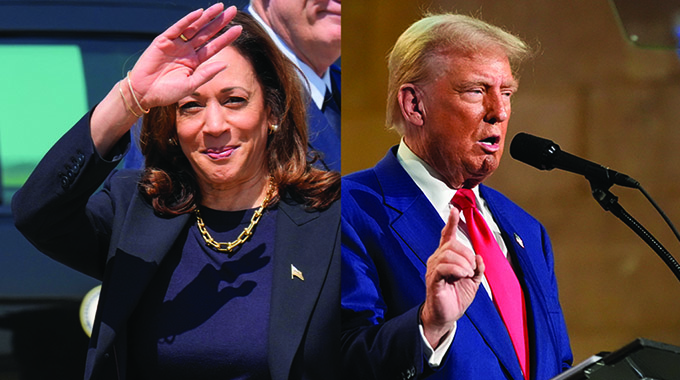
Correspondent
Election Day in the United States is a few hours away, here’s how the 2024 presidential vote works.
Who can vote?
In the US, citizens must meet some very basic eligibility criteria in order to vote. They must be:
• A US citizen
• A resident of the state where they registered to vote
• 18 years or older
Voter eligibility can vary from state to state, particularly when it comes to criminal convictions. For example, individuals who have a criminal record may face restrictions in certain states, including losing the right to vote permanently.
There are approximately 160 million registered voters, but not all of them will vote. In the 2020 election, the turnout was around 66 percent, the highest it has been for more than a century.
How does the US election work?
US politics is dominated by two parties, the broadly centre-left and liberal Democrats and the right-wing and conservative Republicans; potential candidates emerge from either party to vie for the presidential nomination. To select their nominee, the Democrats and Republicans hold primary elections or caucuses in each state, which culminates in the victor accepting the nomination at either the Republican or Democratic National Conventions. This cycle now pits Democratic Vice-President Kamala Harris against former Republican President Donald Trump.
US President Joe Biden had initially sought re-election to a second term, but he dropped out in July after a disastrous debate performance raised questions about his ability to govern for another four years.

There are also third-party or independent candidates, such as the Green Party’s Jill Stein, the Libertarian Party’s Chase Oliver, and the anti-war academic, Cornel West.
In the elections phase, presidential candidates appoint their own running mates — in this case, Democrat and Minnesota Governor Tim Walz and Republican Ohio Senator JD Vance — who will become vice president if the nominee’s candidacy is successful. Voters then cast their ballots for a president and vice president, and the result of this vote is then channelled through the Electoral College.
Since 1845, US elections have been held on the first Tuesday of November. However, voters also have the option of voting early in most states, and more than 52 million votes have already been cast.
How does the Electoral College work?
To understand how US elections work, and how voters choose their next leader, one must understand the US Electoral College.
Unlike members of the US Congress, who are directly chosen by voters, the US president is not elected by a direct national vote. Instead, when Americans cast their ballots, they are selecting a slate of “electors” from their state who pledge to vote for specific presidential and vice-presidential candidates, based on the votes cast in the state for each candidate. Once votes are counted and certified, these electors formally cast their votes.

How many electoral votes does it take to win the election?
It takes 270 electoral votes to win a US presidential election, which is a majority of the 538 total electoral votes available.
This system can create surprising outcomes: a candidate can win the popular vote across the country yet lose the Electoral College, which has happened five times in US history. The most recent instance was in 2016, when Trump won the presidency over Hillary Clinton despite trailing by nearly three million votes nationwide.
According to the polls, few United States presidential elections have been as tightly contested as this one.
Harris and Trump are in a dead heat and the outcome could be decided by voter turnout in the seven key swing states.
Who is in the lead?
As of Tuesday, FiveThirtyEight’s daily election poll tracker showed Vice President Harris leading the national polls with a 1,5-percentage-point advantage over former President Trump. However, this lead has decreased slightly from last week’s 1,8-point margin, indicating that Trump is gradually closing the gap.
According to the latest Reuters/Ipsos polls, Harris’s lead over Trump has narrowed in the election’s final stretch.
Harris holds a narrow lead of just one percentage point over the Republicans, 44 percent to 43 percent, nationally, according to the poll. The poll has a margin of error of approximately three percentage points in either direction.
When asked which candidate had a superior approach to the economy, unemployment and jobs, voters in the poll favoured Trump by 47 percent to 37 percent. Trump has also maintained an advantage on economic and immigration issues.
The poll also showed that Harris’ lead on the issue of political extremism is diminishing. Approximately 40 percent of voters felt she had a better approach to addressing political extremism and threats to democracy, while 38 percent favoured Trump.

Both candidates’ margins are within the average of the polls’ margins of error, meaning that either could potentially be in the lead. While most polls indicate Harris is ahead in the national vote, the two candidates are closely matched in swing states.
It’s important to note that while national surveys offer insights into voter sentiment, the Electoral College will ultimately determine the winner, not the nationwide popular vote. Many states tend to strongly favour either Republicans or Democrats.
What are the polls saying about the swing states?
The seven key swing states are Pennsylvania (19 electoral votes), North Carolina (16), Georgia (16), Michigan (15), Arizona (11), Wisconsin (10), and Nevada (6), which together hold 93 Electoral College votes.
According to FiveThirtyEight’s average of recent surveys, Harris and Trump are within the margin of error in each of these states. In Michigan, Harris maintains a slight lead over Trump, with a margin of +0,8 points since last week. She has also gained a narrow advantage in Nevada and Wisconsin, highlighting how easily these states could swing in either direction.
Conversely, Trump has a slight edge in Pennsylvania and a more significant lead in North Carolina, Arizona and Georgia.
Continuing last week’s trend, if the narrow margins reflected in the poll averages hold on election night, Trump is favoured to win. However, even a small shift away from him in these critical states — or an underestimation of Harris’ support — could result in a victory for the vice president.
Notably, in the 2020 presidential election, Georgia, where Trump is leading, shifted from Republican to Democratic after nearly 30 years of voting Republican. Similarly, Arizona, where Trump also has a lead, was won by Democrats by just 0,3 percentage points.
How trustworthy are polls?
Election polls predict how the population might vote by surveying a sample of voters. Surveys are most commonly conducted by phone or online. In some cases, it is via post or in person.
Poll trackers, which aggregate a number of polls together, are weighted based on a number of factors, such as the sample size of the poll, the pollster quality, how recently the poll was conducted and the particular methodologies employed.
Polls are never 100 percent accurate. Both the 2016 and 2020 US elections saw opinion polls underestimate the popularity of Republican candidates.
Pollsters got it wrong again in the 2022 midterm elections. That time, they under-counted the support for Democrats and predicted a win for Republicans, only to be proven wrong.
Experts note that while pollster services are sophisticated, they have a limited shelf life.
“The problem is that, as the cliché goes, they’re snapshots in time, so as soon as you see them, they’re already out of date. The big question (this year is) with the undecided voters,” Steven Erlanger, the European diplomatic correspondent at The New York Times, said. Many of the polls conducted before this year’s presidential election have shown the difference in support between Harris and Trump within the margin of error.

When will we know who won? When will the results be announced?
That’s up in the air. It’s highly unlikely that a winner will be determined on election night. However, it’s not out of the question. Historically, a winner would be announced on the night of or morning after the election.
As polls close across the country on Election Day, the media will report real-time results, with results coming in from the Eastern Time Zone first. Final tallies may not be available immediately, particularly with the increased volume of mail-in and absentee ballots. In some cases, states have laws allowing ballots postmarked by Election Day to be counted even if they arrive later. This process can lead to delays in certain states, particularly those with narrow margins.
These delays could be seized upon by Trump to spread the narrative that the election has been stolen, as he falsely tried to do in 2020. In that election, many of the votes that arrived or were counted late were for the Democrats, typically because the party has more support in cities where vote counting takes longer, and because Trump discouraged his supporters from using mail-in ballots.
If no candidate wins 270 electoral votes, a contingent election occurs. The House elects the president, with each state casting one vote, and the Senate elects the vice president. A House candidate needs a majority (26 states) to win. This rare process last happened in 1824 when John Quincy Adams was elected by the House of Representatives after Andrew Jackson won the popular and electoral votes but fell short of a majority.
What are the key dates to watch?
• Election Day: November 5 – Most Americans vote in person or by mail.
• Certification deadlines: November 6 – December 11 – States certify election results within this timeframe.
• Electoral College vote: December 17 – Electors meet to cast their official votes.
• Congress counts electoral votes: January 6, 2025 – Congress convenes to count and confirm electoral votes.
• Inauguration Day: January 20, 2025 – The president-elect is sworn in, marking the transition of power. — Al Jazeera



 Online Reporter