Online Reporter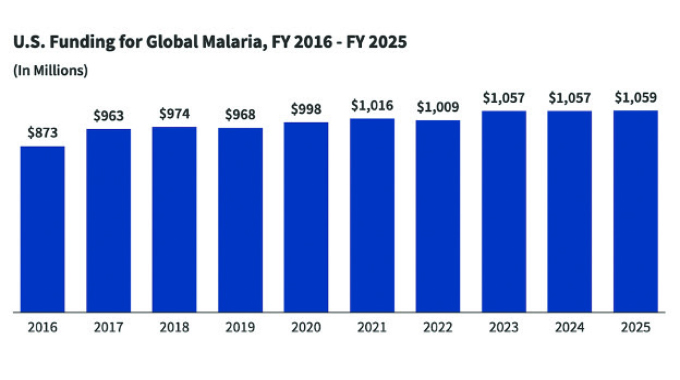
Cuts to United States-funded malaria programmes are adding to a host of issues confronting Congolese mother Mwayuma Idi Feza, whose city, Goma, is at the centre of the country’s intensifying conflict and run by a vicious militia.
“I have a child who is sick. He has had malaria for a week and a few days now,” Feza (36) told CNN of her 1-year-old son, whose fever she suspects is caused by the mosquito-borne illness.
She is also experiencing symptoms of the disease, she said.
“I’m feeling cold. I feel bitterness in my mouth.” The single mother is out of work and said she can barely afford food, much less malaria treatment for her and her baby.
Malaria is a preventable and curable disease, but it still claims hundreds of thousands of lives around the world each year. Infants, children under five and pregnant women are most likely to die from a malaria infection.
It’s a leading cause of death in the Democratic Republic of Congo (DRC), which bears the world’s second-highest malaria burden after Nigeria, according to the World Health Organisation (WHO).
In 2022, some 24 000 people were estimated to have died of the disease in the central African nation. More than half those deaths were of children under 5.
Since the Trump administration started slashing foreign aid early this year, an estimated 36 percent of US Agency for International Development (USAID) funding for malaria programmes has been cut, according to the Center for Global Development, a DC-based think tank. But the true level of aid cuts remains uncertain.
In the DRC, that money funded the supply of antimalarials to “many health zones” across the country, “including intermittent preventive treatment for pregnant women,” according to Michel Itabu, a former spokesperson for the country’s National Malaria Control Programme (PNLP), referring to a WHO-recommended programme in areas where malaria is endemic.
“The PNLP is already feeling the effects” of the funding cuts, Itabu told CNN. Such preventive programmes might have protected Idi Feza and her baby son – instead, if infected, they are both at risk of serious illness or even death.
Possible repercussions at home
The US government has long been the largest donor to global efforts to combat malaria. For decades, USAID spearheaded a programme called the President’s Malaria Initiative (PMI) to drive down mortality and eliminate malaria in 30 of the hardest-hit nations, most of which are in Africa.
Launched by George W. Bush in 2005, the programme helped reduce malaria deaths by more than 60 percent – saving millions of lives.
CNN spoke to several people who previously worked on the initiative but were recently laid off amid Trump’s dismantling of USAID. Most PMI staff have been let go or had their work halted by stop-work orders, and the Trump administration’s proposed budget called for a 47 percent cut to the program.
“One of the reasons that we don’t have malaria in the US is because we fund and track malaria worldwide, for global health security.”
Every aid worker who spoke to CNN emphasised that people would die in the short term as a result of the disruption to malaria prevention and treatment efforts.
Longer term, they said the funding cuts would destroy years of American progress in driving down the prevalence and severity of the disease.
US-backed surveillance systems that were once the backbone of efforts to monitor malaria and other disease outbreaks around the world have also been cut, former US government workers told CNN, underscoring long-term concerns.
“One of the reasons that we don’t have malaria in the US is because we fund and track malaria worldwide, for global health security,” one former USAID contractor told CNN in February, speaking anonymously for fear of reprisals.
She warned that locally acquired malaria cases, like Florida experienced in 2023, could become more common “if we’re not funding driving down the parasite elsewhere.”
Aid workers and nonprofits have repeatedly made the case that malaria programs and US disease monitoring make America “safer, stronger and more prosperous,” which was Secretary of State Marco Rubio’s stated framework for assessing US foreign assistance.
For example, USAID and the US military have long invested in malaria vaccine research to both reduce the global disease burden and protect US soldiers serving abroad.
Spencer Knoll, US policy and advocacy director at the nonprofit Malaria No More, said in testimony to the US House Appropriations Subcommittee in April that “the world’s most dangerous infectious diseases – including Ebola, Marburg, and pandemic influenza – often present first as fevers, and malaria detection programmes can stop outbreaks in their tracks.”
Between 2010 and 2023, the US contributed more than one-third of the world’s malaria financing, according to WHO.
As of last year, the US was also the largest contributor to the Global Fund, which works to fight AIDS, tuberculosis and malaria. It’s unclear what the future level of US funding for the independent, public-private programme will be, following the Trump administration’s proposal to halve US matching contributions.
The Trump administration’s funding cuts “could reverse decades of progress earned, in part, through longstanding investments from the United States of America and other global partners,” WHO warned in a statement earlier this year. “Although funding for some US-supported malaria programs have been reinstated, the disruptions have left critical gaps.”
A State Department spokesperson told CNN that “PMI life-saving programs are continuing in partner countries . . . Life-saving malaria activities are not under stop work orders.” The department is also “preparing a contribution to the Global Fund, which we’re working with them to finalise,” according to the spokesperson.
“Consistent with Secretary Rubio’s statements, continuing foreign assistance programs advance the core national interests of the United States, including providing emergency assistance in conflict zones and supporting key American strategic partners,” the spokesperson added.
Former aid workers emphasised concerns about lack of investment to tackle several global threats related to malaria, including drug resistance, increasingly insecticide-resistant mosquitoes and new, invasive types of mosquitoes that are moving into urban areas with high populations.
“The timing for all of this couldn’t be worse. Malaria is seasonal, and so having interruptions during times of seasonality sets us back significantly,” said Nathaniel Moller, formerly a senior innovation adviser at the PMI, whose job was cut in January. He warned that with less funding for measures like bed nets and preventative medicine, the baseline of cases will rise this year, enabling further spread of the disease down the road.
“You missed that window, and you can’t just go back to that initial baseline . . . it’s going to go up,” Moller said, noting that the rainy season is already underway in parts of east, central and southern Africa. “We risk losing years of investments and seeing the caseload increase significantly.”
That bad timing is particularly evident in Malawi, where recent flooding and cyclones have driven up malaria infections, the country’s National Malaria Control Manager Lumbani Munthali told CNN. He added that cuts to USAID funding for malaria interventions have put the country in “a difficult situation” because “it’s not easy to close the gaps that have been created.”
More than 2 000 people died of malaria in Malawi last year. Some 9 million were infected.
“Malawi has made significant progress in reducing malaria deaths because of the technical and financial support from the US government,” Munthali said. That funding went towards procuring millions of malaria tests kits annually and providing insecticide-treated bed nets and antimalarial medication for pregnant women and nursing mothers.
“We are trying to close those gaps but may not close them completely,” Munthali said, as Malawi adjusts to the sharp drop-off in US foreign aid. About 64 percent of Malawi’s USAID funding has been cut across all programmes, according to the Center for Global Development’s analysis.
In 2023, the most recent year for which PMI figures are available, Malawi received $24 million for its fight against malaria. It’s not yet clear exactly how much it will lose this year, Munthali said.
Cuts to other areas of US foreign aid, like malnutrition programmes, will have overlapping effects in Africa, aid workers also warned. – CNN.