admin
admin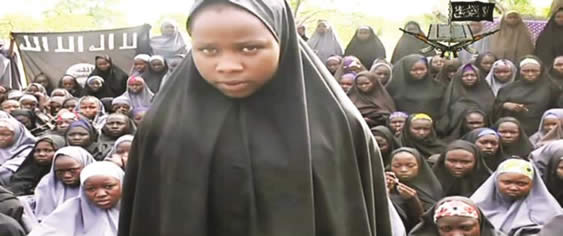

The United States has been flying “manned” missions over Nigeria to track down more than 200 abducted schoolgirls, the Pentagon said, as experts pored over a new video, seeking clues to where they are being held. “We have shared commercial satellite imagery with the Nigerians and are flying manned ISR (intelligence, surveillance and reconnaissance) assets over Nigeria with the government’s permission,” a senior administration official said on Monday, asking not to be named.
It was not immediately clear what kinds of aircraft were being deployed, nor where they had come from.
A new video released by the Boko Haram group purportedly showing about 130 of the girls was being carefully studied by US experts in the hope it might yield vital clues as to where they are being held.
“Our intelligence experts are combing through every detail of the video for clues that might help ongoing efforts to secure the release of the girls,” State Department spokeswoman Jen Psaki said earlier on Monday.
“We have no reason to question its authenticity,” she added of the video.
In the video, the Islamic group’s leader Abubakar Shekau said the girls may be released once Nigeria frees all the Boko Haram prisoners it has in custody.
But that proposal has been rejected by the Nigerian government, and Psaki recalled that the US policy is also “to deny kidnappers the benefits of their criminal acts, including ransoms or concessions”.
A 30-strong US team arrived on the ground last week in Nigeria to help growing efforts to find the girls aged between 16 to 18, snatched from their boarding school in the northeast of the country on April 14.
The White House said the team included five State Department officials, two strategic communications experts, a civilian security expert and a regional medical support officer.
Also on the manifest are 10 Defence Department planners already in Nigeria, seven extra military advisors from US Africa Command and four FBI officials expert in hostage negotiations.
“We are talking about helping the Nigerian government search an area that is roughly the size of New England,” White House spokesman Jay Carney said, referring to the region in the US north-east.
“So this is no small task. But we are certainly bringing resources to bear in our effort to assist the government.”
Psaki stressed the Nigerian authorities were “in the lead” during the investigation.
The girls’ plight has triggered a storm of outrage across the US, and First Lady Michelle Obama on Saturday for the first time delivered her husband’s weekly address to the nation to say they were both “outraged and heartbroken” by the kidnapping.
“This unconscionable act was committed by a terrorist group determined to keep these girls from getting an education – grown men attempting to snuff out the aspirations of young girls,” she said.
Meanwhile, the father of one of Nigeria’s kidnapped schoolgirls has reportedly said he would rather have his child die than have her convert to Islam or be exchanged for Boko Haram prisoners.
According to The Telegraph, the man said his daughter was a Christian and would rather she died a “princess” rather than convert to Islam.
The man’s remarks came after the Islamist group released a video on Monday claiming to show the missing Nigerian girls and saying they have converted to Islam.
In the video, the group’s leader, Abubakar Shekau, speaks for 17 minutes before showing about 130 girls in black and grey full-length hijabs sitting on scrubland near trees, reciting the first chapter of the Muslim holy book, the Koran, and holding their palms upwards in prayer.
A total of 276 girls were abducted on 14 April from the north-eastern town of Chibok, in Borno state, which has a sizeable Christian community. At least 223 are still missing.
According to AFP Shekau said the girls could be released once Nigeria freed all the Boko Haram prisoners it has in custody.
The father of one of the girls concurred with the stance taken by the government saying a prisoner exchange would simply encourage more kidnappings.
“Our daughters are not prisoners, and they should not be exchanged for anyone,” the man was quoted as saying, adding that the government had the mandate to rescue them.
Boko Haram has been waging an increasingly deadly insurgency in Nigeria’s mainly Muslim north since 2009, attacking schools teaching a “Western” curriculum, churches and government targets. — AFPAl Jazeera


 Online Reporter