

 Online Reporter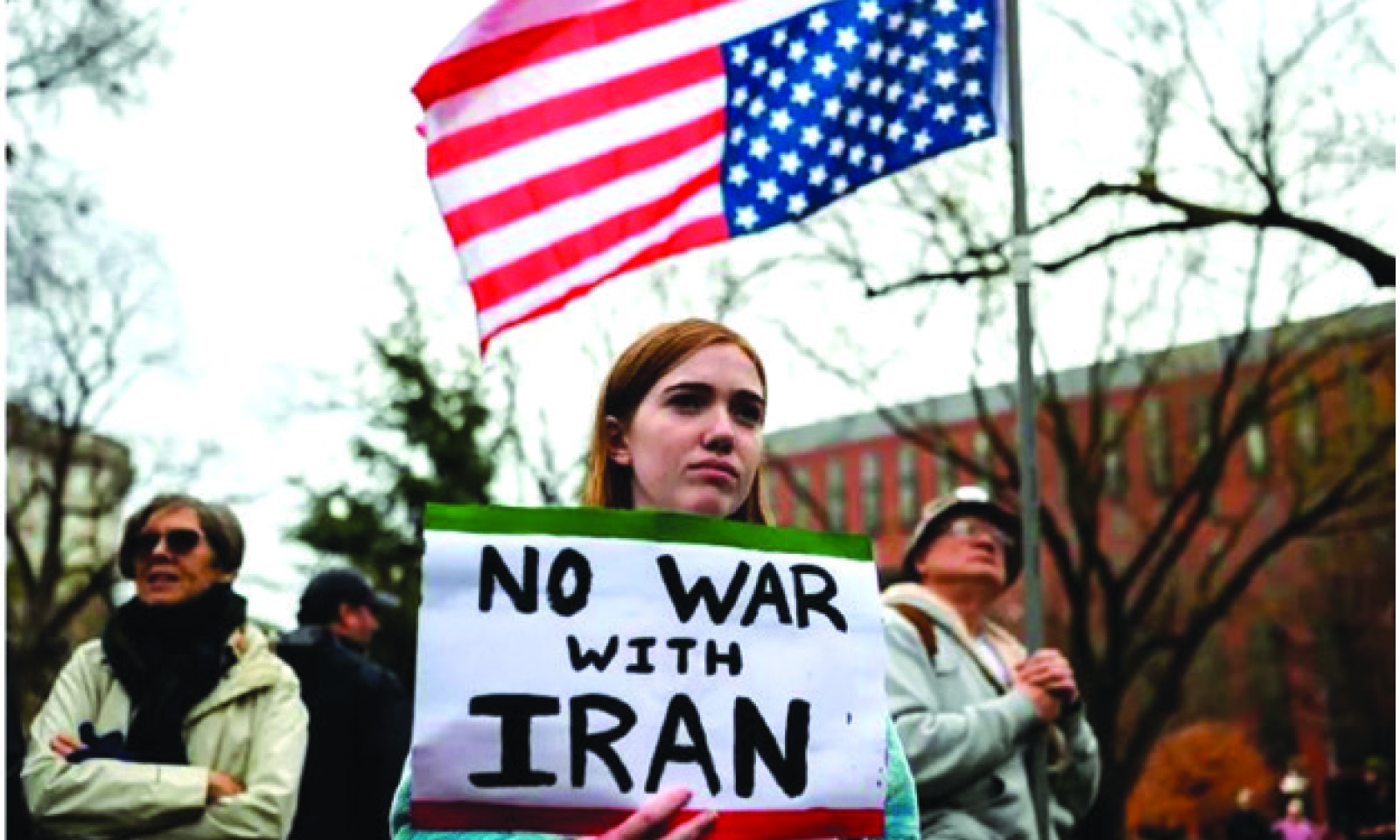
Gibson Nyikadzino
Zimpapers Politics Hub
THE United States is beating the drums of war against Iran.
President Donald Trump appears to be using war rhetoric to cajole the Persian civilisation to force a negotiation that will see Iran give up its nuclear programme.
But again, the Iranians do not want to develop nuclear weapons because the logic they put forward is that such weapons are immoral.
Yet, US military personnel and equipment are already being deployed in the Middle East at US military establishments.
The decision to mobilise war resources by the US comes after Iran refused direct negotiations with Washington. And war is becoming a resort for the US.
The current US military build-up in the Middle East is real, involving moving air defences, fighters, support planes, carriers, and B-2 stealth bombers.
From the deployments, the US is looking forward to a limited air operation and improved post-event capabilities to protect critical interests.
However, this level of deterrence works best as a strategy against a country that is not ready to defend its sovereignty. Here, Iran is willing to defend its sovereignty by even inflicting maximum damage on US interests in the region.
This level of deterrence by the US is overboard. The idea of deterrence is to get a good result by merely posing rather than by really employing the troops.
This kind of brinkmanship is extremely dangerous, particularly as it is taking place concurrently with efforts to reach a peace agreement in Ukraine and as China intensifies its military exercises to protect itself against US aggression through Taiwan.
On the other hand, Trump’s hand now appears much weaker in this important geopolitical encounter. Given his repeated claims to be a staunchly anti-war president who steers clear of involving America in international conflicts, this might place Trump in a very difficult position.
With the way he has disrupted the international order through his chainsaw diplomacy, many see him as a troublemaker who, in some ways, is unreasonable.
This feedback only signals one element: the US of today is no longer the US of the 1990s when it emerged as a unilateral superpower following the collapse of the Soviet Union.
It is a country that presently is fighting from many fronts, politically, socially, technologically, and economically, additionally having severe internal challenges with the immigration crisis, a polarised society, and growing moral decay.
The world is already turning against the US and the West in general because of Gaza and also the trade war.
It is also being despised for supporting the restart of the Palestinian genocide after there was a universal sigh of relief that the slaughter died down.
The slaughter of Palestinians did not stop, but died down and restarted.
What is also outrageous is Trump’s video he shared recently, where he was boasting about the US killing of Yemeni tribal men, whom he said were Houthis getting instructions to sink American ships.
The American media is pretending as if nothing happened, making it interesting at how the liberal media in the US has been hostile on any of Trump’s cases, except this one for the murder of innocent civilians.
When it comes to killing innocent people in Yemen or slaughtering people in Gaza, American media have been quiet and said nothing about this Yemen incident.
It is, therefore, stunning how Western mainstream media is inhumane when it comes to these atrocities.
However, the Julian Assange WikiLeaks cables that exposed US atrocities in Iraq and Afghanistan might be dissuading America’s corporate media from broadcasting the murder of Yemeni civilians.
The US, for decades now, has been bombing weddings in Iraq and Afghanistan and has helped the Saudis bomb funerals in Yemen and get away with it.
While the US remains a dominant yet declining superpower, indications are that it currently has no moral, morale, and financial capability to sustain a major war because its competitors, including not just Iran but Russia and China, are now much stronger today than they were 30 years ago. It is now a very different world.
There is a slim chance the US can win a war against Iran when it failed to win in Iraq, it fled Afghanistan, and is failing to win against the Houthis in Yemen.
Consequences of a US-Iran war are bigger than in any region. US client states in the Persian Gulf that host American bases are aware that if there is a war between Iran and the US, their regimes will fall within hours and days, and the global oil and gas markets will blow and collapse the global economy.
In this scenario, it is, however, difficult to imagine a war is likely to break out because there are a lot of losses that will be incurred not only by the Iranians, Americans, or Arab and Persian Gulf states, but the whole world.
War could be replaced by mere airstrikes, though it is highly unlikely that the Americans will use Turkish airspace, even though Turkey has worked alongside Israelis and Americans during these years as a NATO member.
Because of this, Trump’s disruptive behaviour is enabling the people of Iran to rally around their armed forces and they see Trump as a troublemaker, a supporter of genocide in Palestine, and as someone who is anti-Iran.
He has not made it easy for himself with this behaviour.
He has united Iranians because there is a consensus in Iran that the US is a regime that invades countries that have weak armies and weak armed forces. In this case, Iranians are ready to fight back if there is a war.
It is clear that the US has failed in Yemen. It has been unable to damage the underground missile and drone sites in Yemen, except killing civilians and destroying civilian infrastructure and homes.
US air strikes have been unable to deter the Yemeni armed forces, who are heroically fighting back.
Therefore, if the US cannot win in Yemen, it is completely unrealistic to imagine it will win against Iran.
It can only be hoped that peace will triumph and that the Trump administration and Iran will find a way to prevent driving the world and the Middle East into a great Armageddon.
Chances are high that actions by Trump can be interpreted as a bluff if he later decides against taking military action. However, with so many other global crises — or ones that are developing — occurring concurrently with this one, failing to take any significant action may be interpreted as a serious blow to the credibility of the still-young Trump administration.
However, one thing stands out in the midst of all of the uncertainty. The world has entered a huge game of chicken with genuinely unimaginable stakes.



