admin
admin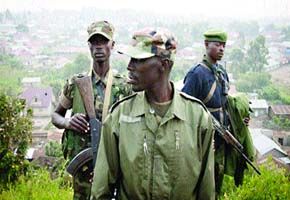
The US Treasury Department on Tuesday accused Baudoin Ngaruye and Innocent Kaina of using child soldiers.
The Treasury said the two men were punished for their “involvement in the recruitment and use of child soldiers in the conflict in the DRC and for being leaders of a group that is impeding the disarmament, repatriation, or resettlement of combatants.”
It also accused Ngaruye of targeting children through “killing, maiming, and sexual violence.”
Kinshasa and UN experts say that Rwanda is supplying, supporting, and directing the M23 rebels, who are strengthening their grip over the provinces of North Kivu and South Kivu in the eastern Congo and could seriously threaten the writ of the Congolese government in the region.
The M23 rebels defected from the Congolese army in April in protest against alleged mistreatment in the Armed Forces of the Democratic Republic of Congo (FARDC). They had previously been integrated into the Congolese army under a peace deal signed in 2009.
Since early May, over 900 000 people have fled their homes in the eastern Congo. Most of them have resettled inside Congo, but tens of thousands have crossed into neighbouring Rwanda and Uganda.
The eastern Congo has experienced interminable cycles of violence since 1998, and over 5.5 million people have been killed in 14 years of war.
Meanwhile,The International Criminal Court has acquitted former militia leader Mathieu Ngudjolo Chui on charges of committing war crimes and crimes against humanity in the Democratic Republic of Congo.
The Hague-based ICC issued the verdicts on Tuesday and ordered that he should be freed immediately, the state-funded BBC reported.
The charges were made in connection with a massacre of 200 people in the village of Bogoro in Ituri province of the eastern Congo in 2003.
Ngudjolo was charged with seven counts of war crimes and three counts of crimes against humanity, with the court hearing testimony saying that people were burned alive, babies were battered to death, and women were raped.
Ngudjolo said he did not order the assault on the village and only heard about the attack a few days later.
He was also accused of enlisting child soldiers and using them to carry out the massacre.
Presiding Judge Bruno Cotte said the world court acquitted Ngudjolo of all charges, because the prosecution had “not proved beyond reasonable doubt that Mathieu Ngudjolo Chui was responsible” for the crimes.
The decision was unanimous and was made because witness testimony was “too contradictory and too hazy,” Cotte added.
“The chamber also emphasised that the fact of deciding that an accused is not guilty does not necessarily mean that the chamber finds him innocent,” the ICC said in a statement.
“Such a decision simply demonstrates that, given the standard of proof, the evidence presented to support his guilt has not allowed the chamber to form a conviction ‘beyond reasonable doubt,’” the ICC statement added.
Geraldine Mattioli-Zeltner, the international justice advocacy director of Human Rights Watch, commented on the verdict, saying, “The ICC prosecutor needs to strengthen its investigations of those responsible for grave crimes in Ituri, including high-ranking officials in Congo, Rwanda, and Uganda who supported the armed groups fighting there.”
The Coalition for the ICC (CICC) called the verdict “a hard blow for the victims and affected communities who had placed all their hopes in the court to deliver justice, considering the great harm they suffered during the ethnic war in Ituri.”
The CICC is an international NGO with a membership of over 2 500 civil society organisations in 150 different countries, which was established to monitor the court’s activities. — Presstv.


 Online Reporter