Theseus Mauruki Shambare Features Writer
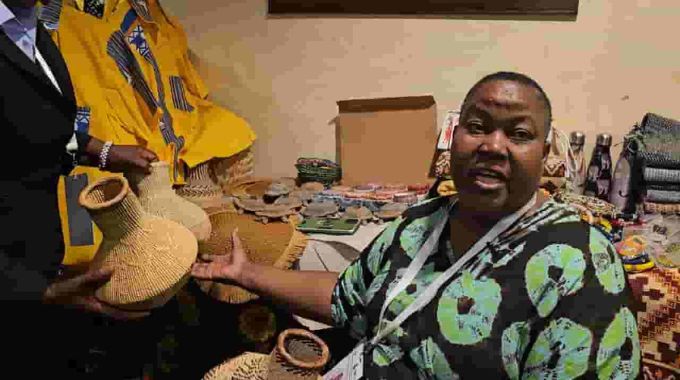
WHEN Vice President Kembo Mohadi stopped at Loveness Mhlanga’s exhibition stand in Victoria Falls, he found more than baskets, rugs and jewellery neatly arranged for sale.
Behind the colourful display was a small but growing women-led value chain stretching from the tourist town of Victoria Falls into rural communities such as Binga and Hwange.
Mhlanga operates from Victoria Falls, where she runs Go-Bag-It Shop, but many of the 50 women whose products she sells are based in rural areas.
They make baskets and other crafts, which Mhlanga buys at wholesale prices before bringing them to Victoria Falls, where she sells them at a profit.
It is a simple business model, but one that connects women who produce in rural communities with customers in one of Zimbabwe’s busiest tourism destinations.
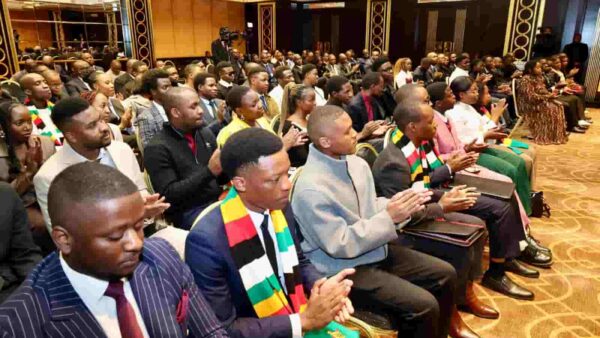
And it was this enterprise that Mhlanga and her colleagues were given an opportunity to showcase during the Zimbabwe Tripartite Negotiating Forum Global Summit held in Victoria Falls recently under the theme
“Inclusive Growth, Decent Work, Beneficiation & Investment Promotion.”
With the support of the Ministry of Women Affairs, Community, Small and Medium Enterprises Development, the women exhibited their products and sold directly to local and international delegates attending the summit.
For Mhlanga, it was an opportunity to take a rural women’s enterprise into a national and international economic conversation.
Then the Vice President arrived.
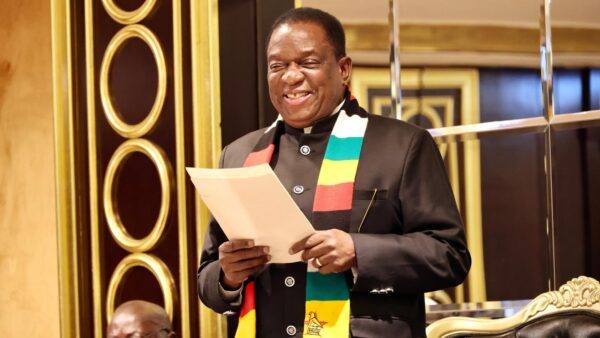
“This is very good; we want to see women playing a key role in economic activities. Let this not be in Zimbabwe only but let it go beyond borders,” Vice President Mohadi said during his tour of the exhibition stands.
For the women, it was a brief encounter.
But for an enterprise built around women who produce far from the country’s major commercial centres, the message was significant.
Mhlanga’s business begins far from the polished exhibition stands of Victoria Falls. Her members are scattered across Binga, Hwange and other rural communities. They make baskets and other handmade products, often using skills passed from one woman to another.
Mhlanga then provides a link to the market. She purchases their products at wholesale prices and brings them to Victoria Falls, where the town’s tourism industry provides access to a different customer base.
“This is Go-Bag-It. Everything here is a gift shop,” she said in an interview. “We sell rugs, throws, African earrings, garlic baskets and jewellery that is handmade.”
The products on her stand are, therefore, not simply goods. They are the end point of a chain of women’s labour.
A basket may begin in a rural homestead before travelling to Victoria Falls, where it is placed before a tourist or conference delegate. The money then travels back through the chain.
That is the promise of linking rural production with urban and tourism markets. But it is also where the vulnerabilities of small businesses become apparent.
Mhlanga’s own entrepreneurial story is a reminder that none of this happened overnight.
At 29, she was working at a casino.
She had a job and by her own account, life was going well. But she wanted to work for herself. So, she left formal employment. What followed was a journey of trial, error and persistence.
“I did not start out knowing exactly what I was doing. You learn little by little,” she said.
Her first ventures were modest. She bought and resold buckets, paraffin and other household goods. She travelled to places such as Kariba and Binga looking for customers. She learnt from other women.
Eventually, she ventured into sewing, with some of the work being done from home. The business grew, but the uncertainty never completely disappeared.
Today, a good month can bring her as much as US$1 000. A weaker month can bring about US$500.
“If we work hard, we can make up to around US$1 000 in a month. “In some months, we can make around US$500,” she said with a smile.
Those figures capture the contradiction at the heart of small-scale entrepreneurship.
The business can provide meaningful income. But that income is not guaranteed.
“The journey has not been smooth. It has been a very rocky journey. My journey has been very, very rocky,” she shared.
Mhlanga’s business has grown beyond her own household. She now works with about 50 women involved in making baskets of different shapes, sizes and prices.
For many of them, the craft is not a hobby. It is a livelihood.
“We are a large group of women, about 50, who make baskets,” she said
Some of the women are single mothers, while others are widows and some care for orphans. Their economic circumstances may differ, but their need for reliable income is shared.
“They come here to support themselves and provide for their children,” Mhlanga said.
That is what makes the rural-to-market link important. A woman in a rural community does not necessarily need to move to Victoria Falls to participate in the tourism economy. She can produce where she lives.
Mhlanga can then create the commercial bridge. But the bridge only works if there are buyers.
Ottillia Mathe, an officer with the Ministry of Women Affairs, Community, Small and Medium Enterprises Development, said their role was to help women turn their skills into viable businesses.
“We empower women with skills and training, particularly in business and marketing, so that they can develop their work into sustainable livelihoods,” she said.
Mathe said the Ministry also assisted women to formalise their enterprises by registering companies and cooperatives, while helping them find markets for their products.
“We also assist them with formal registration of their companies and cooperatives and help them to market their products. The idea is to make sure that what they produce does not remain at home, but reaches the market,” she said
For the women at the Victoria Falls summit, that support translated into an opportunity to exhibit before an audience far beyond their usual customers.
There were baskets, dresses, beadwork, wood carvings, stonework and other crafts.
Groups, including Zambezi Art and Craft, Lugwasyano and the Women Curio Market showcased their products. But the exhibition also revealed an uncomfortable reality.
Training can give a woman a skill. Registration can give her a formal business identity. Production can give her something to sell. But the market determines whether that skill becomes an income.
Mhlanga said this remains one of the biggest challenges facing women.
“We also encourage other women to work hard,” she said. “Those who do not have capital, we ask that we come together, we discuss how the ministry can assist us where we are facing challenges.”
In the hands of a tourist, a basket can be a souvenir. In the hands of the woman who made it, it can represent hours of work. In the hands of Mhlanga, it becomes part of a business.
And for the woman who receives payment after it is sold, it may represent food, school fees or another day of keeping her family afloat. This is the often-invisible gender dimension of small enterprise.
Women are not merely participating in markets. For many, the income they generate supports entire households.
Zimbabwe’s 2022 Population and Housing Census recorded women as 52 percent of the country’s population, making them the majority of Zimbabweans. Their economic participation, therefore, matters not only as a gender issue, but as an economic one.
Yet female entrepreneurs can face a particularly difficult combination of responsibilities. They must produce, sell, take good care for children as well as manage households.
And when the market fails, there is often no salary waiting at the end of the month. The Victoria Falls exhibition offered Mhlanga and her colleagues something precious — visibility.
International delegates could see their products. Some bought them. Others asked questions.
Vice President Mohadi stopped to engage them.
For women accustomed to working in rural communities, suddenly finding themselves at the centre of a major economic summit was itself a form of recognition.
But Mhlanga does not want recognition alone. She wants a functioning market. She wants women in Binga, Hwange and other rural areas to be able to produce knowing that somebody will buy. She wants the women in her network to increase production.
And she wants the products to travel beyond Zimbabwe. That is why Vice President Mohadi’s words stayed with the exhibitors.
“Let this not be in Zimbabwe only but let it go beyond borders,” he said.
For Mhlanga, crossing borders would mean more than exporting baskets. It would mean taking the labour of rural women into markets they have never physically reached.
Mhlanga, now 53, has three children, including a 30-year-old son and a 14-year-old child still at school.
Her own journey has taken her from a casino job to selling buckets and paraffin, to sewing and eventually to building a network of women whose products can find a market in Victoria Falls.
She has seen US$1 000 months and US$500 months. She has seen opportunities and setbacks. And she has learnt that entrepreneurship is not a movie-style straight road from poverty to prosperity. It is a road with bends.
“We have single mothers who are crying out for help. There are many women who are struggling and looking for help,” she said.
Therefore, her story does not end with the exhibition in Victoria Falls. The exhibition was only one stop. The real journey continues in the rural communities where