Chronicle Editor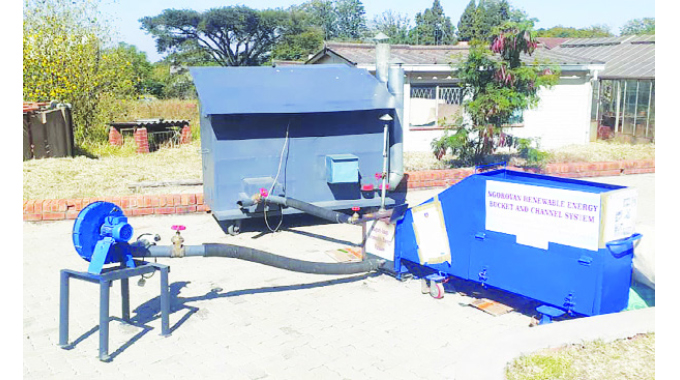
Sifelani Tsiko, Zimpapers Election Desk
A University of Zimbabwe engineer has built a new hybrid energy source tobacco barn that uses solar power and corncobs to help reduce the huge amounts of firewood used by tobacco farmers in curing the golden leaf.
Engineer Nelson Shati, a researcher in the Department of Industrial Engineering and Mechatronics, developed the barn that uses solar thermal energy and electric energy to cure up to 100kg or a bale of tobacco in six or seven days.
In addition to this positive innovation, he developed the Ngorovan bucket and channel cart and “Maguri” renewable energy test furnace to promote the use of affordable local biomass resources with a comparative advantage for local farmers.
“There is a strong push for tobacco farmers to move away from using firewood for tobacco curing. This prompted me to develop an alternative renewable energy system. This initiative was to design and construct a prototype tobacco barn which uses solar thermal and auxiliary tobacco curing systems.”
Eng Shati designed the barn that has a cross-section of a tobacco leaf at 68cm length and 40cm width. This prototype has a roof rail that sustains tobacco mass 50kg. Globally, there is an aggressive push to force tobacco producing countries to adopt tobacco curing processes that use energy with less adverse environmental impact as firewood and other fossil fuels are not sustainable.

The UZ innovator believes strongly that the use of solar thermal-powered tobacco barns will help Zimbabwe to attain Sustainable Development Goal number 7 which requires countries and businesses to accelerate the use of affordable, reliable and sustainable renewable energy.
“There is extensive tree cutting by tobacco farmers for firewood use as curing fuel,” he said. “Deforestation threatens biodiversity and sustainable tobacco production. So, I was motivated to design and construct a sustainable tobacco curing hybrid system of solar thermal and non-wood auxiliary energy.”
The barn has two air inlets, one connecting the solar collector where there is sufficient heating from the sun and one directly from the blower into the heater element when its cloudy and there is insufficient sunshine.
The flat plate solar collectors can generate heat of between 30 degrees Celsius and 80 degrees Celsius, while the electric heating system can reach 80 degrees Celsius. It has been tested successfully and the project now intends to acquire the solar thermal collector and requisite control instrumentation in order to conduct a full test of tobacco curing using solar air heater and the auxiliaries. However, the use of solar barns still has some limitations.
“Solar thermal air heaters are not yet a mature technology and sourcing their components such as appropriate insulation in Zimbabwe and the air heaters abroad was a challenge. All the three solar technologies are negatively affected by either inadequacy or unavailability of sunshine, making them perform badly under such weather conditions. This demands very expensive storage devices or energy accumulators to be put in place. Faced with these solar technologies challenges, the research borrowed a leaf from the Ceylon Tobacco Company’s paddy husk energy systems in Sri Lankan tobacco sector barns and explored use of affordable local biomass resources where Zimbabwe has a comparative advantage.”
The Ngorovan — corncob system has a horizontal bucket and channel cart and furnace renewable energy system that addresses solar energy technologies’ limitations. It’s an all-weather biomass agro-residue system that operates even in adverse weather conditions of rainfall, overcasts, transients and night-time.
“The Improved fuel charging system removes issues of firewood loading labour issues, raising ergonomics of farmers’ physical and mental health. Inefficiency due to furnace porosity heat losses is addressed thereby saving energy. The energy feedstock is corncob, which is naturally compact and used without any other cost-inducing value addition processing such as briquetting. To assist it rolling into a sloped furnace, the channel has got a slope. We also looked at Zimbabwe’s comparative advantage in the corncob, as maize is our staple food, its current abuse by not attaching a value on the cobs.,” Engineer Shati said.
He said at a bio-ethanol project in Harlan, Iowa, US in 1996, a ton of corncobs cost US$55, yet in Zimbabwe, it is strewn all over as waste or residue. Upon observing that the initial tests of the corncob renewable energy system were successful, the researcher is now working in conjunction with other stakeholders in the tobacco sector to showcase his new innovations.
“I have invited people in the tobacco industry for a specific technology operational demonstration. The response has been extremely favourable and I am looking forward to the commercialisation of the Ngorovan prototype. This basic technology costs US$2 500. Payback period is 1 to 2 years. As with other renewable technologies, with minimum maintenance such as gauze replacements and other fixtures and light repairs, the energy system’s life expectancy is 20 years and above. We have taken this opportunity to introduce renewable energy technology to the tobacco sector stewards. There could still be areas to be improved or modified or reconfigured. This is a process of continual improvement as we engage in pilot projects of implementing the corn cob renewable technology.”

The utilisation of solar tobacco barns and corncob renewable energy systems can have vast payoffs for farmers and the entire Zimbabwe tobacco chain. Miombo woodlands are major sources of wood fuel due mainly to their high energy value and their ecological dominance within the tobacco farming regions.
Despite efforts by the tobacco industry to provide farmers with coal for curing tobacco, small holder farmers continue to use wood fuel with negative impacts on wood resources. There is a need for the stakeholders in the tobacco industry to educate farmers to start considering the use of solar barns and corncob powered systems and create woodlots.
At present, most farmers use tobacco barns which are inefficient and require large volumes of wood against low production levels. Zimbabwe desperately needs sustainable tobacco curing processes that are environmentally friendly, energy efficient and capable of reducing the fuel requirements for curing tobacco.
Energy-efficient curing barn could easily ensure the survival of Zimbabwe’s tobacco industry, which is under immense pressure to ensure smallholder farmers reduce the cutting down of trees used for curing processes. In addition, it could result in economic savings, benefit industry value chains and consumers through enhanced product quality.
Tobacco curing — the act of drying tobacco in readiness for the market — has led to the destruction of large tracts of forests in the country. Zimbabwe, the world’s fourth largest producer of flue-cured tobacco, has more than 90 000 registered growers made up largely of smallholder farmers who rely heavily on wood for curing.

The tobacco industry’s value chain remains one of the country’s largest, employing over two million people. The Second Republic has set a target of increasing tobacco production to 300 million kg per year amid plans to transform the sector into a US$5 billion industry by 2025.
As at June 30 this year, more than 270 million kg of tobacco worth US$817 million had been sold at the auction and contract floors since the beginning of the marketing season in March, with huge benefits for tobacco farmers.
Statistics from Tobacco Industries and Marketing Board TIMB indicate that this is an increase of 52 percent from 177million kg sold during the same period in 2022 at a value of US$169 million dollars.
Zimbabwe generates more than US$1 billion annually from tobacco exports and the sector has in recent years been critical in sustaining the economy through improving the much-needed foreign currency reserves.
The country which produces 6 percent of the world’s tobacco, exports to over 60 countries around the world, among them China, Japan, the United Arab Emirates, Indonesia, Belgium, the United Kingdom, United States of America, Brazil, South Africa, Botswana, Malawi, Egypt, Tanzania, Zambia, Mozambique and Lesotho.
Zimbabwe and most other African producers are increasingly finding it difficult to battle the anti-lobby campaign which are calling for the imposition of tighter regulations and heavy taxes on their tobacco industries — which are a major source of foreign currency and major employer.
To survive this, the country is tapping on new innovations by its researchers to harness new technologies that can enhance efficiency and output, reducing deforestation and other negative effects.


 Online Reporter