


 Online Reporter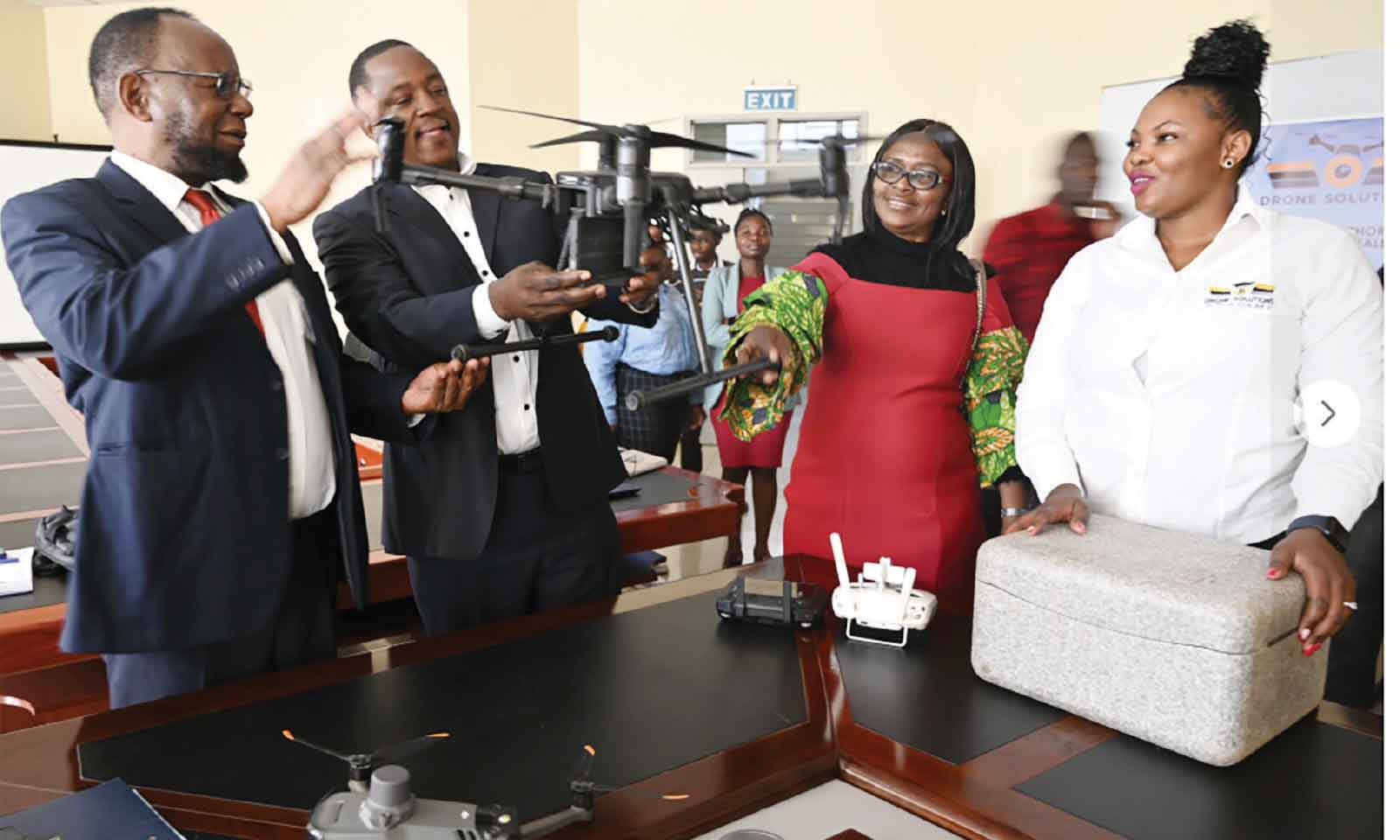
Fungai Lupande
Mashonaland Central Bureau
BINDURA University of Science Education (BUSE) is scaling up drone technology as part of its industrialisation drive, moving from training operators to locally assembling the remotely piloted aircraft.
This is expected to reduce costs, build technical capacity and transform agriculture through precision farming and climate resilience strategies.
The initiative positions the university at the forefront of Zimbabwe’s innovation ecosystem and complements its existing Palp Technologies plant, which assembles smartphones, tablets and laptops.
In an interview, BUSE vice-chancellor Professor Eddie Mwenje said the university’s innovation agenda is anchored in Vision 2030, which prioritises science, technology and industrialisation.
“We are excited about the vision of the country, as enunciated by His Excellency the President,” he said.
“As a university, we are playing our part in ensuring that we contribute towards a prosperous and empowered society.”
BUSE, he added, was now intensifying its focus on drone technology as part of a broader strategy to transform key sectors of the economy, particularly agriculture.
Prof Mwenje said drone technology was a critical pillar within the university’s innovation hub, especially under its climate change and smart agriculture programmes.
“When we talk about our innovation hub, we focus on software development, food systems, natural products and climate change,” he said.
“Under climate change, drone technology is one of the key solutions we are advancing.”
Prof Mwenje said the institution was already offering training in drone operations through its Department of Communication Science, equipping students and professionals with skills to operate unmanned aerial systems across various sectors.
“These courses have been running for over a year now. We are training people to fly drones and apply them in different sectors of the economy,” said Prof Mwenje.
BUSE is now moving towards the next phase of assembling the drones locally, a development expected to reduce costs, build technical capacity and stimulate industrial growth.
“This will enhance our research capabilities and ensure Zimbabwe begins to produce its own drone technologies,” he said.
In agriculture, drones are being positioned as a game-changer in addressing productivity challenges and the impact of climate change.
The university is exploring applications such as crop spraying, field mapping and cloud seeding to improve rainfall patterns in drought-prone areas.
“These are practical solutions that can assist farmers and improve agricultural output,” Prof Mwenje said
Over the past five years, the university has established innovation hubs and industrial parks, laying the foundation for home-grown technological solutions.
The device assembly plant is already making a nationwide impact, particularly in the education sector, where demand for digital learning tools continues to grow.
“We have supplied gadgets to over 800 schools across the country. With more than 11 000 primary schools, the uptake is rising significantly. Our products are affordable and competitive in terms of quality,” said Prof Mwenje.
The availability of locally assembled devices is easing the financial burden on institutions that previously relied on imports, while supporting the Government’s digitalisation
drive.
Factory supervisor Mr Isaiah Kanyimo said production had scaled up to meet demand.
“We are producing around 12 000 devices per day. Although we recently experienced a two-week disruption due to global shipping challenges, supplies are now being rerouted and operations are stabilising,” he said.
The plant has created employment opportunities, with at least 25 workers drawn from surrounding communities, in line with BUSE’s rural industrialisation agenda.
Beyond manufacturing, the university is leveraging software innovation to enhance efficiency across sectors.
Its flagship platform, Chiringa, is a real-time monitoring and evaluation system now being used by 23 Government ministries.
Prof Mwenje described the system as a “game-changer” that enables institutions to track projects and performance in real time.
“Chiringa allows us to monitor progress and ensure effective implementation of national programmes,” he said.
BUSE is advancing artificial intelligence (AI) through Afrocentric innovations.
Software innovation manager Mr Leo Hassan Ali said the university developed an AI system known as TITUS, capable of understanding Zimbabwe’s 16 languages.
“We are expanding it to cover the rest of Africa. This ensures that technology speaks to our context and culture,” he said.
In line with the Government’s rural industrialisation agenda, BUSE is implementing community-based projects, including a masau fruit processing plant that is now more than 95 percent complete.
The university is also promoting smart agriculture initiatives, such as artificial insemination to improve livestock productivity.
“We are working with communities, especially women and the youth, to ensure our innovations have a direct impact on livelihoods,” said Prof Mwenje.
As Zimbabwe accelerates towards Vision 2030, BUSE’s integration of education, innovation and industrial production is emerging as a model for national development, with drone technology and local manufacturing set to play a defining role in the country’s transformation.



