Online Reporter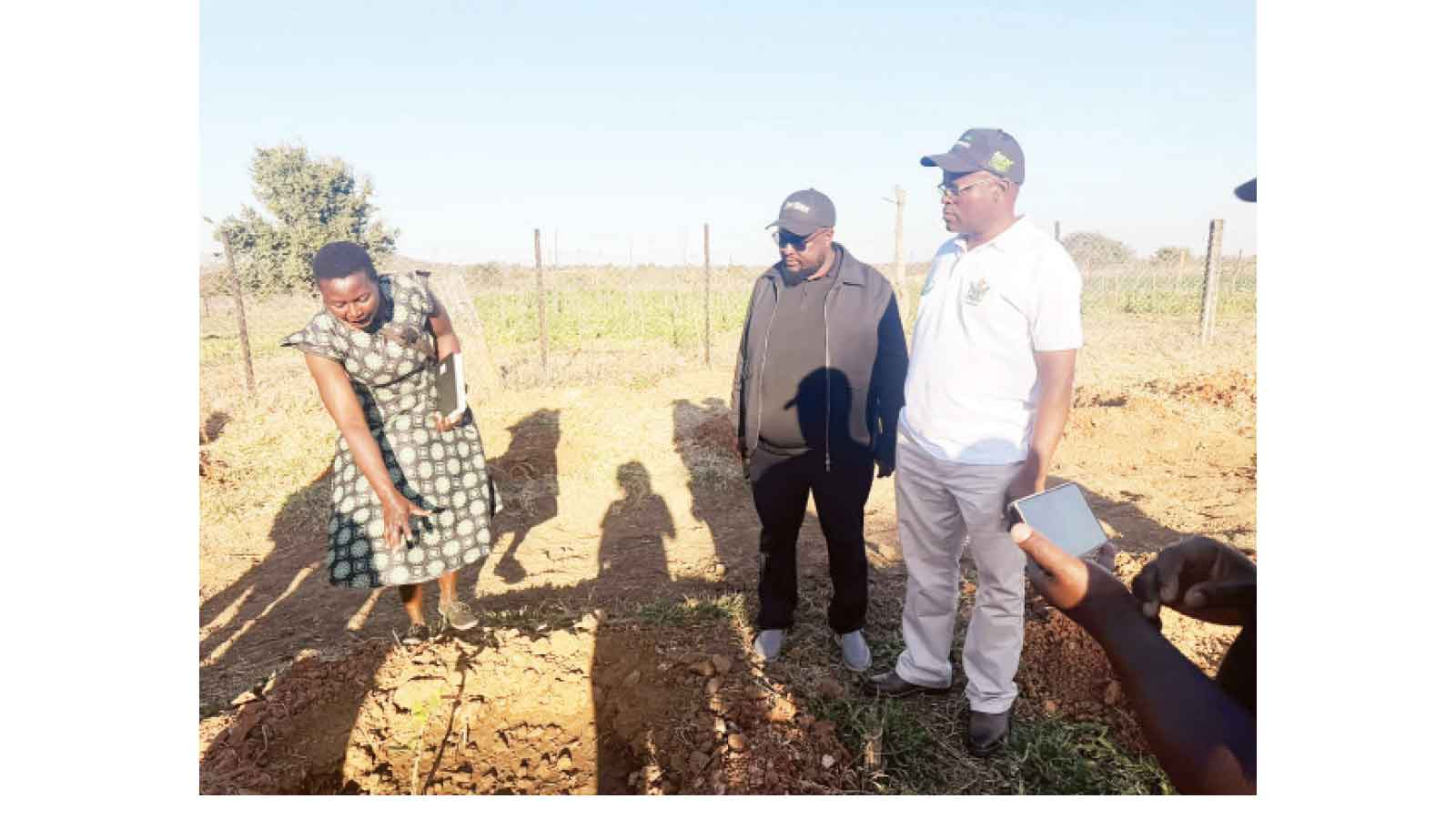
Nyasha Simbisai
Agriculture Correspondent
Chivi North legislator Cde Godfrey Mukungurwa is leading by example in the Government-driven transformation of rural agriculture from subsistence production into diversified, market-oriented and income-generating enterprises.
Cde Mukungurwa said his constituency now has 100 Business Units including School Business Units and Village Business Units, reflecting growing community participation in Government’s drive to transform rural households into productive agricultural enterprises.
His homestead-based VBU is demonstrating how horticulture, aquaculture, fruit production, crop rotation and value addition can be integrated into a single productive agricultural enterprise.
The initiative was recently visited by a delegation of agriculture authorities led by Director of Agricultural Planning and Development Mr Leonard Munamati, who commended the enterprise as a practical demonstration of the implementation of Government’s agricultural programmes at household and community level.
Rather than limiting agricultural transformation to policy and programmes, Cde Mukungurwa has established a working model at his own homestead, where different enterprises complement each other to enhance food production, nutrition and household incomes.
Horticulture forms the backbone of the VBU, with onions, tomatoes, cabbage and rape being produced under intensive management.
The onion enterprise includes king onion production covering approximately 0,1224 hectares, with about 10 200 Texas Grano onion plants are under production. A separate onion plot covers approximately 0,05 hectares.
Trinity variety tomatoes occupy about 0,06 hectares and are currently fetching US$10 per 20kg bucket, while cabbage is grown on approximately 0,04 hectares. The English Giant variety of rape is being produced on approximately 0,1224 hectares.
The VBU has 60 members, 58 of whom are women, highlighting the critical role women are playing in community-based agricultural production and rural economic development.
Each member has an individual vegetable ridge carrying about 140 plants arranged in double lines, giving farmers a direct stake in production and the proceeds generated from the enterprise.
The group is preparing to harvest its onions next month and is already planning to move beyond primary production through value addition.
Farmers intend to dry onions and vegetables after harvesting in a bid to extend shelf life, reduce post-harvest losses and improve returns from their produce.
Agriculture Business Advisory Officer (ABAO) Ms Lindiwe Chiombe said the onion enterprise could generate about US$1 500 if farmers maintain good agronomic practices and achieve the anticipated yields.
The VBU has also diversified into aquaculture, with two fish ponds forming part of the enterprise.
Each pond was stocked with 1 000 tilapia fingerlings in October last year.
Since stocking, farmers have harvested fish five times, while breeding activities are continuing.
The aquaculture enterprise is providing an additional source of food and income while demonstrating the potential of integrating fish production with crop-based agricultural activities.
The diversification is particularly important in rural communities, where farmers are being encouraged to establish multiple enterprises as a strategy for strengthening resilience, improving household nutrition and creating sustainable income streams.
Fruit production is another key component of the homestead enterprise.
An orchard has been established on land previously occupied by a cattle kraal, demonstrating how underutilised spaces around homesteads can be repurposed for productive agricultural activities.
The orchard contains grafted fruit trees, which have the advantage of reaching fruiting stage earlier than conventional seedlings, thereby shortening the period between establishment and production.
More than 45 fruit trees have already been planted at the homestead, providing a practical example of the implementation of the Government’s Presidential fruit-tree programme.
Mr Munamati encouraged other households in Chivi to establish orchards, emphasising that every household should have at least 10 fruit trees.
“There is also a programme to distribute fruit trees to various households. And the target is that every household should establish a minimum of 10 fruit trees each homestead,” he said.
He described the more than 45 trees established at the homestead as an exemplary demonstration of the Presidential fruit-production programme.
“We encourage households in this district, in Chivi district, to establish a minimum of 10 fruit trees per every household,” he said.
Mr Munamati also urged local committees to engage agricultural authorities so that more households could access fruit trees under the Presidential programme. However, he stressed that communities should take ownership of the initiative instead of waiting for Government assistance.
“But we don’t want to wait for Government. We encourage households to start doing even in a small way,” he said.
He urged families to start with whatever number of trees they could manage and progressively expand their orchards.
“If a household can plant two trees this year, another three the next year, eventually we will have a big orchard for fruit tree production, for nutrition, also for income,” he said.
The philosophy of gradual, but deliberate investment is evident throughout the VBU, where different enterprises are being developed according to available resources and space.
Crop rotation is also being practised, with farmers rotating maize and green mealies with sugar beans before moving to crops such as cabbage and rape.
The practice helps maintain soil productivity while reducing the risks associated with continuous production of the same crop.
The VBU’s integrated approach also enables farmers to spread production and income opportunities across different enterprises, reducing reliance on a single commodity.
The strong participation of women further enhances the socio-economic significance of the initiative.
With 58 women among its 60 members, the VBU provides a platform for women to participate directly in agricultural production, marketing and value addition while contributing to household food security and incomes.
The initiative also illustrates the importance of leadership in driving agricultural transformation.
By establishing and supporting productive agricultural enterprises at his own homestead, Cde Mukungurwa is demonstrating that community leaders can lead from the front in encouraging households to embrace Government programmes and adopt modern, diversified farming practices.
The example comes at a time when Government is intensifying efforts to build resilient rural livelihoods through diversified production, value addition, household food security and market-oriented agriculture.
Technical support from agricultural extension personnel, including ABAO Ms Chiombe, will remain critical in sustaining production, improving agronomic practices and supporting farmers as they move into harvesting and value addition.
For Chivi North, the VBU has consequently evolved beyond a demonstration plot into a practical rural enterprise where horticulture, aquaculture, fruit production, crop rotation and value addition converge.
The transformation of a former cattle kraal into an orchard, the establishment of productive fish ponds and the cultivation of market-oriented vegetables demonstrate the possibilities that can be unlocked when rural households take ownership of agricultural development.
The Chivi North model reinforces a simple but powerful message: agricultural transformation begins with leadership by example, gains momentum through community participation and becomes sustainable when production is linked to markets, nutrition and income.
As Cde Mukungurwa leads by example, his VBU offers a practical model of how Zimbabwe’s rural homesteads can evolve into diversified agricultural enterprises — one vegetable plot, one fish pond, one orchard and one value-added product at a time.