

 admin
admin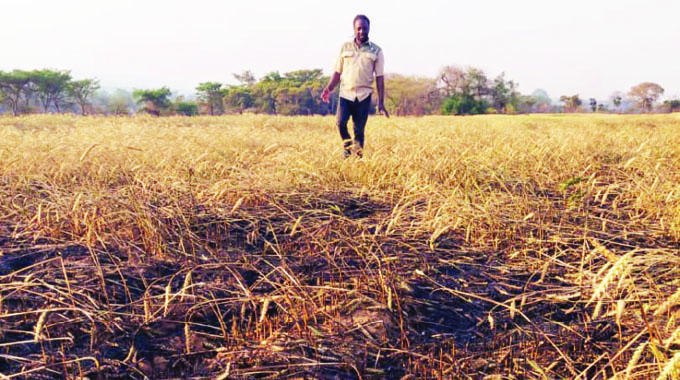
Blessings Chidakwa and Fungai Lupande
AT least 200 hectares of wheat was destroyed by veld fires countrywide in space of a week, leaving farmers and the nation at large counting losses.
Wheat plays an integral role in the Zimbabwean economy as it is ranked among the most important strategic food security crop after maize and traditional grains.
Speaking after yesterday’s Cabinet meeting, Information, Publicity and Broadcasting Services Minister Monica Mutsvangwa said it has been noted with dismay the prevalence of veld fires across the country.
“To date five wheat fields of about 200 hectares have been burnt by wild fires this week.
“Farmers are encouraged to have the requisite fire guards around their farms and the public is urged to desist from unnecessarily starting fires as they have grave consequences on human life and property,” she said.
Among the destroyed wheat close to 90 hectares of ripened standing wheat was destroyed by three separate veld fires in just two days following strong winds experienced across Mashonaland Central.
The wheat belonged to three farmers.
One of the farmers, Mr Benedict Wandiona Chagumuka of Machewe Farm in Mvurwi, was nominated by Zimpapers as one of the best wheat farmers in Mashonaland Central four days ago.
He lost 12 hectares at Foyle farm in Mazowe while 44ha hectares were destroyed and 35 hectares were burnt at Pembi Chase in Mvurwi.
Mr Chagumuka said he saw smoke in the middle of the field when he was about to leave the house in the morning.
“When I went close to investigate the fire had spread and I could not tell the source of the fire, but it was at the centre of the field,” he said. “I didn’t have insurance for the crop and this is a lesson to other farmers to insure their crop. Now the bank wants its loan back and I have to pay electricity and labour.
“I am appealing for assistance from the Government so that I can get back to my feet.”
Provincial Agritex officer Mr Misheck Chitokomere visited the farms in Mvurwi and described the situation as a disaster for the farmers.
The province had 14 290 hectares of wheat and boasted of an average yield of 4,5 tonnes a hectare, giving almost 65 000 tonnes.
Farmers have started harvesting their wheat and Mr Chitokomera urged farmers to hasten in removing their crop from the fields.
“The situation is bad and at Pembi Chase farm a guard room together with property of the centre pivot minder were also burnt,” he said. “At Foyle farm in Mazowe there was a gold rush and artisanal miners had invaded the farm. The fire is suspected to have been sparked by the gold panners today. The 44 hectares had a potential yield of six tonnes per hectare.”
Mr Chitokomera said at plot 11, Machewe farm belonging to Mr Chagumuka, 12 hectares were destroyed by fire before people moved in to put it out.
Meanwhile at Pembi Chase t,he 35 hectares had a potential yield of five tonnes per hectare.
“This is a catastrophe in the province. At Pembi Chase farm there is a homestead close to the plot. However, the cause of the fire could not be verified,” he said.
“Due to strong winds being experienced in the province the fire could not be controlled. Although we advise our farmers to construct fire guards, the winds are too much and fire can jump the fire guards.
“We are advising farmers to quickly remove their crops to avoid further losses.”
Environmental Management Agency (EMA) education and publicist manager Mr Maxwell Mupotsa said the agency is worried by increasing fires in the province.
“We have lost life, homes, property and crops to fire. We received a report of the Mvurwi farms and this is devastating now that we want to attain wheat self-sufficiency as a country,” he said.
“The farmer said he had constructed a fire guard but the fire jumped and destroyed 12 hectares. We are urging farmers to have veld fire preparedness equipment including knapsacks, bowsers and fire beaters.”
Changing weather patterns and strong winds being experienced in the province were attributed to be fuelling more fire incidents compared to last year.



 Online Reporter