admin
admin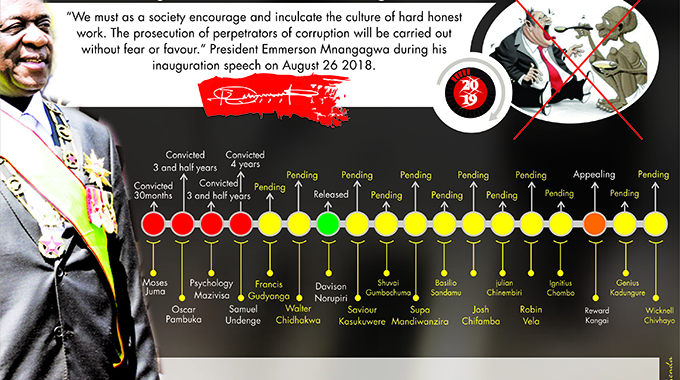
“We must as a society encourage and inculcate the culture of hard honest work. The prosecution of perpetrators of corruption will be carried out without fear or favour.” President Emmerson Mnangagwa during his inauguration speech on August 26 2018.
Since assuming the helm as the country’s second executive president, President Emmerson Mnangagwa, who now leads the Second Republic, has been leading a concerted drive against corruption.
Since then, the dragnet continues to be strengthened in order to account for corrupt individuals in both the private and public sector. The Prosecutor-General’s Office is presently being rejigged to make it better able to execute its mandate.
About 317 prosecutors were recruited this year to cover the National Prosecuting Authority’s 59 districts across the country. Also, the NPA is currently in the process of reorganising the Asset Seizure Unit, which will be responsible for recovering assets acquired through corrupt means.
The Judiciary also opened Anti-Corruption Courts in March this year.
In addition, President Mnangagwa has since established a six-member Special Anti-Corruption Unit in his office.
It is led by seasoned lawyer and former State prosecutor Mr Tabani Mpofu.
The mandate of the unit is to help investigate corruption cases and make recommendations working with the Zimbabwe Republic Police, Zimbabwe Anti-Corruption Commission (Zacc) and the National Prosecuting Authority, among other organisations.
Last month, the President also used temporary powers for a new law that will see illegal currency traders being sentenced to a maximum 10 years in jail, while ill-gotten wealth will be confiscated.
Under the regulations, Government will track unexplained movement of money in the financial system.
President Mnangagwa’s intervention – which entailed amending the Exchange Control and Money Laundering and Proceeds of Crime Acts – was made through constitutional provisions of the Presidential Powers (Temporary Measures) Act.
Government believes the fight against corruption, which has an adverse impact on the economy, is inextricably linked to efforts to grow the country into a middle-income economy by 2030.
So far, Zacc has investigated more than 400 cases since the beginning of the year, up from 294 cases that were handled last year. Above listed are some of the major highlights of the war against corruption.
2019 promises to be an equally eventful year.



 Online Reporter