


 Chronicle Editor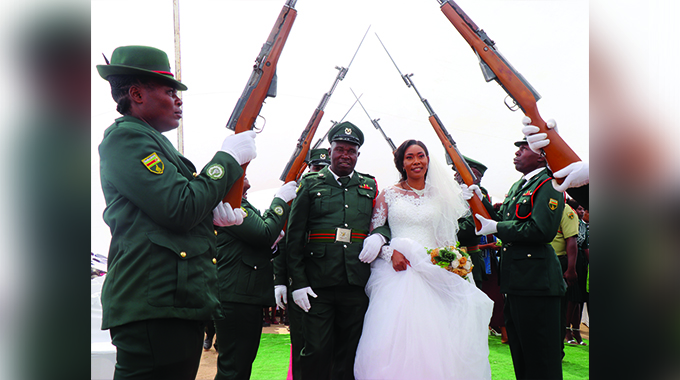
Faith Ndlovu, Sunday News Reporter
THE appearance of military personnel from the Zimbabwe National Army (ZNA) in the streets of Bulawayo yesterday evoked memories of the Covid-19 era when their presence was felt everywhere.
The men and women from the barracks yesterday filled the hot summer air with romance and jubilation as echoes of military drums set the tone for a special wedding ceremony.
The procession commenced at the Large City Hall, marching towards the Bulawayo Centre, where shuttles transported guests to the Zaoga Church in Lobengula for the continuation of the festivities.

The military men and women were celebrating the joining in holy matrimony of Senior Warrant Officer Class 2 (WO2), Jaffias Mauswa and Knowledge Tapera in a ceremony that beautifully blended military tradition with personal vows.
One could not miss the celebratory nature infused with a great sense of patriotism and discipline that sets them apart from civilian nuptials.
The ceremony was distinguished by five key traditions: The officiating officer, swords/SKS bayonets, the bridal team, cake cutting, and the presence of ark guards.
At a military wedding, an officiating officer plays a critical role, acting as the liaison between the couple and the military hierarchy whose attendance signifies the importance of the event, reminding all guests of the couple’s dedication to both their union and their country.

Tradition dictates that military weddings incorporate swords or SKS bayonets as powerful symbols of commitment.
Commissioned officers display swords, while non-commissioned officers present bayonets, emblematic of their unwavering loyalty to service and the nation.
During the ceremony, ark guards provided protection for the couple, reflecting the belief that their union is a valuable asset to the country while the guards escorted the couple’s vehicles and stood watch over the celebrations, symbolising national protection and blessings.

Another unique aspect of military weddings is the cake-cutting ceremony, which includes a symbolic bayonet-cleaning ritual. The bride cleans the bayonet, signifying her commitment to uphold the soldier’s standards of excellence and discipline.
Pastor Bonginkosi Dube, Senior Chaplain of the Bulawayo District stationed at Imbizo Barracks, officiated at the wedding and described the experience as enlightening.
He noted that it showcased a different side of the army that many in the community might not recognise.
Snr Chaplain Dube emphasised the significant differences between military and traditional civilian weddings, citing protocols such as dress code, weapons display, and movement orders that contribute to the distinct character of military unions.
He explained: “For one to have a military wedding, at least one partner must be in uniform. This could be a man or a woman, but military representation is essential.”
Beyond weddings, Snr Chaplain Dube highlighted the army’s commitment to community development through initiatives like Silverton Interim Assistance, emphasising that the military’s role extends beyond combat to fostering relationships and building communities.
As the celebrations of the union set over Bulawayo, one thing was clear, military weddings are not just about the union of two people, but also about celebrating dedication to both love and country.



 Bongani Ndlovu
 Online Reporter