Chronicle Editor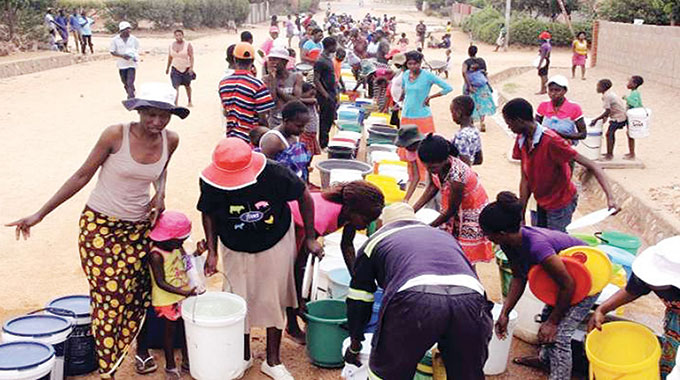
Andile Tshuma
Imagine going for 10 consecutive days without running water. If you have been staying in Bulawayo in the past fortnight, you probably know the struggle.
Before you even imagine the implications, the inconvenience of going from one borehole to the next or one suburb to the next looking for somewhere to fill up containers, and having to brave the meandering queues for hours has humbled everyone.
Safe and readily available water is important for public health, whether it is for drinking, domestic use, food production or recreational purposes. Improved water supply and sanitation, and better management of water resources, can boost a country’s economic growth and can contribute greatly to poverty reduction.
Since the municipality embarked on major rehabilitation works under the Bulawayo Water and Sewerage Services Improvement Project (BWSSIP) funded by the African Development Bank, some suburbs last had running tap water on July 1.
The BWSSIP programme is meant to improve municipal water supply and sanitation services in the city to improve the health and social well-being of residents.
Some neighbours we haven’t seen in a while, we exchanged greetings at the boreholes in these past weeks, and we thought some were not even in the country. Well it’s not even funny, this is because people had to go out of their routines to find the precious liquid.
People in a neighbourhood may spend days or even weeks, without seeing each other. This is because everyone is busy, but because the taps were dry, no matter how busy people got, they had to find time to either queue at the boreholes or to go wherever to find water, and meet people. This means a lot of productive time was lost too.
I can imagine someone who has kids that need to be bathed and prepared for school, without water and electricity. It can’t be easy, but yet we still survive.
I think the ongoing power load shedding programme is unbearable. Where I stay, we spend up to 18 hours on a daily basis without power. It’s very frustrating to say the least.
But with power you can compromise and find other alternative fuels such as firewood, gas, paraffin etc, even if they are not as convenient. When it comes to water there is just no compromise. Life literally stops. So people this week, in the past fortnight rather, have been going through a lot. I just hope the water situation is addressed soon.
Water and power outages have crippled activities at schools in the city with some now resorting to the use of buckets to flash toilets.
In an interview this week, Bulawayo Provincial Education Director Mrs Olicah Kaira said thousands of learners have been affected by water and power cuts at schools.
Learners are reportedly missing many lessons that require water and electricity, especially practical subjects, at a time when schools are preparing for mid-year examinations.
For subjects such as Food and Nutrition, water and electricity is required while Fashion and Fabrics requires electricity for pupils to use sewing machines, irons and other appliances.
Pupils also need electricity to power up machinery used in subjects such as Woodwork, Metal Work, Computer Science, Biology, Physics and Chemistry.
Students with agricultural projects such as gardens require water to tend their gardening projects and also need water to prepare feed for chickens and for dressing the birds.
Teachers and students who spoke to The Chronicle said toilets were unusable.
Also affected are students on the night school programme as there would be no power in the evenings.
“Agricultural projects, poultry rearing, school feeding and general health care is compromised. The weekly cuts are taking a toll on institutions in general. Operations are compromised especially with power cuts when schools need to run the mid-year exams. Computers and printers are not working. Schools need water and electricity to be fully functional,” said Mrs Kaira.
It surely never rains, it pours.
Coming from a period of tragic cholera and typhoid outbreaks that rocked the country recently, such long water cuts may bring fear and panic to Zimbabweans. It is a relief that Bulawayo has so far been spared from the water borne disease outbreaks.
Drinking water from storage containers brings about its own challenges. Water stored in secondary reservoirs means that one has to be extra sure that the containers are very clean. The water is exposed to potential contamination as it may be stored in dirty containers or be handled by dirty hands.
According to the World Health Organisation (WHO), globally, at least two billion people use a drinking water source contaminated with faeces.
Contaminated water can transmit diseases such diarrhoea, cholera, dysentery, typhoid, and polio. Contaminated drinking water is estimated to cause 485 000 diarrhoeal deaths each year.
In 2010, the UN General Assembly explicitly recognised the human right to water and sanitation. Everyone has the right to sufficient, continuous, safe, acceptable, physically accessible, and affordable water for personal and domestic use.
When water comes from improved and more accessible sources, people spend less time and effort physically collecting it, meaning they can be productive in other ways. This can also result in greater personal safety by reducing the need to make long or risky journeys to collect water.
Absent, inadequate, or inappropriately managed water and sanitation services expose individuals to preventable health risks. This is particularly the case in health care facilities where both patients and staff are placed at additional risk of infection and disease when water, sanitation, and hygiene services are lacking.
Generally, Bulawayo has not faced acute water challenges in the past and hopefully the Bulawayo City Council will conclude the rehabilitation project soon enough so that residents will smile again.


 Online Reporter