admin
admin
 Martin Kadzere and Blessing Bonga
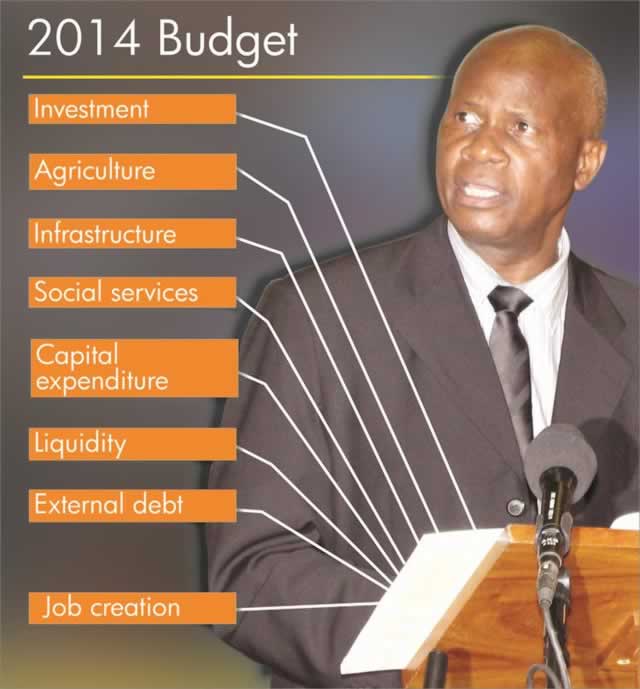
Ordinary Zimbabweans and economists have called on Finance Minister Patrick Chinamasa to include measures in the upcoming Budget that will halt economic deceleration and encourage investment.
The Budget comes at a time when Zimbabwe’s economic sectors are performing below par, largely as a result of biting liquidity constraints, the effects of illegal sanctions, fall in prices of commodities on global markets and the poor performance of agriculture.
Zimbabwe’s economy is expected to grow 3,4 percent this year, having been revised from 5 percent projected earlier. The manufacturing sector is clearly struggling, under pressure from lack of capital, high cost of utilities and lack of competitiveness.
According to the Confederation of Zimbabwe Industries, activity at manufacturing firms fell from 44 percent in 2012 to 35 percent this year.
Many companies have closed down while some are scaling down. Agriculture was initially projected to grow by 11,6 percent this year, but this has been revised to -5,8 percent, while mining is expected to expand from an initial projection of 15,9 percent to 16,7 percent.
The country is experiencing severe power cuts and poor social services. There is huge infrastructure backlog. The minister will also be under pressure to improve salaries for civil servants.
A summary of areas which need quick attention include:
- US$2 billion for manufacturing sector;
- US$2 billion for agriculture sector;
- US$10,7 billion national debt
- US$1,5 billion current account deficit
These funding requirements exclude other pressing issues such as electricity and food imports. If forecasts from previous trends on Budget outlay based on the capacity of the economy are anything to go by, Zimbabweans should not expect a Budget exceeding US$4 billion for next year.
Taking into account high expectations in the economy coupled with pressing financial demands, Minister Chinamasa has the unenviable task of coming up with a Budget that can stimulate economic growth.
“These miracles can come through borrowing from friendly countries,” economist Mr Gift Mugano said.
“In the same vein, Government must also moot other policy strategies aimed at mobilising resources such as public private partnerships and luring Foreign Direct Investment by providing a conducive environment for business,” said Mr Mugano.
Economic analysts said the upcoming Budget should seriously address recapitalisation of critical sectors such as agriculture and manufacturing for sustainable recovery.
Economist Mr Erickson Mvududu said financial support for agriculture was critical as it guaranteed food security and, as such, needed priority in the upcoming National Budget.
“There is need to prioritise agriculture in the Budget to ensure food security,” he said.
“I think Government should come up with an irrigation fund for affordable long-term lending to farmers as this will ensure that the country gets a good yield even in the event that we do not receive favourable rains.” Mr Mvududu added that this could perhaps come in the form of a 10-year loan facility for irrigation infrastructure purposes that would be accessed by farmers through financial institutions.
He stressed the need to address the issue of capacity building of local industry through resuscitation of funding packages that would help increase capacity utilisation.
“Decreasing capacity utilisation is the major stumbling block in the manufacturing sector, so there is need to provide for a resuscitation financial plan.
“This will then be channelled towards boosting capacity utilisation while there is also need to have a guaranteed end market for locally manufactured products to avoid dependence on imports,” he added.
Another analyst, Mr Witness Chinyama concurred with Mr Mvududu on the need to prioritise the agricultural sector, particularly on the mechanisation aspect to increase yields.
“There is definitely need to prioritise agriculture as it will ensure self sufficiency which will rule out the need for importing produce such as grain that strains the fiscus.
“To this effect there should be enough Budget allocation for mechanisation of the sector so that we can achieve efficiency in as far as production is concerned,” he said.
Mr Chinyama also expressed concern over the small budget allocations that various ministries end up getting and in particular, economic ministries, thus making it difficult for implementation of economic recovery policies. He expressed the need to increase capital budgets which he said, have for long been low in relation to total expenditure.
“Capital budgets should be increased as they have always been pegged at below 10 percent of total expenditure,” he said. “An ideal scenario is to increase them to around 25 percent of total expenditure so that we can be able to create an enabling environment across all sectors through the rehabilitation of critical infrastructure such as dams for irrigation purposes and transport networks.”
Zimbabwe Investment Authority chairman Mr Nigel Chanakira said a clear, simple and consistent macroeconomic policy framework during Minister Chinamasa’s tenure would will be the bedrock for the promotion of domestic and foreign investment.
“This is our greatest expectation,” said Mr Chanakira. “We need the 2014 budget to send the right signals to FDI and capital flows into our money, capital and equity markets.
“Clearly, Zimbabwe has inadequate domestic savings to fund our current and capital requirements.
“A top priority for the minister must be the issue of introducing measures to deal with Zimbabwe’’s foreign debt which would unlock multi-lateral investment and infrastructure funding from the likes of the African Development Bank and China-Africa Development Fund, who seem keen to work with Zimbabwe to complement the work by African Export and Import Bank and PTA Bank.
“Other key partners going forward are the IMF and the World Bank and I hope that programmes can be agreed with these institutions within the next fiscal year for purposes of funding for infrastructure investments which could re-start macroeconomic growth and this would undoubtedly develop traction for Foreign Direct Investment,” he said.
A carpenter at Glen View Industrial Complex said Minister Chinamasa should avail funds to capacitate local banks and lenders of small to medium businesses. These funds should be accessed at concessionary rates.
“It is known that our businesses are the ones providing employment but we are failing to expand because we don’t have money,” said Mr Tobias Mareza, whose business employs five people.
“As you can see, we are also crowded and we need more space and Government should do something.”
A Harare woman Ms Tracey Razawo said the budget should provide priority to social services.
“Our social service delivery has collapsed and we need the minister to allocate resources to improve our health and education systems,” she said. Some cotton farmers interviewed said Mr Chinamasa should introduce subsidies in light of poor prices.
Parliamentarians are expected to meetin in Victoria Falls next week for pre-budget seminar where they will discuss the forthcoming budget. Trade bodies the Zimbabwe National Chamber of Commerce and the Confederation of Zimbabwe Industries have since drafted their position papers that will be tabled at the retreat.


 Online Reporter