


 malvernmugadzikwa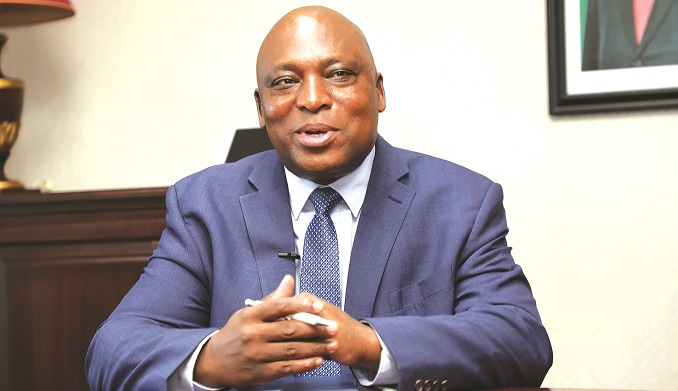
Reserve Bank of Zimbabwe (RBZ) Governor Dr John Mushayavanhu (pictured above) recently took up the challenge of championing the country’s currency reforms. In his inaugural Monetary Policy Statement on April 5, he introduced the Zimbabwe Gold (ZiG) currency.
In this interview with The Sunday Mail’s DEBRA MATABVU, Dr Mushayavanhu tackles questions on inflation, currency stability and how ZiG will impact businesses and consumers.
**********************
Q: May you please begin by giving us a brief outline of your career in the banking sector?
A: I have been a banker most of my life. I started at the Standard Chartered Bank, where I rose to a very senior rank before I joined FBC.
I joined the Reserve Bank of Zimbabwe on March 28, 2024.
Q: How many years have you been in the banking sector?
A: Over 30 years now.
Q: Can you outline your vision for the central bank as you commence executing your new mandate?
A: The statutory role of the Reserve Bank of Zimbabwe to maintain price stability in the macro-economy through ensuring financial sector, monetary, currency and exchange rate stability.
The RBZ also seeks to ensure that inflation is under control. My vision is to do exactly that.
I want to see a stable currency. I want to see a currency that can trade and be exchangeable with other currencies. I want a currency whose exchange rate is not volatile.

Q: Having said that, what areas of Zimbabwe’s financial sector do you think require your most urgent attention?
A: What requires urgent attention in the Zimbabwean financial sector is to arrest the volatility in the exchange rate, which is what we have done by introducing the new structured currency — ZiG.
Prior to the introduction of ZiG, we were seeing exchange rates moving on a daily basis and at the time we introduced ZiG, the exchange rate had gone up to as high as US$1:$33 000 and it was still going up.
We then decided that we needed to stop that and introduced a currency that is stable and which is centred on gold and other precious minerals that we have in stock, as well as foreign exchange balances that we hold.
Q: Can you outline the thinking behind the historic introduction of ZiG and what exactly it seeks to achieve?

A: For a currency to be stable, it has to be anchored in reserves.
Previously, we did not have enough reserves to cover the amount of money that was circulating in the economy.
So, when we introduced ZiG, the first thing we did was to make sure that we had enough cover by way of reserves.
At the time we introduced ZiG, we had over US$100 million in nostro balances.
We also had 2,5 tonnes of gold which, as you may recall, we have unveiled to the public in the presence of His Excellency, the President of the Republic of Zimbabwe.
In total, we had US$285 million in reserve equivalent to more than three times cover for the ZiG introduced on April 5, 2024.
Q: ZiG notes and coins will be introduced on April 30. May you please give us an outline of the rollout plan and whether you have started minting the new currency?
A: The new currency has already been introduced.
It was introduced on April 5 when we announced the Monetary Policy Statement.
On that day, we converted all our Zimbabwe dollar balances into ZiG.
So, if you go to your bank today, you will find that your balance has been converted to ZiG.
The next stage is now to introduce the notes and coins.
And these are the ones that are going to be introduced on April 30.
The money has already been printed. It is there.
But before issuing it to the public, we have to make sure that we have undertaken an extensive education campaign so that people understand the features of the new currency.
We want to avoid a situation where some unscrupulous people can cheat people by giving them fake notes and coins. So, this process is ongoing.
We are being assisted by the Ministry of Information, Publicity and Broadcasting Services.
And we also have our own teams going out in the regions.
We are going to be on all radio stations.
We are also even going to be in your newspaper, The Sunday Mail, and all other newspapers published in this country.
We will give the notes and coins to the banks, which will then pay out to their customers.
Remember, we said that those who are holding bond notes in cash can go and surrender them at the bank in exchange for ZiG notes and coins.
We will print and mint enough notes and coins wholly covered by reserves with the aim of satisfying the needs of the market.
Q: How do you see the introduction of ZiG impacting inflation and exchange rate volatility?
A: ZiG is a stable currency. If you have been watching developments of late, since we introduced ZiG on April 5, it has been trading now for over a week. And every day it has been strengthening. It is mainly influenced by the movements in the price of gold. So, if you have a currency that is anchored in a valuable commodity like gold, definitely it is bound to strengthen and be stable.
Q: Prior to the introduction of bond notes, the RBZ gave Zimbabweans assurances that the local unit was to be backed by a multi-million-dollar facility that was being held offshore. Some stakeholders are worried we could witness a recurrence of the same scenario. How do you respond to those fears?
A: It is true that previously there was an offshore facility backing the Zimbabwe dollar.
But over time, that facility was overtaken by the amount of money that was in circulation.
At the time that it was announced, the amount of money that was in circulation was fully covered.
However, due to certain disturbances in the economy, we ended up with more money in circulation compared to the cover that we held.
But going forward, as we said, we are starting with a cover worth US$285 million, against currency in circulation of about US$80 million.
So, at the time of commencement of ZiG, we are already more than three times covered.
And we have made an undertaking in the Monetary Policy Statement that we will not increase the amount of ZiG in circulation beyond the amount of cover that we have.
So, any increase in the amount of ZiG will be made by a concomitant increase in the reserves that we hold.
Q: With the introduction of ZiG notes and coins in a week, there is concern about lack of small change, particularly impacting the informal sector. Since many transactions currently involve the use of US dollars, vendors are forced to set a minimum charge of US$1 due to the absence of change. How will this initial shortage of small change be addressed?
A: In fact, that is a problem.
It is one of the problems that ZiG is intended to address.
One ZiG is equal to plus or minus 6 US cents.
But we are going to split the ZiG further into smaller denominations — quarter ZiG and half ZiG — so that people can get change.
This is meant to ensure that there is divisibility of the currency.
So, the introduction of ZiG is actually addressing the problem that we have mentioned.
Q: In your Monetary Policy Statement, you mentioned that a currency roadmap will be created towards 2030. Could you please briefly explain how the roadmap will assist in achieving a stable and predictable currency?
A: The multicurrency arrangement is in place until 2030, in accordance with Statutory Instrument 218 of 2023.
Currently, it is estimated that between 80 to 85 percent of the transactions happening in this economy are in US dollars.
The balance of 15 percent is in the local currency.
Our roadmap envisages a situation where we will increase demand for ZiG to an extent where, as we go towards 2030, the ratio of US dollar to ZiG circulating in this economy will change.
For example, if we can end this year at 70 percent in US dollars and 30 percent in ZiG; and then we go into next year and we are at 60 percent US dollars and 40 percent ZiG; maybe by 2026 we will be at 50:50.
And when we get to 50:50, people will be indifferent as to which currency they are using.
How are we going to ensure that there is demand for ZiG?
The Government has agreed that all tax payments on quarterly payment dates (QPDs) will be paid 50 percent in ZiG and 50 percent in other currencies.
That way, you will see increased demand for ZiG because companies will now be exchanging their USD for ZiG so that they can pay taxes.
Q: What other measures have the RBZ put in place to control inflation and stimulate economic growth?
A: The measures that we put in the Monetary Policy Statement are meant to control inflation.
If you are going to have a currency that is stable, it means that inflation will be contained.
If the exchange rate for ZiG to the US dollar is strengthening, it actually means that prices should go down, instead of going up.
Our fear is actually not inflation but rather deflation.
Q: What plans do you have for increasing access to credit for businesses and individuals?
A: In the Monetary Policy Statement, we reduced interest rates to as low as a maximum of 20 percent per annum.
If you recall, interest rates were as high as 130 percent prior to the Monetary Policy Statement.
We think that this should encourage banks to lend to their customers for productive purposes.
We don’t want to encourage borrowing for consumptive purposes but for productive purposes.
Q: During your tenure, what do you intend to do to improve financial inclusion?
A: The central bank has already started working on an extensive financial inclusion programme.
As we speak right now, we have our teams in the regions, conscientising people about the need to bank money.
With the introduction of a strong and stable currency, people should now start saving their money in ZiG.
We have also asked banks to introduce KYC (Know Your Customer)-lite accounts.
We understand that if you are a married woman and the house you live in is registered in your husband’s name, and the electricity bill is coming in your husband’s name, you cannot have proof of residence because there is no utility bill that is in your name.
So, we said to banks that they must open KYC-lite accounts where some of those requirements are waived.
That way, we can encourage women to also open bank accounts and bank.
You also notice that in the Monetary Policy Statement, we ordered banks not to charge bank charges on balances below US$100 or the equivalent in ZiG.
We want to use that to encourage people to bank their money because monies were being eroded by bank charges.
By introducing that, we are actually creating a situation where people can leave their money in the bank and find it there when they come back.
Q: As the RBZ, what steps will you be taking to increase the public’s trust in the banking sector, which has been eroded over the years?
A: As RBZ, we have introduced a stable currency.
When a country is operating using a stable currency, there will be confidence.
Also, as RBZ, we have ensured that the banking sector is safe and sound; we don’t have any troubled banks and, therefore, the public should feel free to go to bank with any bank of their choice.
Q: Do we have any instances where the Financial Intelligence Unit (FIU) has frozen bank accounts belonging to any corporates for refusing to accept ZiG?
A: The FIU goes out into the market to monitor corporates as they trade.
ZiG is our currency.
ZiG is legal tender and shops, companies and businesses should invoice their goods in either ZiG or US dollars because we are operating under a multi-currency system.
But where we see companies refusing to accept ZiG, obviously the FIU is bound to take action.
Such action includes freezing accounts, and also some corporates may be fined.
Q: Do we have instances where corporates have been fined or had their accounts frozen?
A: Yes, there have been such incidences.
But I cannot give you names because that would be breaching confidentiality.
Q: And this was due to refusal to transact in ZiG?
A: Yes!



 Bongani Ndlovu
 Online Reporter