

 admin
admin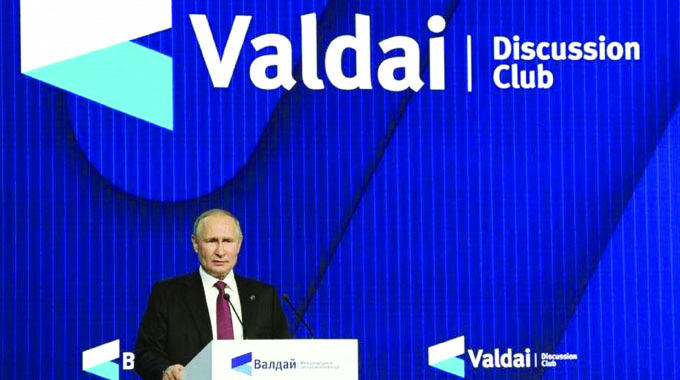
President Putin’s speech at Valdai club MOSCOW, October 27
The age of Western global dominance is becoming a thing of the past, and the world has the most important decade since the end of World War II ahead, Russian President Vladimir Putin said during the Valdai international discussion club meeting Thursday.
In his speech, President Putin underscored that Russia does not oppose Western elites and does not aspire for hegemony in the new multipolar world; he juxtaposed true integration to the Western “neo-colonial” globalisation, and called to “build a symphony of the human civilisation.” Answering questions from the participants, President Putin said he sees no point in relocation of the Russian capital or nationalisation of businesses, made a joke about nuclear war and told a joke about freezing Germans.
Here are key points of the president’s speech and his key answers to questions.
On Western policy
The West claims all resources of mankind, and the “rule-based order” that it proposes, is supposed to allow it to live without any rules at all. The West is incapable of ruling the mankind alone, but is desperately trying to do that, and “most nations of the world no longer want to tolerate that.”
The West parlayed its power over the world in its game, but “this game is, without doubt, dangerous, bloody and […] dirty”: “it denies sovereignty of countries and peoples, their identity and uniqueness; it disregards interests of other states.”
The West must remember that “one who sows wind, shall reap the whirlwind.” The West and other centres of a multipolar world will have to begin an equal conversation about the future, and “the sooner, the better.”
On crisis of liberalism
The modern liberalism has change beyond recognition, into absurdity, when alternative points of view are being declared undermining, and any criticism is perceived as “Kremlin’s machinations”: “That’s delirious, what have they come to.”
The neo-liberal model of the world “a la America” is suffering “not merely systemic, but doctrinal crisis”: “They simply have nothing to offer the world except for their dominance.”
The West’s belief in its infallibility is dangerous, because it is one step away from the “desire of the most infallible to simply destroy those they don’t like, to ‘cancel’ them, as they say.” But history will set everything straight and will “cancel” those who somehow thought themselves entitled to order the world culture around on their own whim.
The global civilization is based on traditional societies with their traditional values, which, unlike the neo-liberal ones, are unique to every country. The West is entitled to have “dozens of genders and gay prides,” but must not seek to impose it on others.
On Russia and the West
Russia has not considered and does not consider itself a West’s enemy, and offered to live in accord back in the day, but was met with rejection.
There are “at least two different Wests” — the traditional one, with extremely rich culture, and the aggressive and neo-colonial one, whose diktat Russia will never reconcile with.
The West was unable to “wipe Russia off the geopolitical map,” and it will never be able to,” just like nobody will be able to dictate Russia, what society to build and on which principles.
“Russia does not challenge Western elites. Russia simply defends its right for existence and free development. Meanwhile, we do not plan to become some new hegemon.”
Moscow also does not plan to impose its own values: “Unlike the West, we do not seek to get into somebody else’s backyard.”
On importance of today
The world stands on a historic threshold, facing “probably, the most dangerous, unpredictable and at the same time important decade since the end of World War II.” The importance of today is that all countries now have an opportunity to choose its own, original development path.
The new world order must be based on law and justice, be free and fair. Global trade must benefit the majority, not individual corporations; technological development must reduce inequality instead of increasing it.
The world also needs new, independent international financial platforms to replace those discredited by the West as international reserves: “First, [the West] devalued them through inflation in dollar and euro zone, and then it went full on and pocketed our gold and foreign exchange reserves.”
Multipolarity is a real, and effectively the only chance for Europe to restore its political and economic capability, which is “seriously limited” today.
On nuclear threat
“As long as nuclear weapons exist, so will exist the treat of it being used.” Situations, in which Russia might use its nuclear weapons, are all written down in its doctrine.
Moscow was never the first to talk about the use of nuclear weapons, it only “responded by hinting” to remarks made by Western leaders. Russia believes that the West is deliberately blackmailing it: for example, no one in the West reacted to claims made by “girl a bit out of her mind” Liz Truss, the UK ex-Prime Minister.
There is no military or political sense for Russia to strike Ukraine with nuclear weapons, and the “today’s fuss around nuclear threats” only aims to pressure Moscow’s allies, friendly and neutral states.
Russia welcomes IAEA’s plans to send a mission to check the reports about a “dirty bomb,” and this “must be done as soon as possible and as wide as possible,” because Kiev is doing everything to cover its tracks.
On operation in Ukraine
Had Russia not started the special military operation, the situation would have become increasingly worse and future casualties — higher for Moscow. Meanwhile, Putin disagreed that the enemy in Ukraine was underestimated.
The main goal of the operation remains to help the people of Donbass. Russia could not simply recognize the republics’ independence: “They cannot survive alone, it is an obvious fact.”
The events in Ukraine can partially be interpreted as a civil war, because Russians and Ukrainians are a single people, whose people found themselves in separate states.
“Russia, who created the modern Ukraine, can be the only true, serious guarantor of Ukrainian statehood, sovereignty and territorial integrity.”
Moscow is still ready for negotiations with Kiev, but Kiev decided not to continue them. Washington should give Kiev a signal that problems must be resolved peacefully.
On situation in Russia
The events in Ukraine showed that Russia is a great country that proved itself much stronger amid Western sanctions than anyone thought, even Russia itself. The peak of problems caused by the sanctions is already behind, and no official has disappointed with their actions in the past year.
The special military operation inflicts losses on Moscow, human losses first and foremost, but there are also “huge gains”: “What is happening will, undoubtedly, eventually benefit Russia and its future.”
Russia has an almost complete consensus regarding the need to combat external threats; “people of absolutely pro-Western views” comprise a small part of the society.
Konstantin Kosachev, Deputy Chairman of the Federation Council, mentioned that “A fundamental, one might say, ideological speech by Vladimir Putin at the Valdai Forum. Substantive, constructive and aimed at finding real ways out of the current crisis, and not at raising the stakes to the level of no return. This is a speech addressed in fact to the leaders of all sovereign states of the planet: let’s build a world in which there will be a place for everyone.
Those who expected some kind of challenge to another round of confrontation in Valdai must have been disappointed. But Russia does not challenge anyone, does not try to change unipolarity to bipolarity, one dominance to another. It only defends its right to exist in a just and free world order.
Therefore, the focus of the speech is the world system, its manageability, the main actors and principles.
Description of the moment from the Russian leader: the crisis is truly global. And in this situation, the West actually staked its world domination. It is provided by the notorious order, based on the rules that the West itself writes. At the same time, it is not clear what the rules are based on and by whom exactly they are written. And it seems to be only one thing: the right of the main world power to live without rules.
There are two ways out of the crisis: either to accumulate problems further, or, having pushed aside political strife, to work together on solving global problems. In fact, Putin offers the West to abandon the logic of the zero-sum game, which, as they say, manifested itself in all its glory during the conflict in Ukraine.
In the West, its outcome is seen as the complete collapse of either Russia or the West. But this is not the case either in Ukraine or on a global scale: the rejection of world domination will not mean the destruction of the West and its achievements.
The Russian leader demonstrated that the entire world audience became the addressee of his speech at Valdai: he began with universal problems — climate, culture. History shows that attempts to “cancel” culture will lead to the “cancellation” of the “cancellers” themselves. They will disappear from human memory, while Dostoevsky and Tchaikovsky will remain in it.
Another important thesis is the actual unwillingness of the West to agree to democracy in international relations. At the same time, the current world order is hypocritically called liberal, but in reality it is becoming more and more intolerant. It hits even US allies. And attempts to fit everyone into one pattern are doomed to failure. In fact, Putin acted as a defender of the democratic world order.
The thesis about an allegedly insurmountable conflict of values between Russia and the West has also been refuted. The problem is not that we are allegedly not satisfied with everything that the West has elevated to the rank of values, despite, to put it mildly, the controversial nature of certain postulates. But the fact is that Russia does not seek to impose its point of view as the only true one, unlike the adherents of the next “only true” doctrine in the history of mankind, which liberalism has become today in its Western reading. Russia cannot and is not going to put up with attempts to ignore civilisational, cultural and religious diversity. And this is with her the absolute world majority.
Is it possible to make the world system manageable and efficient without dependence on one centre? Putin’s answer: yes!
In this context, the speech of the Russian leader is Russia’s actual application for participation in the formation of a new, honest and based on law and justice world order.



 Online Reporter